• HOME
  • NEWS
  • EXPLORE
    • CAREER
      • Companies
      • Jobs
    • EVENTS
    • iGEM
      • News
      • Team
    • PHOTOS
    • VIDEO
    • WIKI
  • BLOG
  • COMMUNITY
    • FACEBOOK
    • INSTAGRAM
    • TWITTER
Wednesday, July 8, 2026
BIOENGINEER.ORG
No Result
View All Result
  • Login
  • HOME
  • NEWS
  • EXPLORE
    • CAREER
      • Companies
      • Jobs
        • Lecturer
        • PhD Studentship
        • Postdoc
        • Research Assistant
    • EVENTS
    • iGEM
      • News
      • Team
    • PHOTOS
    • VIDEO
    • WIKI
  • BLOG
  • COMMUNITY
    • FACEBOOK
    • INSTAGRAM
    • TWITTER
  • HOME
  • NEWS
  • EXPLORE
    • CAREER
      • Companies
      • Jobs
        • Lecturer
        • PhD Studentship
        • Postdoc
        • Research Assistant
    • EVENTS
    • iGEM
      • News
      • Team
    • PHOTOS
    • VIDEO
    • WIKI
  • BLOG
  • COMMUNITY
    • FACEBOOK
    • INSTAGRAM
    • TWITTER
No Result
View All Result
Bioengineer.org
No Result
View All Result
Home NEWS Science News Biology

Discovery of beneficial fungal taxa may help restore native plant in the PNW

Bioengineer by Bioengineer
January 21, 2020
in Biology
Reading Time: 2 mins read
0
IMAGE
Share on FacebookShare on TwitterShare on LinkedinShare on RedditShare on Telegram

IMAGE

Credit: Gretchen Freed, Daniel Schlatter, Timothy Paulitz, and Frank Dugan


Camas, a seed-producing forb, grows in prairie and wetland habitats in the Pacific Northwest (PNW) and carries profound prehistoric and current significance as a food resource and article of commerce among indigenous cultures of the PNW. The forb once flourished among the region but decreased in population after the conversion to modern forms of agricultural production.

The establishment of new camas populations in prairie and wetland restoration sites in the PNW has become challenging, though. According to plant pathologist Gretchen Freed, camas populations are readily established when grown in a monoculture setting for seed increase and bulb production at the nursery.

“Camas is a keystone component of native plant restoration efforts in ephemeral wetland and prairie ecosystems in the PNW,” says Freed. “Fungal communities associated with camas seeds may provide inoculum for colonization of seedling tissues to support the establishment of camas populations in diverse plant communities. Yet little is known about the composition of the fungal communities associated with camas.”

“Seeds likely harbor communities that co-occur with camas plants and facilitate the annual growth cycle of plant tissues and the decomposition of plant debris in the soil,” says Freed. “Seed taxa may influence the local adaptation of camas seedlings to new wetland environments.”

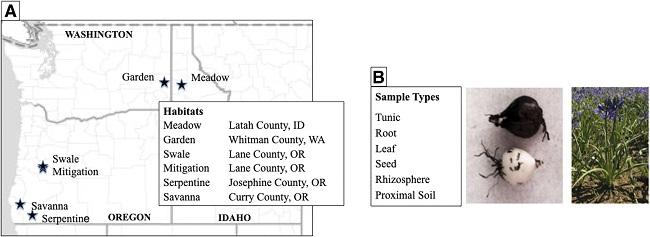
To learn more, Freed and colleagues conducted the first comprehensive study of above- and below-ground fungal communities associated with camas using samples from wetland habitats in Oregon, Idaho, and a home garden plot in Washington. They found that the local environment of each sampled camas population had a significant impact on above-ground fungal community diversity. However, the below-ground fungal communities detected in plant tissues and closely associated soils are similar among the camas sampled in the wetland habitats.

Additionally, they found that camas plant roots may be preferentially colonized by endophytic fungi recruited from nearby soil communities suggesting that plants limit complexity of fungal communities.

The discovery of the diversity among fungal taxa present in the different types of tissues from a native plant that grows for many years is a unique opportunity to explore the endophytes that promote plant population longevity within diverse plant communities.

“What surprised us the most was the number of endophytic fungal taxa that are present among the camas seeds, roots, rhizospheres, and leaves. It is curious whether these taxa may be required for the establishment of camas populations.”

This information may help native prairie and wetland restoration scientists restore camas populations in the PNW.

###

For more information read the open access “Mycological Insights Into Wetland Fungal Communities: The Mycobiome of Camassia in the Pacific Northwest” published in the November issue of Phytobiomes Journal.

Media Contact
Ashley Bergman Carlin
[email protected]
651-994-3832

Related Journal Article

http://dx.doi.org/10.1094/PBIOMES-04-19-0022-R

Tags: AgricultureBiodiversityEcology/EnvironmentForestryGeology/SoilMicrobiologyMycologyPlant Sciences
Share12Tweet8Share2ShareShareShare2

Related Posts

Four new indigenous cacao groups discovered in Peru

Four new indigenous cacao groups discovered in Peru

July 8, 2026
Evolution silences Hawaii’s crickets in record time

Evolution silences Hawaii’s crickets in record time

July 8, 2026

New imaging reveals nerves with stunning clarity

July 8, 2026

Here are a few rewritten headlines for a science magazine post, each with a slightly different tone: Intriguing & poetic: How do organs sculpt themselves? Sea stars hold the secret Direct & research-focused: Sea stars reveal the hidden rules of organ formation Metaphorical & inviting: Tiny architects beneath the waves: What sea stars teach us about building organs Short & punchy: Star-shaped clues to how our organs take shape Question-led: Could a sea star show us how organs form? Elegant & feature-style: The body’s blueprint, glimpsed in a sea star’s arm

July 6, 2026
Please login to join discussion

POPULAR NEWS

  • Detection of EDCs in Breast Milk and Infant Urine Up to Six Months Highlights Early Exposure Risks

    77 shares
    Share 31 Tweet 19
  • New Drug Candidate Developed at McMaster Shows Potential for Treating Brain Cancer

    58 shares
    Share 23 Tweet 15
  • KTU Researchers Explore Ultrasound’s Role in Enhancing Blood Flow Beyond Diagnostics

    53 shares
    Share 21 Tweet 13
  • 高齢者の骨粗鬆症治療の持続性比較

    51 shares
    Share 20 Tweet 13

About

We bring you the latest biotechnology news from best research centers and universities around the world. Check our website.

Follow us

Recent News

Evidence supports traditional Chinese medicine for chikungunya fever management.

Four new indigenous cacao groups discovered in Peru

Weight loss improves liver health in obese children and teens

Subscribe to Blog via Email

Enter your email address to subscribe to this blog and receive notifications of new posts by email.

Join 83 other subscribers
  • Contact Us

Bioengineer.org © Copyright 2023 All Rights Reserved.

Welcome Back!

Login to your account below

Forgotten Password?

Retrieve your password

Please enter your username or email address to reset your password.

Log In
No Result
View All Result
  • Homepages
    • Home Page 1
    • Home Page 2
  • News
  • National
  • Business
  • Health
  • Lifestyle
  • Science

Bioengineer.org © Copyright 2023 All Rights Reserved.