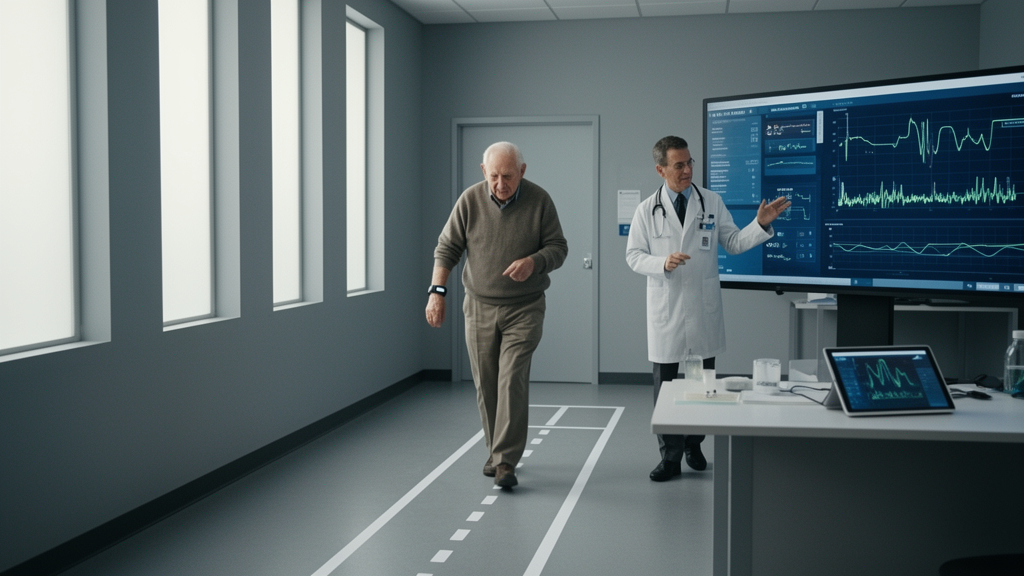
Wearable-sensor measures of everyday walking can detect small declines in people with mild-to-moderate Parkinson disease over two years, but they do not reduce the number of participants a trial would need compared with established clinical rating scales, according to an analysis published in BMC Neurology.
Researchers analysed 524 participants from the observational Mobilise-D Clinical Validation Study, which was prospectively registered with the ISRCTN registry (ISRCTN12051706) on 10 December 2020. Each participant wore a lower-back sensor for seven-day assessment periods, with up to five such assessments over 24 months, yielding 2,081 observations for the primary analysis.
The primary outcome was the weekly 90th percentile of walking speed in bouts longer than 30 seconds, a measure designed to capture the faster end of a person’s real-world walking rather than average pace. Mixed models were used to assess longitudinal change, while within-participant models assessed whether the sensor measures changed in step with clinical scores.
Over the follow-up period, the primary outcome declined by 0.0164 metres per second per year, with a 95 percent confidence interval of 0.0226 to 0.0103 metres per second per year. Walking-bout steps and stride length also declined over the same period.
The sensor measures also moved in parallel with standard clinical assessments. A within-participant reduction in walking speed equal to one baseline standard deviation accompanied a 1.10-point worsening on the MDS-UPDRS Part II, a 1.79-point worsening on Part III, and a 0.92-point reduction on the Late-Life Function and Disability Instrument function score.
Attrition shaped what could be concluded at the end of follow-up. At 24 months, 359 participants still had data for the primary outcome. Sensitivity analyses that treated missing data as not missing at random preserved the direction of the decline when unobserved values were assumed to be worse, but the magnitude of the decline remained uncertain.
Sample-size planning was conducted post hoc, under a hypothetical 24-month scenario with 80 percent power targeting a 30 percent reduction in slope. Under that scenario, the primary sensor outcome required approximately 3,450 participants per arm, compared with roughly 2,150 for MDS-UPDRS Part II and 2,550 for Part III. The sensor measure therefore showed no sample-size advantage over both clinical comparators.
The authors emphasised that the properties they examined are distinct. A digital outcome can change over time and can co-vary with clinical scores without representing a meaningful treatment benefit, a benefit patients perceive, or a reduction in the sample size a trial requires. Longitudinal responsiveness and clinical convergence, they concluded, did not establish treatment responsiveness or patient-perceived benefit.
The study’s scope matters for interpretation. The findings apply to ambulatory people with mild-to-moderate Parkinson disease assessed with lower-back sensors, and the sample-size estimates are post hoc projections rather than results from an actual treatment trial. Within those limits, the analysis suggests that continuous digital measures of real-world mobility can register small group-level changes in Parkinson disease over two years, while cautioning against assuming that such sensitivity automatically translates into smaller, faster clinical trials.
Subject of Research: Digital lower-back sensor mobility outcomes in ambulatory Parkinson disease
Article Title: Digital mobility outcomes showed responsiveness and clinical convergence without sample size advantage in Parkinson disease
Article References: Guo, W., Liu, J., Wu, Z., Xu, X., Ruan, Z., Huang, A., Xu, E., Mao, W., Chan, P., & Chan, P. (2026). Digital mobility outcomes showed responsiveness and clinical convergence without sample size advantage in Parkinson disease. BMC Neurology. https://doi.org/10.1186/s12883-026-05539-4
Image Credits: AI Generated
DOI: 10.1186/s12883-026-05539-4
Keywords: Parkinson disease, digital mobility outcomes, wearable sensors, walking speed, MDS-UPDRS, sample size, clinical trials, Mobilise-D, longitudinal decline, neurodegeneration, Digital, mobility
News Source: Diana Fleming. (October 28, 2026). Digital mobility metrics track Parkinson decline but offer no sample-size edge. Scienmag.