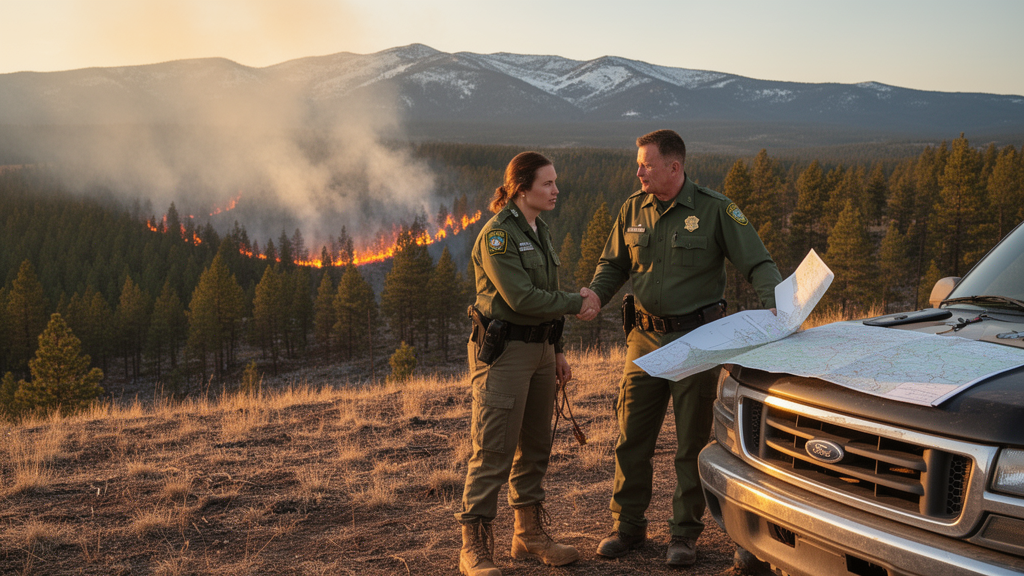
Fire does not respect the property lines that divide forests, but the institutions that manage fire do. A new case study of the Southern Ute Indian Tribe and the San Juan National Forest in southwestern Colorado has catalogued, in unusually fine detail, what gets in the way of Tribal and federal agencies working together on fire and fuels management, and what could make that collaboration work better. The research, published in the journal Fire Ecology on 19 October 2026, identified 31 distinct types of barriers and 28 types of opportunities shaping collaborative fire governance between the two governments, along with four distinct fire-use contexts that each motivate cooperation in different ways.
The study was conducted using a participatory action research approach, co-designed with staff of both the Tribe and the Forest through scoping discussions held between 2022 and 2024. Twenty-eight participants took part, drawn from three overlapping groups: San Juan National Forest staff, Southern Ute Tribal-serving staff, and Southern Ute Tribal community members. Twenty-four interviews were conducted, averaging 64 minutes each, and a mixed-group focus group took place on the Forest itself on May 28, 2025, beginning with a guided walk through areas treated with fuels reduction before discussion began.
The researchers were deliberate about data sovereignty. At the request of Tribal Council, the study’s institutional review protocol was supplemented with a data sharing agreement and a Tribal Resolution establishing that the Southern Ute Indian Tribe retains control and ownership of all Tribal data supplied for the study, including culturally sensitive information. Tribal community members were compensated for their time, and initial results were presented back to a second Tribal Council meeting after data collection. The authors acknowledge the limits of the design: with a small, purposively sampled, non-random participant pool, the findings are not statistically generalizable to all staff or community members, nor easily replicated, since they represent a unique point in time.
The most frequently cited barrier, after normalizing code frequencies to account for uneven group sizes, was a lack of multi-agency communication. Tribal-serving staff described fuels planning as fairly exclusive between the two governments, with little sharing of information about the locations and prescriptions of planned treatments. Notably, the collaborative groups the Forest already participates in were themselves described as a barrier: they were designed for stakeholder engagement rather than government-to-government relationships, and one Forest Service staff member explained that the Tribe has expressed reluctance to join because participating in those collaboratives felt like it diminished the Tribe’s sovereign nation status, making the Tribe seem like everybody else in that scenario. Confusion about each other’s organizational structures compounded the problem, with more than 80 percent of quotes on that confusion coming from Forest Service staff, suggesting a broad lack of clarity about Tribal government structure.
Staffing shortages and lack of capacity followed close behind. Over half of the quotes about personnel shortages identified Bureau of Indian Affairs staffing as the bottleneck: at the time of the interviews, the BIA Southern Ute Agency had a vacant fuels program position for five years, limiting the ability to conduct prescribed burns. Constraints crossing land ownership boundaries, including bureaucratic, administrative and regulatory hurdles on moving personnel, resources or treatments between federal and Tribal lands, ranked fourth. Tribal-serving staff described projects that go right up to the line and stop, with the Forest Service doing the same on its side. Tribal-Federal borders were described as uniquely challenging compared with other jurisdictional boundaries because of complex treaty rights, and questions about liability, such as who the lead agency would be if something went wrong on a shared burn, added further friction. Consultation issues rounded out the top five, with Tribal community members expressing a strong desire for consultation on fuels treatments occurring within the Brunot Area and uncertainty about whether it was happening.
When focus group participants sorted these barriers by scale of decision-making authority, a striking pattern emerged. Concerns about liability, internal agency communication, lack of relationships and trust, and confusion over organizational structures were judged to be within the groups’ own control to change, resolvable through dialogue. Lack of funding, multi-agency communication, consultation issues, treaty rights coordination and lack of agreements could be influenced at district, department or leadership levels. But staffing shortages, staffing turnover, an unsupportive political landscape and lack of capacity sat outside the groups’ control, shaped by external forces including cost of living, the COVID-19 pandemic, generational interest in the workforce, and federal-level policy whiplash tied to changing administrations and shifting fire and fuels priorities.
On the opportunity side, multi-agency communication again led the list, with participants suggesting more frequent meetings, wider departmental inclusion, earlier engagement in planning, and preferably meetings in the field. The most recent Four Corners Interagency Multiple Tribe Meeting in April 2024 was cited as a successful example, and regular meetings between the Forest’s Tribal Relations Program, its Heritage Program and the Tribe’s Tribal Historic Preservation Office, tied to a Tribal Forest Protection Act contract, show how existing policy mechanisms and funding sources can facilitate collaboration. Consultation itself emerged as both a barrier and an opportunity, serving as a baseline for further engagement and an entry point for values-based engagement that elicits Tribal priorities rather than merely concerns. Public notification and outreach was the most frequent opportunity mentioned by Tribal community members, who suggested expanding the mediums and the content of notifications, including information about impacts to harvesting within the Brunot Area.
Opportunities around human capacity included new BIA hires described by Tribal-serving staff as the key element to standing back up the Tribe’s prescribed fire program, sharing staff across forestry, fuels and fire programs, recruiting Tribal members into land management workforces, placements through Ancestral Lands Programs, and cultural competency training such as Forest Service training on Culturally Modified Trees, or peel trees. Joint planning and implementation opportunities included shared protocols for fuels effectiveness monitoring, joint burn plans, and joint mastication or prescribed fire treatments across borders. Participants also noted that resource-sharing mechanisms already functioning for wildfire response, such as pre-season discussions and the sharing of fire engines and personnel, could serve as models for fuels work.
Perhaps the study’s most distinctive contribution is its identification of four fire-use contexts that each motivate collaboration differently. Fuels reduction on federally managed lands with overlapping legal authority, grounded in trust responsibilities and treaty obligations, was the most frequently discussed context, mentioned 85 times across all interviews, with consultation and treaty rights coordination prominent. Cross-boundary fuels reduction treatments, which physically straddle or pool resources across the jurisdictional line, were discussed 53 times and identified by focus group consensus as the most challenging to implement, constrained by boundary-crossing barriers and staffing shortages. Wildfire response, mentioned 41 times, was described as considerably easier: multi-agency communication and joint implementation already occur routinely, with one Tribal staff member noting that agencies work together in a pinch. Strategically aligned fuels treatments, placed on both sides of the boundary without crossing it, were mentioned 23 times and considered easier to plan, though differing priorities between the two governments can restrict where alignment is possible.
The case is set against a rich historical backdrop. The Southern Ute Indian Tribe, headquartered in Ignacio, Colorado, has approximately 1,400 Tribal members and a reservation with an exterior boundary of roughly 681,000 acres. The Brunot Agreement, negotiated in 1873 and ratified by Congress in 1874, ceded approximately 3.7 million acres of Ute reservation land, including mineral-rich portions of the San Juan Mountains, while reserving continued hunting, fishing and gathering rights on the ceded lands that the Tribes maintain remain in effect today. About 70 percent of the 1.8-million-acre San Juan National Forest lies within the Brunot Agreement Area, and approximately 55,000 acres of the Forest sit within the Tribe’s exterior reservation boundary. The Forest is undertaking landscape-scale restoration aiming to accomplish roughly 402,000 acres of hazardous fuels reduction by 2032, including 210,000 acres of prescribed fire. The authors hope their framework, from a less-studied region of the intermountain West and an early stage of Tribal-Federal collaboration, will help other partnerships clarify the fire-use context early in a collaborative process and match governance mechanisms to the specific circumstances at hand, with arrangements that center Tribal self-determination and sovereignty.
Subject of Research: Barriers and opportunities for Tribal-Federal collaborative fire governance between the Southern Ute Indian Tribe and the San Juan National Forest in southwestern Colorado
Article Title: “Fire sees no boundaries”: barriers and opportunities for Tribal-Federal collaborative fire governance between the Southern Ute Indian Tribe and San Juan National Forest
Article References: LoPresti, A., Dee, L. E., Atencio, C. J., Gideon, B., Glidden, N., & Kelley, S. (2026). “Fire sees no boundaries”: barriers and opportunities for Tribal-Federal collaborative fire governance between the Southern Ute Indian Tribe and San Juan National Forest. Fire Ecology, 22(1), Article 164. https://doi.org/10.1186/s42408-026-00581-6
Image Credits: AI Generated
DOI: 10.1186/s42408-026-00581-6
Keywords: fire governance, Tribal-Federal collaboration, Southern Ute Indian Tribe, San Juan National Forest, fuels reduction, prescribed fire, Indigenous Fire Stewardship, consultation, Brunot Agreement, wildfire response, cross-boundary management, Colorado
News Source: Drew Townsend. (October 28, 2026). Fire knows no fence lines: study maps what blocks and what enables Tribal-Federal fire collaboration in Colorado. Scienmag.