• HOME
  • NEWS
  • EXPLORE
    • CAREER
      • Companies
      • Jobs
    • EVENTS
    • iGEM
      • News
      • Team
    • PHOTOS
    • VIDEO
    • WIKI
  • BLOG
  • COMMUNITY
    • FACEBOOK
    • INSTAGRAM
    • TWITTER
Tuesday, May 12, 2026
BIOENGINEER.ORG
No Result
View All Result
  • Login
  • HOME
  • NEWS
  • EXPLORE
    • CAREER
      • Companies
      • Jobs
        • Lecturer
        • PhD Studentship
        • Postdoc
        • Research Assistant
    • EVENTS
    • iGEM
      • News
      • Team
    • PHOTOS
    • VIDEO
    • WIKI
  • BLOG
  • COMMUNITY
    • FACEBOOK
    • INSTAGRAM
    • TWITTER
  • HOME
  • NEWS
  • EXPLORE
    • CAREER
      • Companies
      • Jobs
        • Lecturer
        • PhD Studentship
        • Postdoc
        • Research Assistant
    • EVENTS
    • iGEM
      • News
      • Team
    • PHOTOS
    • VIDEO
    • WIKI
  • BLOG
  • COMMUNITY
    • FACEBOOK
    • INSTAGRAM
    • TWITTER
No Result
View All Result
Bioengineer.org
No Result
View All Result
Home NEWS Science News Chemistry

Digital content on track to equal half Earth’s mass by 2245

Bioengineer by Bioengineer
August 11, 2020
in Chemistry
Reading Time: 3 mins read
0
IMAGE
Share on FacebookShare on TwitterShare on LinkedinShare on RedditShare on Telegram

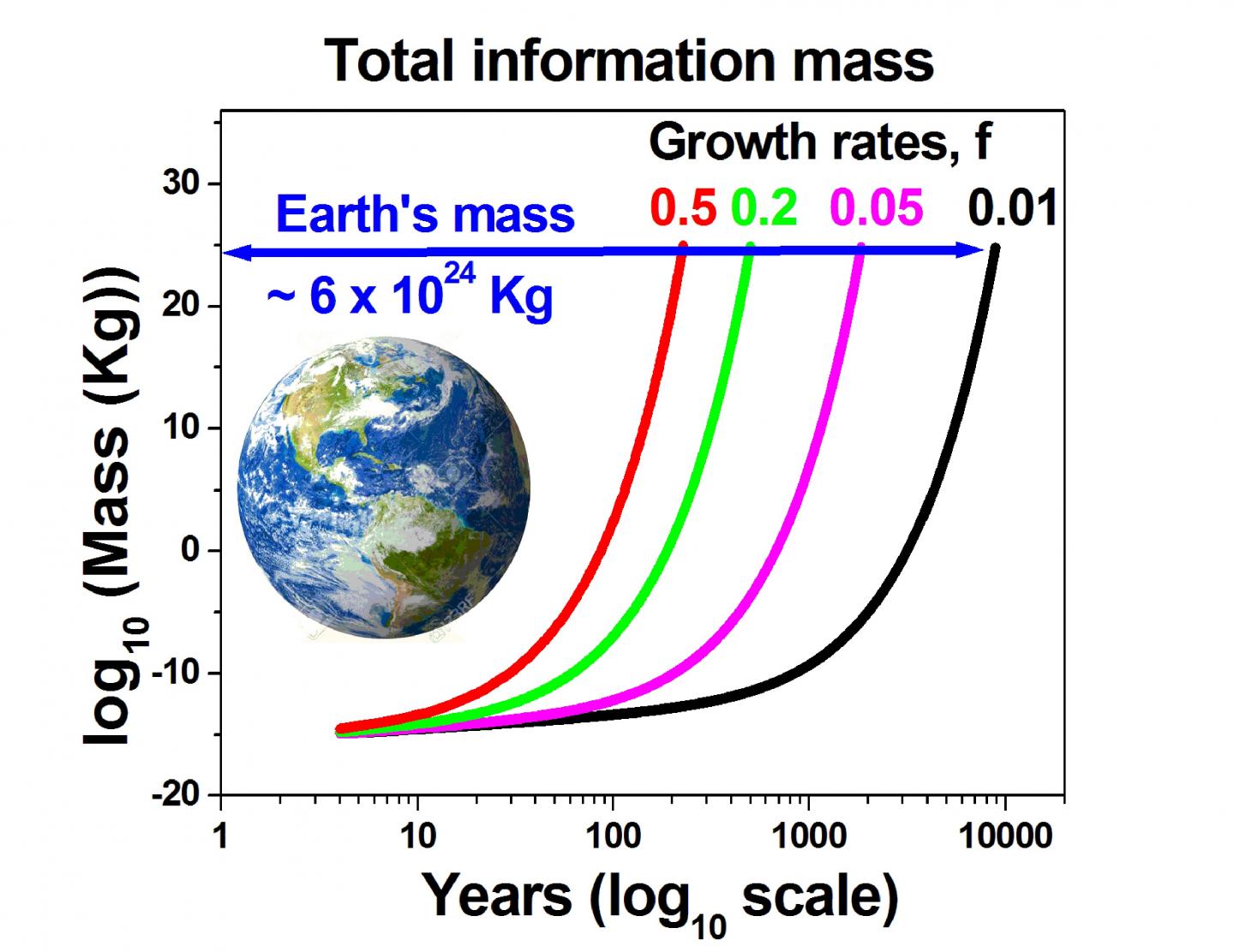
If verified, the mass-energy-information equivalence principle will show that information is a physical, dominant, fifth state of matter, and digital bits will outnumber atoms on Earth — it’s just a matter of time.
IMAGE

Credit: Image courtesy of Melvin Vopson

WASHINGTON, August 11, 2020 — As we use resources, such as coal, oil, natural gas, copper, silicon and aluminum, to power massive computer farms and process digital information, our technological progress is redistributing Earth’s matter from physical atoms to digital information — the fifth state of matter, alongside liquid, solid, gas and plasma.

Eventually, we will reach a point of full saturation, a period in our evolution in which digital bits will outnumber atoms on Earth, a world “mostly computer simulated and dominated by digital bits and computer code,” according to an article published in AIP Advances, by AIP Publishing.

It is just a matter of time.

“We are literally changing the planet bit by bit, and it is an invisible crisis,” author Melvin Vopson said.

Vopson examines the factors driving this digital evolution. He said the impending limit on the number of bits, the energy to produce them, and the distribution of physical and digital mass will overwhelm the planet soon.

For example, using current data storage densities, the number of bits produced per year and the size of a bit compared to the size of an atom, at a rate of 50% annual growth, the number of bits would equal the number of atoms on Earth in approximately 150 years.

It would be approximately 130 years until the power needed to sustain digital information creation would equal all the power currently produced on planet Earth, and by 2245, half of Earth’s mass would be converted to digital information mass.

“The growth of digital information seems truly unstoppable,” Vopson said. “According to IBM and other big data research sources, 90% of the world’s data today has been created in the last 10 years alone. In some ways, the current COVID-19 pandemic has accelerated this process as more digital content is used and produced than ever before.”

Vopson draws on the mass-energy equivalence in Einstein’s theory of general relativity; the work of Rolf Landauer, who applied the laws of thermodynamics to information; and the work of Claude Shannon, the inventor of the digital bit.

In 2019, Vopson formulated a principle that postulates that information moves between states of mass and energy just like other matter.

“The mass-energy-information equivalence principle builds on these concepts and opens up a huge range of new physics, especially in cosmology,” he said. “When one brings information content into existing physical theories, it is almost like an extra dimension to everything in physics.”

###

The article, “The information catastrophe,” is authored by Melvin M. Vopson. The article will appear in AIP Advances on Aug. 11, 2020 (DOI: 10.1063/5.0019941). After that date, it can be accessed at https://aip.scitation.org/doi/10.1063/5.0012711.

ABOUT THE JOURNAL

AIP Advances is an open access journal publishing in all areas of physical sciences–applied, theoretical, and experimental. The inclusive scope of AIP Advances makes it an essential outlet for scientists across the physical sciences. See https://aip.scitation.org/journal/adv.

Media Contact
Larry Frum
[email protected]

Related Journal Article

http://dx.doi.org/10.1063/5.0019941

Tags: Chemistry/Physics/Materials SciencesComputer ScienceElectrical Engineering/ElectronicsMaterialsTechnology/Engineering/Computer ScienceTelecommunications
Share12Tweet8Share2ShareShareShare2

Related Posts

Humans and Zebra Finches Share Similar Speech Learning Techniques #ASA190 — Chemistry

Humans and Zebra Finches Share Similar Speech Learning Techniques #ASA190

May 11, 2026
Unveiling Dark Matter Through Molecular Insights — Chemistry

Unveiling Dark Matter Through Molecular Insights

May 11, 2026

From Touch to Sight: A Bioinspired Multisensory Framework Endows Robots with Human-Like Perception

May 11, 2026

Announcing the 2026 Carbon Future Young Investigator Award Winners

May 11, 2026
Please login to join discussion

POPULAR NEWS

  • Research Indicates Potential Connection Between Prenatal Medication Exposure and Elevated Autism Risk

    841 shares
    Share 336 Tweet 210
  • New Study Reveals Plants Can Detect the Sound of Rain

    728 shares
    Share 290 Tweet 182
  • Salmonella Haem Blocks Macrophages, Boosts Infection

    62 shares
    Share 25 Tweet 16
  • Breastmilk Balances E. coli and Beneficial Bacteria in Infant Gut Microbiomes

    57 shares
    Share 23 Tweet 14

About

We bring you the latest biotechnology news from best research centers and universities around the world. Check our website.

Follow us

Recent News

Humans and Zebra Finches Share Similar Speech Learning Techniques #ASA190

New Study Uncovers How Fungal Parasites Attack Strawberries and Raspberries

City of Hope Researchers to Present Groundbreaking Immunotherapy and Precision Medicine Advances Across Multiple Cancer Types at ASCO 2026

Subscribe to Blog via Email

Enter your email address to subscribe to this blog and receive notifications of new posts by email.

Join 82 other subscribers
  • Contact Us

Bioengineer.org © Copyright 2023 All Rights Reserved.

Welcome Back!

Login to your account below

Forgotten Password?

Retrieve your password

Please enter your username or email address to reset your password.

Log In
No Result
View All Result
  • Homepages
    • Home Page 1
    • Home Page 2
  • News
  • National
  • Business
  • Health
  • Lifestyle
  • Science

Bioengineer.org © Copyright 2023 All Rights Reserved.