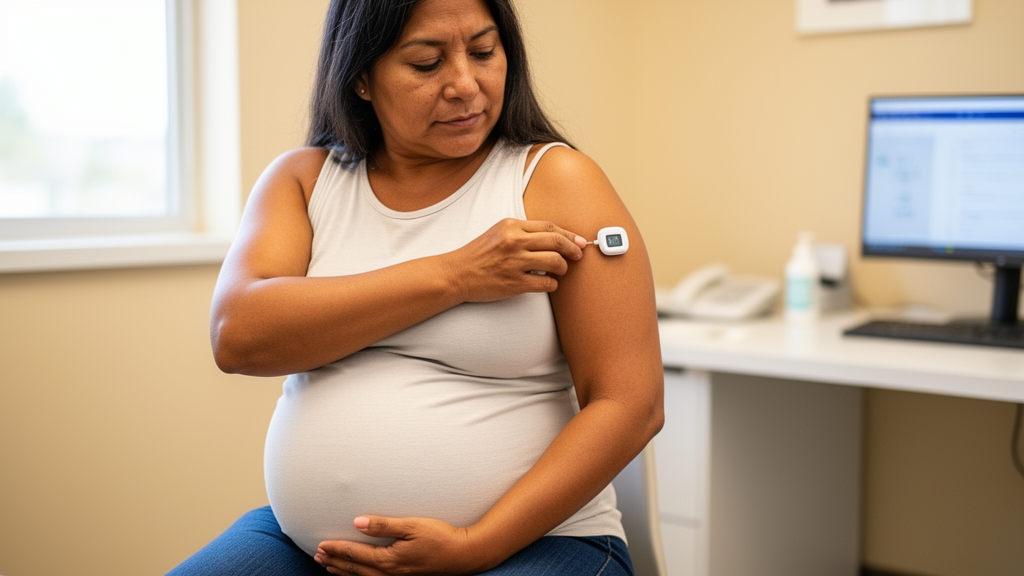
Continuous glucose monitoring is rapidly becoming a cornerstone of diabetes care in pregnancy, but the people who could benefit most from it are largely missing from the research behind it. That is the central conclusion of a scoping review published in Discover Endocrinology and Metabolism, which examined how often persons of colour, ethnic minority and Indigenous groups were included in studies of antenatal continuous glucose monitoring, or CGM. The review, conducted by researchers based in Aotearoa New Zealand, found that ethnicity was reported in only 15 of 28 studies assessing clinical outcomes of CGM use in pregnancy, and in just 3 of 11 studies examining how acceptable and satisfactory pregnant people found the technology. Even where ethnicity was reported, representation of non-white participants was generally low.
The review followed the Joanna Briggs Institute methodology for scoping reviews. The authors searched two databases, MEDLINE and CINAHL, for studies published since 2000, the year CGM first became available for clinical use. After importing 1,209 references and screening 1,008 unique abstracts, two independent reviewers assessed titles, abstracts and full texts, and extracted data in duplicate. The team addressed three questions: how often Indigenous and minority populations appeared in research on CGM as part of antenatal care for diabetes in pregnancy; how often they appeared in research on the acceptability or experience of CGM use; and whether randomised trials of CGM described any specific methods to reduce barriers to participation for these groups.
The scope of the question matters because diabetes is the most common medical complication of pregnancy, affecting roughly one in six pregnancies worldwide. Diabetes in pregnancy may pre-exist as type 1 or type 2 diabetes, or emerge as gestational diabetes, which resolves after birth. Across all types, maternal and fetal adverse outcomes correlate directly with the degree and duration of hyperglycaemia, so antenatal care aims to keep maternal glucose as close to normal pregnancy values as possible. CGM, a wearable subcutaneous sensor that analyses interstitial glucose continuously and transmits readings via Bluetooth to a receiver with visual displays and alarms, reduces the burden of painful, incomplete finger-prick testing and provides a full 24-hour picture of glucose levels.
The technology is not equally established across diabetes types. CGM is already standard of care, and fully subsidised in countries including the UK, USA and Australia, for pregnant people with type 1 diabetes. Evidence for type 2 diabetes and gestational diabetes, the most common form of diabetes in pregnancy, is more limited, involving smaller studies or only intermittent CGM use. Meta-analyses suggest CGM may be better at documenting hyperglycaemia in type 2 diabetes and gestational diabetes, but evidence of benefit on neonatal or maternal clinical outcomes remains inconclusive, and further large randomised studies are required. That gap makes the composition of future trials particularly consequential.
The burden of both type 2 and gestational diabetes falls disproportionately on groups underserved by health systems. Higher rates of gestational diabetes are observed among Indigenous Native American and Canadian First Nations peoples, Australian First Nations peoples, and Māori in Aotearoa New Zealand, as well as among non-Hispanic Black, Mexican American and Other Hispanic populations in the United States. In Australia, type 2 diabetes is four times higher among Indigenous Australians, and in Aotearoa New Zealand, Māori and Pacific adults have 2.5-fold higher rates of type 2 diabetes, with onset typically 5 to 9 years earlier than New Zealand Europeans, often during reproductive age. Indigenous and non-western minority groups also experience worse pregnancy outcomes related to diabetes, alongside inequitable access to diabetes-related technology.
Against that backdrop, the review’s findings on representation are stark. Of the 28 studies of clinical outcomes, 13, or 46 percent, did not report participant ethnicity at all; these were conducted in Denmark, China, Saudi Arabia, Poland, Australia, Japan, Spain, France and Germany. Three studies, all in Italy or Finland, reported that all participants were White, Caucasian or European. Eight studies, conducted across Finland, the UK, Canada, Spain, Italy, Ireland, the USA, the Netherlands and Belgium, reported majority-white participants. Only four studies had majority non-Caucasian participants: a retrospective US study of 360 people with type 2 diabetes, in which 227 were non-Hispanic Black and 48 Hispanic; a Qatari study in which 113 of 265 participants were Qatari and 115 Arab; a Malaysian randomised trial in gestational diabetes; and a small 10-participant US trial. Among twenty studies conducted in colonial Western settings, only two, both in the United States, described significant proportions of people of colour, and one of those was a randomised trial with just 13 participants.
The acceptability literature was thinner still. Of 11 studies on satisfaction and user experience, 8 did not report ethnicity. Only three described participants’ ethnicities, including one Australian study focused on Indigenous Australians in which 34 of 45 participants were of Aboriginal and/or Torres Strait Islander ethnicity, and a US study comparing CGM satisfaction in pregnant people with type 1 and type 2 diabetes, in which 58 participants were non-Hispanic Black. Notably, participants in these studies found antenatal CGM worthwhile and would recommend its use, suggesting the device itself is unlikely to be a barrier. Because socioeconomic status may mediate diabetes prevalence and outcomes, the reviewers also checked whether studies reported social determinants of health instead; few did, and where education or insurance status was described, participants tended to be highly educated and well-resourced.
The third question yielded perhaps the most sobering result. Reviewing the 14 randomised studies, the authors found no study that described methodology specifically used to recruit or retain persons from ethnic minorities. They therefore examined what the trials did report about funding, recruitment and support. Six of 14 trials stated or implied CGM was provided at no cost; in seven it was unclear whether participants bore any cost; and in one, three participants withdrew for cost-related reasons after apparently having to self-fund the device. Recruitment was usually through routine hospital or antenatal clinics, with limited detail. Most studies provided initial CGM education, but descriptions of ongoing support to sustain use were sparse, and in some trials research staff rather than participants placed or replaced sensors.
The authors caution that their review relied on published data, which may not have reported ethnicity that was actually collected, and that investigators may have used inclusion strategies that were simply never described. They also note that concepts of ethnicity, Indigeneity and minority status differ by cultural and historical context; in countries such as China and Japan the dominant ethnic group is the Indigenous population, while in Finland white Europeans are both dominant and Indigenous. Even so, they observed consistent under-representation and inconsistent reporting in colonial Western countries, where historical context and structural inequities have produced the very health disparities CGM research needs to address. The authors also emphasise that when research involves Indigenous peoples, data sovereignty must be upheld, giving these groups access to and influence over data about their communities.
The implications reach beyond academic bookkeeping. Results of research drive service development and resource allocation, and if priority populations are excluded, the resulting interventions and policies will be tailored to majority populations, perpetuating inequity. Lack of representation also risks underestimating CGM’s clinical benefits; a recent New Zealand study found the greatest HbA1c benefit of CGM among Māori children with type 1 diabetes. The review’s authors argue there is a scientific, ethical and public health policy imperative to design future antenatal CGM research to be accessible and culturally acceptable to Indigenous peoples, persons of colour and ethnic minority groups, involving priority-group members from the earliest stages of study design, reporting ethnicity consistently, and describing the strategies that make participation possible.
Subject of Research: Representation of persons of colour, ethnic minority and Indigenous groups in research on continuous glucose monitoring in pregnancy
Article Title: Continuous glucose monitoring to improve pregnancy outcomes: a scoping review of the inclusion of persons of colour, minority and indigenous groups in research
Article References: Gossen-Perez, E., Li, M., Lewis-Hills, E., Okesene-Gafa, K., & Oyston, C. (2026). Continuous glucose monitoring to improve pregnancy outcomes: a scoping review of the inclusion of persons of colour, minority and indigenous groups in research. Discover Endocrinology and Metabolism, 2(1), Article 3. https://doi.org/10.1007/s44417-025-00013-0
Image Credits: AI Generated
DOI: 10.1007/s44417-025-00013-0
Keywords: continuous glucose monitoring, diabetes in pregnancy, gestational diabetes, type 2 diabetes, health equity, Indigenous health, ethnic minorities, scoping review, antenatal care, research representation, data sovereignty, maternal outcomes
News Source: Harold Sullivan. (October 29, 2026). Diabetes in Pregnancy: CGM Research Lacks Ethnic Minority and Indigenous Participants. Scienmag.