• HOME
  • NEWS
  • EXPLORE
    • CAREER
      • Companies
      • Jobs
    • EVENTS
    • iGEM
      • News
      • Team
    • PHOTOS
    • VIDEO
    • WIKI
  • BLOG
  • COMMUNITY
    • FACEBOOK
    • INSTAGRAM
    • TWITTER
Sunday, May 10, 2026
BIOENGINEER.ORG
No Result
View All Result
  • Login
  • HOME
  • NEWS
  • EXPLORE
    • CAREER
      • Companies
      • Jobs
        • Lecturer
        • PhD Studentship
        • Postdoc
        • Research Assistant
    • EVENTS
    • iGEM
      • News
      • Team
    • PHOTOS
    • VIDEO
    • WIKI
  • BLOG
  • COMMUNITY
    • FACEBOOK
    • INSTAGRAM
    • TWITTER
  • HOME
  • NEWS
  • EXPLORE
    • CAREER
      • Companies
      • Jobs
        • Lecturer
        • PhD Studentship
        • Postdoc
        • Research Assistant
    • EVENTS
    • iGEM
      • News
      • Team
    • PHOTOS
    • VIDEO
    • WIKI
  • BLOG
  • COMMUNITY
    • FACEBOOK
    • INSTAGRAM
    • TWITTER
No Result
View All Result
Bioengineer.org
No Result
View All Result
Home NEWS Science News Chemistry

Device cracks milk protein

Bioengineer by Bioengineer
July 23, 2021
in Chemistry
Reading Time: 3 mins read
0
IMAGE
Share on FacebookShare on TwitterShare on LinkedinShare on RedditShare on Telegram

‘Refolding’ molecules to support medical solutions
IMAGE

Credit: Flinders University

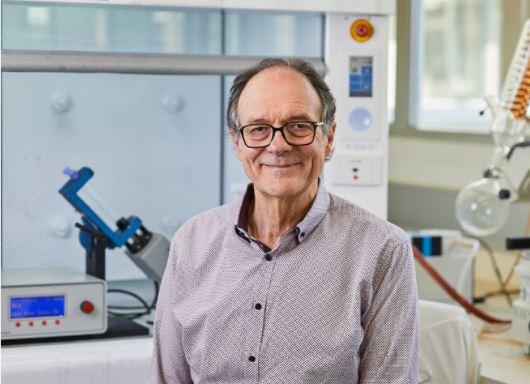
After gaining world attention by ‘unboiling’ egg protein, Flinders University scientists have now used an Australian-made novel thin film microfluidic device to manipulate Beta-lactoglobulin (β-lactoglobulin), the major whey protein in cow’s, sheep’s and other mammals.

The so-called Vortex Fluidic Device has previously been used in an array of experiments to successfully ‘un-boil’ egg protein and even break the molecular bonds of one of the world’s hardest material, carbon nanotubes.

In the latest application, published in Molecules, College of Science and Engineering experts have combined the capabilities of the VFD with a new form of biosensor called TPE-MI, which is an aggregation-induced emission luminogen (AIEgen).

“In the human body, protein folding is a regular process which in some cases may involve misfolding and aggregation such as in gene mutation, which can upset the balance,” says Professor Youhong Tang, whose research focuses on expanding AIEgen technologies.

“One is example is the buildup of amyloid proteins, which is associated with diseases such as Alzheimer’s, Parkinson’s and Huntington’s. Finding ways to monitor these protein levels – and even reversing high levels of these cellular aggregations – could lead to future therapies.”

SA Scientist of the Year Professor Colin Raston, who designed the VFD, says the combination of both technologies produced some promising results in fields of medical discovery.

“In this latest study, we showed how vital proteins can be manipulated – unfolded and refolded – using β-lactoglobulin, which is a relatively simple, low molecular weight protein.

“Combining VFD and AIE technologies provides a fully capable and robust method for controlling and monitoring the progress of protein denaturation and renaturation.”

The research team will now use the technology combination on other proteins, focusing on those highly related to Alzheimer’s disease, Parkinson’s disease, and Huntington’s disease.

###

In Situ Monitored Vortex Fluidic-Mediated Protein Refolding/Unfolding Using an Aggregation-Induced Emission Bioprobe (2021) by Qi Hu, H Hu, X Zhang, K Fan,Y Hong, CL Raston and Y Tang has been published in Molecules Vol 26, Issue 14. DOI: 10.3390/molecules26144273 https://www.mdpi.com/1420-3049/26/14/4273/htm#

See also:

https://news.flinders.edu.au/blog/2021/06/09/wider-applications-for-vortex-fluidic-device/

https://news.flinders.edu.au/blog/2020/11/24/new-frontier-in-enzyme-chemical-processing/

https://news.flinders.edu.au/blog/2021/01/18/new-directions-in-energy-storage/

https://news.flinders.edu.au/blog/2020/06/24/vfd-creates-improved-bacteria-detector/

https://news.flinders.edu.au/blog/2020/09/12/refined-finish-for-more-functional-fish-oil/

Acknowledgements: Q. Hu receives financial support from Postgraduate Research Scholarships (International) for his study at Flinders University. Y. Hong and Y. Tang are supported by the Australia-China Science and Research Fund – Joint Research Centre on Personal Health Technologies. This work is also supported by the Australia Research Council (DP200101106).

Media Contact
Professor Youhong Tang
[email protected]

Related Journal Article

http://dx.doi.org/10.3390/molecules26144273

Tags: AlzheimerBiochemistryBiotechnologyCell BiologyMedicine/Healthneurobiology
Share13Tweet8Share2ShareShareShare2

Related Posts

Miniature Sensor Uses Light to Detect Touch — Chemistry

Miniature Sensor Uses Light to Detect Touch

May 8, 2026
Iron Minerals Determine Whether Dissolved Organic Matter Fuels Microbes or Becomes Long-Term Carbon Storage — Chemistry

Iron Minerals Determine Whether Dissolved Organic Matter Fuels Microbes or Becomes Long-Term Carbon Storage

May 8, 2026

Kate Evans Appointed Associate Lab Director for Biological and Environmental Systems Science at ORNL

May 8, 2026

Advancing Multiscale Modeling and Overcoming Operational Challenges in Autothermal CO₂-to-Methanol Reactors

May 8, 2026
Please login to join discussion

POPULAR NEWS

  • Research Indicates Potential Connection Between Prenatal Medication Exposure and Elevated Autism Risk

    839 shares
    Share 336 Tweet 210
  • New Study Reveals Plants Can Detect the Sound of Rain

    727 shares
    Share 290 Tweet 181
  • Scientists Investigate Possible Connection Between COVID-19 and Increased Lung Cancer Risk

    68 shares
    Share 27 Tweet 17
  • Salmonella Haem Blocks Macrophages, Boosts Infection

    61 shares
    Share 24 Tweet 15

About

BIOENGINEER.ORG

We bring you the latest biotechnology news from best research centers and universities around the world. Check our website.

Follow us

Recent News

Key Pharmacological Markers for HIV Prevention in MSM

Taking 8,500 Steps Daily May Aid Long-Term Weight Management, Study Finds

Group Exercise Boosts Cognition, Fitness in Dementia

Subscribe to Blog via Email

Enter your email address to subscribe to this blog and receive notifications of new posts by email.

Join 82 other subscribers
  • Contact Us

Bioengineer.org © Copyright 2023 All Rights Reserved.

Welcome Back!

Login to your account below

Forgotten Password?

Retrieve your password

Please enter your username or email address to reset your password.

Log In
No Result
View All Result
  • Homepages
    • Home Page 1
    • Home Page 2
  • News
  • National
  • Business
  • Health
  • Lifestyle
  • Science

Bioengineer.org © Copyright 2023 All Rights Reserved.