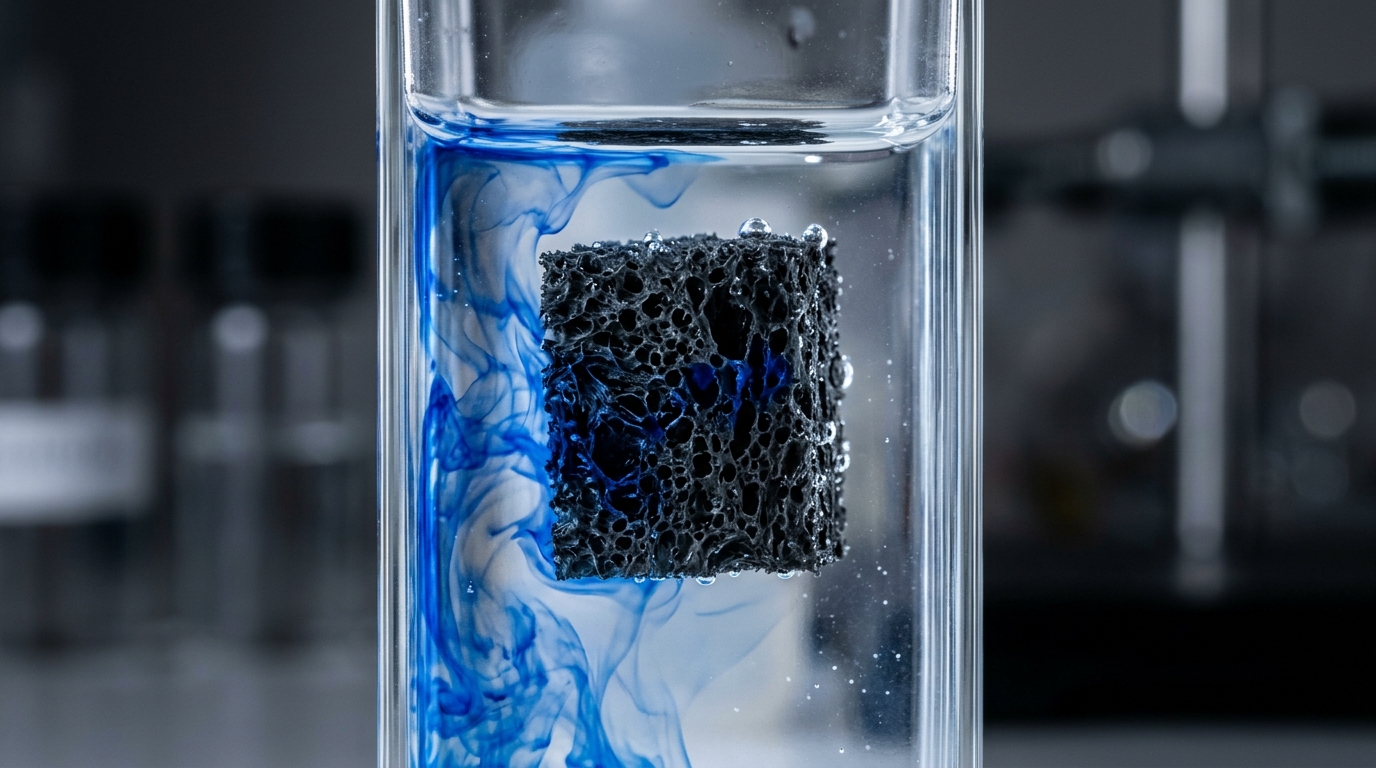
A novel hydrogel composite synthesized from pectin, xanthan gum, and poly(vinyl alcohol) reinforced with graphene oxide effectively removes Basic Blue 12 dye from contaminated water, according to laboratory findings published in Polymer Bulletin. The composite, designated as FT-CA-GO, was synthesized via a sol-gel approach combining freeze-thaw cycles with citric acid crosslinking to serve as an adsorbent for environmental remediation.
The research team systematically characterized the structural, morphological, and thermal properties of the composite using Fourier-transform infrared spectroscopy, X-ray diffraction, Brunauer-Emmett-Teller surface area analysis, thermogravimetric analysis, field emission scanning electron microscopy with energy-dispersive X-ray spectroscopy, and transmission electron microscopy. Using analysis of variance with response surface methodology based on a Box-Behnken design, the investigators identified the optimum adsorption conditions as pH 7, a temperature of 30 °C, a contact time of 60 minutes, an adsorbent dosage of 0.07 grams, and an initial dye concentration of 600 milligrams per liter.
Under these optimal parameters, the experimentally measured equilibrium adsorption capacity reached 948.66 milligrams per gram, with removal efficiencies exceeding 97.66 percent, while nonlinear Langmuir fitting produced a model-estimated maximum adsorption capacity of 988.66 milligrams per gram. Swelling experiments demonstrated pronounced pH-responsive behavior, with swelling increasing in alkaline conditions as a result of enhanced carboxyl group deprotonation.
Adsorption kinetic measurements aligned with a pseudo-first-order model, and the equilibrium data fit best to the Freundlich isotherm, implying multilayer adsorption across diverse surface sites. The FT-CA-GO hydrogel sustained high dye removal across distilled, tap, and river water matrices, maintaining an 88.4 percent removal efficiency after 10 consecutive adsorption-regeneration cycles.
Molecular dynamics simulations indicated stable association of Basic Blue 12 with the hydrogel surface through hydrogen bonding, electrostatic interactions, π–π stacking, and van der Waals interactions, supported by radial distribution function, radius of gyration, and mean square displacement analyses. Biodegradation tests revealed 97 percent degradation within 15 days in non-sterilized soil extract, compared with lower degradation in sterilized soil extract and deionized water, indicating a major microbial contribution and supporting further evaluation in more complex water-treatment systems.
Subject of Research: Adsorption of Basic Blue 12 dye using graphene oxide-reinforced hydrogel
Article Title: Sustainable graphene oxide-reinforced PEC/XG/PVA hydrogel constructed via a green dual-crosslinking strategy: structure–property relationships, adsorption performance, and molecular dynamics insights
Article References: Aljeboree, A. M., Hussein, U. A.-R., Aljamaly, R. K., Altimari, U. S., Abed, B. S., & Alkaim, A. F. (2027). Sustainable graphene oxide-reinforced PEC/XG/PVA hydrogel constructed via a green dual-crosslinking strategy: structure–property relationships, adsorption performance, and molecular dynamics insights. Polymer Bulletin, 84(1), Article 13. https://doi.org/10.1007/s00289-026-06775-x
Image Credits: AI Generated
DOI: 10.1007/s00289-026-06775-x
Keywords: hydrogels, graphene oxide, water remediation, adsorption, Basic Blue 12, pectin, xanthan gum, biodegradable polymers, Sustainable, graphene, oxide-reinforced, hydrogel
News Source: Neil Sanderson. (November 6, 2026). Graphene Oxide Hydrogel Effectively Adsorbs Basic Blue 12 Dye from Water. Scienmag.