• HOME
  • NEWS
  • EXPLORE
    • CAREER
      • Companies
      • Jobs
    • EVENTS
    • iGEM
      • News
      • Team
    • PHOTOS
    • VIDEO
    • WIKI
  • BLOG
  • COMMUNITY
    • FACEBOOK
    • INSTAGRAM
    • TWITTER
Friday, November 20, 2026
BIOENGINEER.ORG
No Result
View All Result
  • Login
  • HOME
  • NEWS
  • EXPLORE
    • CAREER
      • Companies
      • Jobs
        • Lecturer
        • PhD Studentship
        • Postdoc
        • Research Assistant
    • EVENTS
    • iGEM
      • News
      • Team
    • PHOTOS
    • VIDEO
    • WIKI
  • BLOG
  • COMMUNITY
    • FACEBOOK
    • INSTAGRAM
    • TWITTER
No Result
View All Result
Bioengineer.org
No Result
View All Result
Home NEWS Science News Cancer

Dendritic Cells Amplify Tebentafusp-Mediated T Cell Activity Against Tumor Cells

by
November 14, 2026
in Cancer, Health
Reading Time: 2 mins read
0
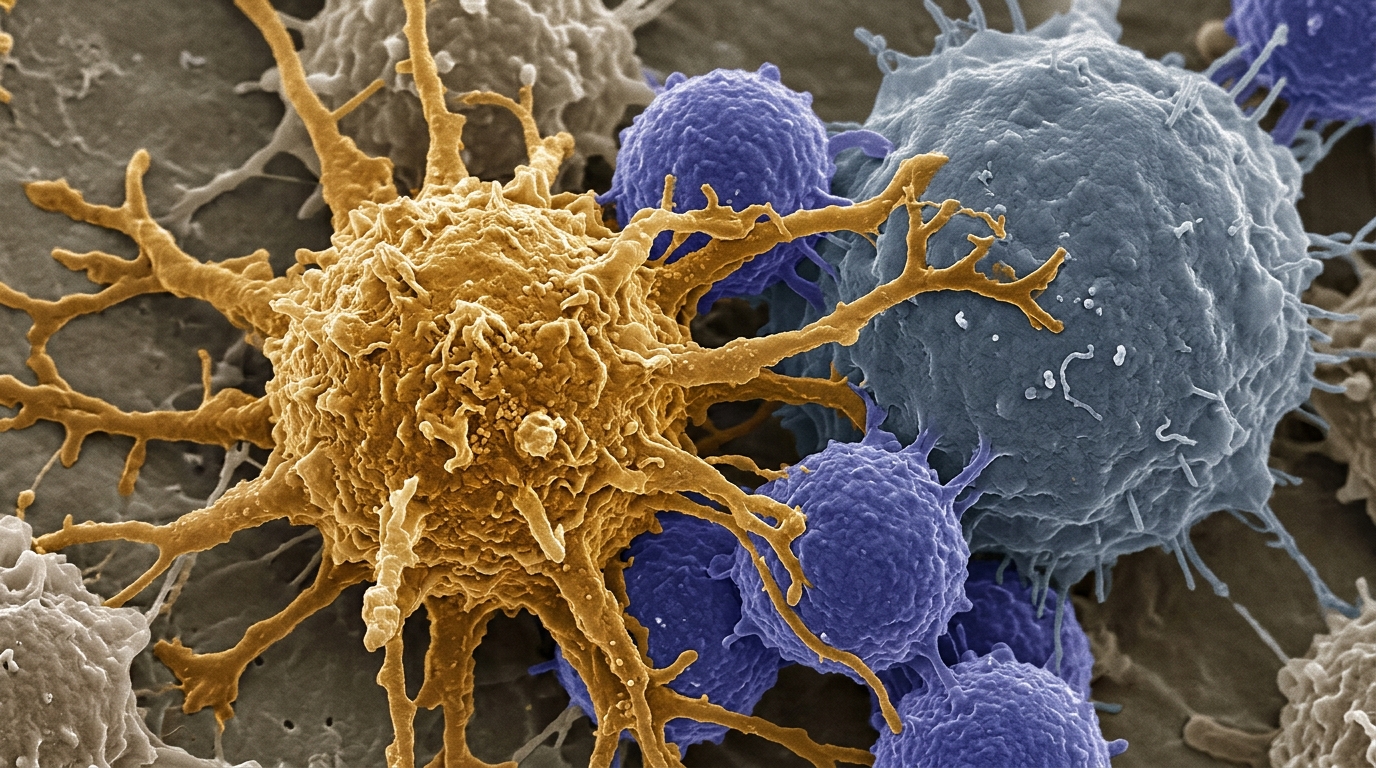
Dendritic Cells Amplify Tebentafusp-Mediated T Cell Activity Against Tumor Cells

Dendritic Cells Amplify Tebentafusp-Mediated T Cell Activity Against Tumor Cells

Share on FacebookShare on TwitterShare on LinkedinShare on RedditShare on Telegram

Dendritic cells enhance tebentafusp-mediated T cell activation, cytokine production, and cytotoxicity through a contact-dependent amplification mechanism, according to an experimental investigation published in Cancer Immunology, Immunotherapy. Tebentafusp represents the first approved T cell receptor-based bispecific therapy and prolongs overall survival in patients with metastatic uveal melanoma by redirecting functional T cells against tumor cells positive for gp100 and HLA-A*02:01. However, the precise ways in which this therapeutic agent reshapes broader immune-cell interactions within the surrounding tumor microenvironment have remained incompletely understood.

To investigate these immune dynamics, the research team employed HLA-defined donor T cells, dendritic cells, and distinct tumor cell models characterized by varied gp100 and HLA-A*02:01 expression profiles. Across the evaluated tumor cell models, the overall magnitude of tebentafusp-mediated functional responses showed a close association with both cellular gp100 abundance and HLA-A*02:01 surface expression. The experimental setup enabled researchers to systematically track how the addition of dendritic cells influenced bispecific-driven antitumor effector responses across varied antigen and receptor densities.

The observed dendritic cell-dependent functional enhancement operated independently of several established immune signaling routes. The authors determined that the amplification was not explained by conventional antigen presentation mechanisms or by the tested CD80/CD86 costimulatory pathway. Furthermore, the augmented T cell activation, cytokine production, and cytotoxic responses were not further enhanced when combining the treatment with immune checkpoint blockade targeting PD-1 or CTLA-4 pathways, demonstrating a distinct mode of action.

Direct cellular interactions proved essential for transferring tebentafusp onto dendritic cell surfaces. Following direct co-culture with tumor cells expressing both gp100 and HLA-A*02:01, even HLA-A*02:01-negative dendritic cells acquired and displayed surface-bound tebentafusp. These cross-decorated dendritic cells subsequently stimulated tebentafusp-specific T cell activation despite the underlying human leukocyte antigen mismatch between the dendritic cells and the target profiles.

Successful molecular transfer onto the dendritic cells required both tumor gp100 and HLA-A*02:01 expression alongside physical cell-to-cell contact, observations consistent with functional dendritic cell cross-dressing. Together, these laboratory findings identify a dendritic cell-mediated amplification mechanism that extends tebentafusp effector activity beyond direct tumor-T cell interactions, illustrating how accessory immune cells can actively reshape bispecific immune redirection within the local tumor microenvironment.

Subject of Research: Dendritic cell enhancement of tebentafusp-mediated T cell effector responses

Article Title: Dendritic cells enhance tebentafusp-mediated T cell effector responses

Article References: Wiesinger, M., Petzold, A., Luber, M., Hilgendorf, P., Wild, A., Heppt, M. V., Schuler-Thurner, B., Schober, K., Berking, C., & Koch, E. A. T. (2026). Dendritic cells enhance tebentafusp-mediated T cell effector responses. Cancer Immunology, Immunotherapy. https://doi.org/10.1007/s00262-026-04609-3

Image Credits: AI Generated

DOI: 10.1007/s00262-026-04609-3

Keywords: tebentafusp, dendritic cells, T cell activation, T cell receptor, bispecific therapy, uveal melanoma, gp100, HLA-A*02:01, cytokine production, cytotoxicity, cross-dressing, tumor microenvironment, antigen presentation, CD80/CD86 pathway, PD-1 blockade, CTLA-4 blockade, immune redirection

News Source: Nathaniel Bowman. (November 14, 2026). Dendritic Cells Amplify Tebentafusp-Mediated T Cell Activity Against Tumor Cells. Scienmag.


Tags: antigen presentationbispecific therapyCD80/CD86 pathwaycross-dressingCTLA-4 blockadecytokine productioncytotoxicitydendritic cellsgp100HLA-A*02:01immune redirectionPD-1 blockadeT cell activationT cell receptortebentafusptumor microenvironmentuveal melanoma
Share12Tweet7Share2ShareShareShare1

Related Posts

BADF-Net Outperforms Eleven Baseline Models in Segmenting Abdominal Ultrasound Structures

BADF-Net Outperforms Eleven Baseline Models in Segmenting Abdominal Ultrasound Structures

November 20, 2026
Study Finds Blood-Borne Pathogen Knowledge Gaps Among Yemeni Health Sciences Students

Study Finds Blood-Borne Pathogen Knowledge Gaps Among Yemeni Health Sciences Students

November 20, 2026

Species Shifts Drove Rising Candida Antifungal Resistance at Mexican Hospital

November 20, 2026

Four Decades of Smelter Data Show Community Cleanups Fail Without Emission Cuts

November 20, 2026

POPULAR NEWS

  • CMOS Potts Chip Harnesses Multiphase Oscillations for Low-Power Memory and Graph Optimization

    CMOS Potts Chip Harnesses Multiphase Oscillations for Low-Power Memory and Graph Optimization

    29 shares
    Share 12 Tweet 7
  • Optimized Radiolabeling Improves iPSMA Homogeneity and Supports Single Vial Cold Kit Formulation

    29 shares
    Share 12 Tweet 7
  • Cross-Sectional Bahrain Survey Links Weather, Demands, and Gender to Activity Rates

    29 shares
    Share 12 Tweet 7
  • Biologists Propose Teleonome Framework to Assess Animal Welfare and Agency

    29 shares
    Share 12 Tweet 7

About

We bring you the latest biotechnology news from best research centers and universities around the world. Check our website.

Follow us

Recent News

BADF-Net Outperforms Eleven Baseline Models in Segmenting Abdominal Ultrasound Structures

Mild Hypoxia Enriches Mesoderm Formation During Early Human Pluripotent Stem Cell Differentiation

Study Finds Blood-Borne Pathogen Knowledge Gaps Among Yemeni Health Sciences Students

Subscribe to Blog via Email

Enter your email address to subscribe to this blog and receive notifications of new posts by email.

Join 89 other subscribers
  • Contact Us

Bioengineer.org © Copyright 2023 All Rights Reserved.

Welcome Back!

Login to your account below

Forgotten Password?

Retrieve your password

Please enter your username or email address to reset your password.

Log In
No Result
View All Result
  • Homepages
    • Home Page 1
    • Home Page 2
  • News
  • National
  • Business
  • Health
  • Lifestyle
  • Science

Bioengineer.org © Copyright 2023 All Rights Reserved.