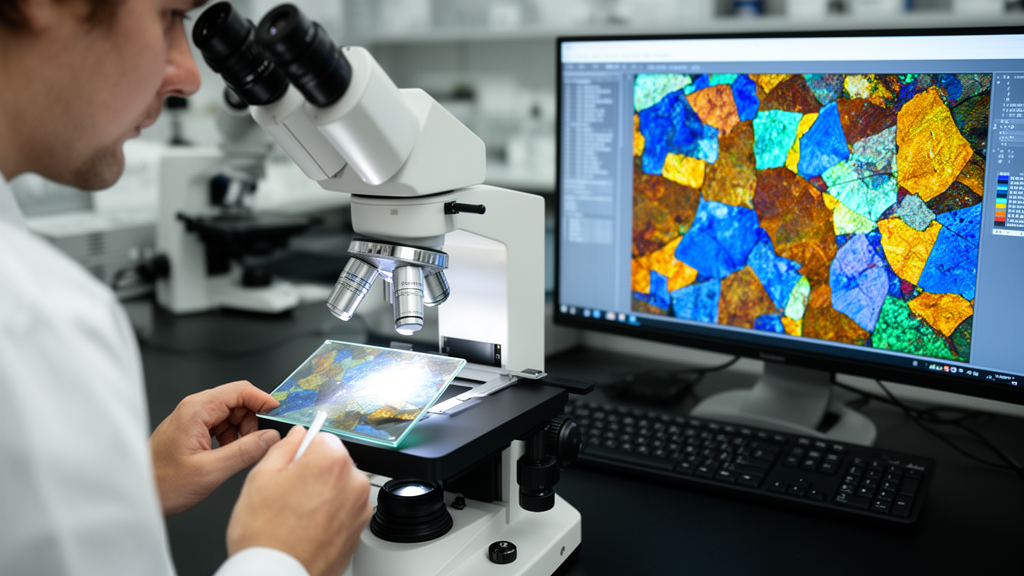
Identifying minerals in petrographic thin sections has long been a slow, manual task performed by geoscientists peering through optical microscopes. A new study published in Earth Science Informatics on 8 October 2026 reports a deep learning approach that automates this process, using a ResNeXt101-UNet architecture to perform semantic segmentation of minerals directly in thin section images. The work, led by Noureldin Laban, Safaa M. Hassan, Hind H. Zeyada and Mohamed R. Metwalli, with colleagues including Mabrouk Sami, Abdullah Alohali, Suhail S. Alhejji, Ioan V. Sanislav and Saif M. Abo Khashaba, targets eleven semantic classes: ten distinct mineral phases and one background class.
The ten mineral phases covered by the model are biotite, chlorite, K-feldspar, muscovite, olivine, plagioclase, quartz, serpentine, talc and titanite, a set chosen to represent diverse silicate and phyllosilicate minerals commonly found in basement rocks. The architecture combines ResNeXt101 as an encoder, which extracts feature representations from the images, with a U-Net decoder that provides the spatial precision needed to trace mineral boundaries.
The quantitative results come from evaluation over 4,440,900 annotated test pixels. The ResNeXt101-UNet reached macro-averaged precision, recall and F1-score of 0.842, 0.811 and 0.813 respectively, and weighted-averaged values of 0.874, 0.860 and 0.863. In benchmark comparisons, the model outperformed both a baseline U-Net and a ResNet-UNet across multiple segmentation metrics, with the largest advantages appearing in handling mineralogical heterogeneity and subtle textural variations within the thin sections.
Performance varied considerably across mineral classes. The model was most accurate for optically distinctive phases: olivine achieved an F1-score of 0.95, serpentine 0.91 and biotite 0.90. At the other end of the scale, the background class scored an F1 of just 0.44, and sparsely represented accessory minerals such as titanite (0.76) and chlorite (0.78) also lagged behind. The authors identify these weakly represented classes as the principal sources of error in the segmentation output, a pattern consistent with the difficulty of learning from fewer annotated examples of rare phases.
The study’s authors argue that these results highlight the potential of advanced deep learning frameworks to support and accelerate petrographic analysis with high accuracy and reliability. Because the model was evaluated on a large annotated test set spanning common rock-forming minerals as well as minor accessory phases, the reported scores offer a detailed picture of where automated mineral mapping currently succeeds and where it still struggles. The full article, published in Volume 19 of Earth Science Informatics as article number 226, is available from Springer, with access provided through institutional subscription or purchase.
Subject of Research: Deep learning-based semantic segmentation of minerals in petrographic thin sections for automated mineral mapping
Article Title: Semantic segmentation of petrographic thin sections using deep neural networks for automated mineral mapping
Article References: Laban, N., Hassan, S. M., Zeyada, H. H., Metwalli, M. R., Sami, M., Alohali, A., Alhejji, S. S., Sanislav, I. V., & Abo Khashaba, S. M. (2026). Semantic segmentation of petrographic thin sections using deep neural networks for automated mineral mapping. Earth Science Informatics, 19(12), Article 226. https://doi.org/10.1007/s12145-026-02269-6
Image Credits: AI Generated
DOI: 10.1007/s12145-026-02269-6
Keywords: semantic segmentation, petrographic thin sections, deep learning, ResNeXt101-UNet, mineral mapping, geosciences, optical microscopy, U-Net, basement rocks, image segmentation, Semantic, segmentation
News Source: Blake Davidson. (October 28, 2026). Deep neural network maps minerals in petrographic thin sections with high accuracy. Scienmag.