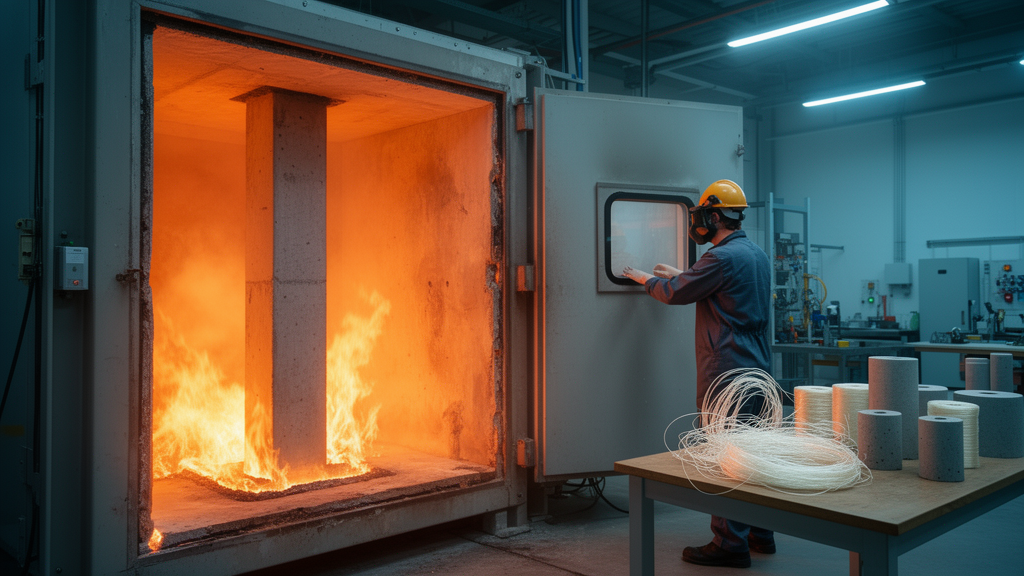
Columns are the least forgiving members of a building when fire strikes. They carry most of the vertical load with little redundancy, and fire attacks them on all faces at once, weakening the concrete, softening the reinforcement and imposing steep thermal-gradient stresses. A new systematic review, published in Discover Civil Engineering, pulls together 115 studies and 1,321 specimen-level records on how high-strength concrete (HSC), ultra-high-performance concrete (UHPC), reactive powder concrete (RPC), concrete-filled steel tube (CFST) and steel-reinforced concrete (SRC) columns behave during fire and how much load-bearing capacity they retain afterward. It is, according to the authors, the first cross-typology synthesis to explicitly separate during-fire resistance from post-fire residual capacity and to benchmark the data against Eurocode 2, Eurocode 4 and ACI 216.1.
The review’s most striking finding concerns explosive spalling, the sudden violent ejection of surface concrete that distinguishes high-strength systems from ordinary concrete. In HSC, spalling can begin as early as five minutes into a standard ISO 834 fire, and in severe cases strips the cover and exposes the reinforcement. The mechanism is pore-pressure build-up: dense, low-permeability matrices trap vaporized water, and at 100 to 300 degrees Celsius the surface vapor pressure exceeds the temperature-degraded tensile strength. Severity rises with concrete strength, moisture content above roughly 3 percent, faster heating rates, smaller sections and higher axial load, with siliceous aggregates performing worse than carbonate ones because of the quartz inversion near 573 degrees Celsius.
Polypropylene fibers emerge as the most reliable countermeasure. Melting at about 160 to 170 degrees Celsius, they open micro-channels that vent vapor pressure. Across the reviewed HSC specimens, spalling incidence fell from 85 percent with no fibers to 65 percent at 0.9 to 1.5 kilograms per cubic meter, and to zero at 1.5 to 3.0 kilograms per cubic meter. Steel fibers complement this by bridging cracks and raising fracture energy, and hybrid PP-plus-steel mixes substantially reduced spalling while retaining those benefits. In UHPC, however, the picture is more conditional: the review found that PP fiber effectiveness depends strongly on mixture composition, moisture content and heating rate, and should be evaluated for each formulation rather than assumed from fiber presence alone.
UHPC and RPC are more fire-vulnerable than HSC in several respects. Their extremely low permeability makes spalling onset occur earlier, at 200 to 350 degrees Celsius versus 300 to 450 degrees Celsius for HSC, and in some cases plain UHPC specimens were destroyed before reaching 500 degrees Celsius surface temperature. Strength retention at 400 degrees Celsius is lower for UHPC than HSC, and elastic modulus is even more thermally sensitive, dropping to roughly 15 to 20 percent of its ambient value at 600 degrees Celsius. Geopolymer binders showed a notable advantage in extreme heating tests, surviving 800 to 1000 degrees Celsius intact while Portland-cement UHPC spalled apart, though those comparisons used isothermal rather than standard fire curves.
Concrete-filled steel tubes behave differently. The steel tube heats rapidly, shedding load to the still-strong concrete core, and full-scale unprotected sections typically achieve 60 to 120 minutes of fire resistance versus 20 to 40 minutes for equivalent hollow steel tubes. But the benefit erodes under the conditions common in modern high-rise construction: slender columns, eccentric loading and high-strength infill. Internal spalling at the tube-concrete interface can trigger sudden failure for infill above 80 megapascals, and the review found that the maximum damage to CFST columns with axial load ratios of 0.3 to 0.5 and fire resistance ratings of 30 to 90 minutes was caused by eccentric loading and high slenderness ratios.
Post-fire residual capacity, the quantity that drives repair-versus-demolition decisions, degrades in a characterized pattern. The residual axial capacity of UHPC columns after fire was 0.35 to 0.78 of initial capacity, depending on axial load ratio, cross-sectional dimensions and fiber dose. For HSC columns, the ratio falls from roughly 0.70 to 0.85 after about 30 minutes of ISO 834 exposure to 0.25 to 0.45 near 90 minutes. Slender columns fared 15 to 25 percent worse than short ones under identical fire exposure, an effect attributed to thermal-bow amplification. Across typologies, CFST columns retained the highest residual capacity at equivalent exposure, followed by HSC and then non-fiber UHPC, while the SRC subset was too small to rank reliably.
The axial load ratio proved the most consistently influential parameter across all typologies, though the review stresses this is a descriptive trend rather than a statistically controlled ranking. For HSC columns, each 0.1 increase in load ratio was associated with an approximate 8 to 15 minute reduction in fire-resistance time, and for UHPC columns an increase from 0.3 to 0.6 was associated with reductions of 30 to 40 minutes in several studies. Maintaining a load ratio at or below 0.4 is associated with better performance, an indicative observation rather than a codified limit. Cover thickness and section size also matter: increasing cover from 25 to 50 millimeters delays the rebar reaching 400 degrees Celsius by about 20 to 35 minutes, and columns wider than 300 millimeters achieved 30 to 50 percent higher fire resistance ratings than 200-millimeter columns under similar loading.
The review also documents a deformation story with life-safety implications. Concrete-filled steel tubes deform the most before failure, shortening progressively and visibly as the tube yields and redistributes load, giving substantial warning. Exposed high-strength and UHPC columns behave oppositely, reaching failure at very small deformation, and in several heated HSC columns tested at service-level load the member was still net-elongated at the instant of failure, meaning thermal expansion outpaced load-driven contraction right up to the brittle limit state. Post-fire median axial strains were 2.31 percent for CFST columns versus 0.81 percent for HSC and 0.53 percent for UHPC. The authors present the resulting frame-level concern, that fire-shortened columns may shift load to cooler neighbors and distort floors in tall buildings, as a conceptual hypothesis requiring validation rather than an established conclusion.
On the modeling side, finite element analysis dominates, appearing in 48 studies, with ABAQUS used in roughly 70 percent of computational work. Validation is generally strong, with predicted-to-measured fire-resistance ratios typically within about 15 percent, though accuracy degrades for columns with spalling, non-uniform fire exposure or eccentric loading. Machine learning remains an emerging rather than established tool: the screening identified no column-fire study in which machine learning was applied as a validated primary predictive method against qualifying experimental data, largely because the evidence base is too small relative to the high-dimensional parameter space.
The code implications are pointed. Eurocode 2 Part 1-2 extends to HSC through Annex B but provides nothing for UHPC or RPC, and Eurocode 4’s CFST method was shown unconservative for slender, eccentric, HSC-filled and non-circular columns. ACI 216.1 remains calibrated on normal-strength data. The review’s priority research list includes natural and parametric fire curves, a standardized UHPC fire test protocol, fire-seismic combination data, and dedicated programs for SRC columns, the least-studied typology with only 13 dedicated fire studies. The authors caution that their quantitative ranges are descriptive pooled trends from heterogeneous test protocols, not a formal meta-analysis, and that no structured quality-appraisal instrument was applied, so the conclusions should be read as an evidence map for future calibration rather than finished design rules.
Subject of Research: Fire performance and post-fire residual capacity of advanced and composite concrete columns
Article Title: Systematic review of spalling fire resistance and residual capacity in advanced and composite concrete columns exposed to fire
Article References: Almakinachi, W. R., Salahaldin, A. I., Ghaidan, D. J., & Ahmed, J. K. (2026). Systematic review of spalling fire resistance and residual capacity in advanced and composite concrete columns exposed to fire. Discover Civil Engineering, 3(1), Article 262. https://doi.org/10.1007/s44290-026-00660-2
Image Credits: AI Generated
DOI: 10.1007/s44290-026-00660-2
Keywords: concrete columns, fire resistance, explosive spalling, UHPC, HSC, CFST, SRC, polypropylene fibers, residual capacity, Eurocode, systematic review, high-rise buildings
News Source: Denise Maddox. (October 29, 2026). Fire review finds polypropylene fibers and load ratios decide column survival. Scienmag.