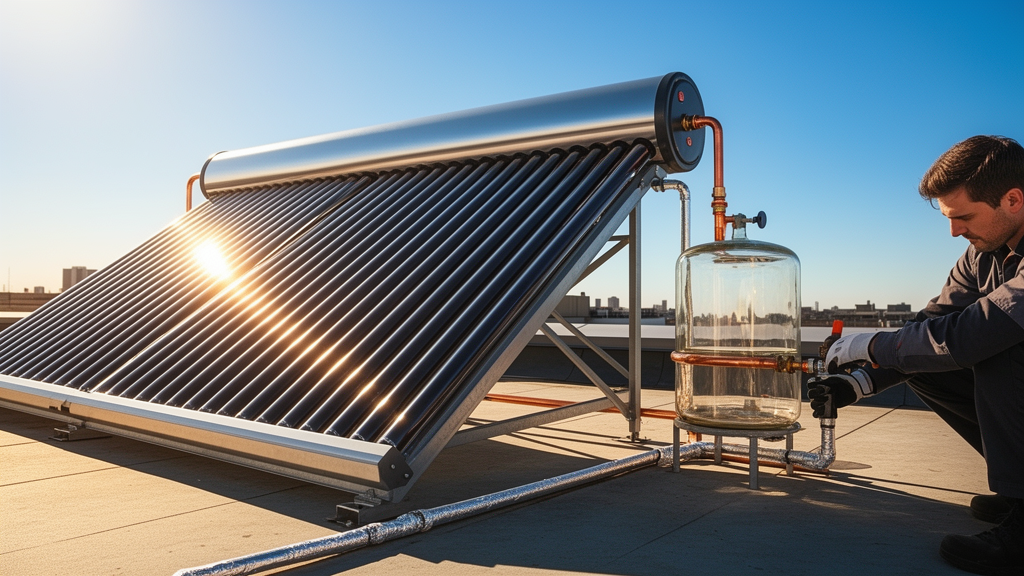
Engineers testing a flat-plate solar water heating system under real outdoor skies report that simply swapping water for a suspension of aluminium oxide nanoparticles pushed the collector’s peak thermal efficiency from 65.1% to 80.3%, an absolute gain of 15.2 percentage points. The best result came with the highest nanoparticle loading, 3 wt% Al2O3 in water, circulated at 20 kg per hour during the peak irradiance window between 14:00 and 15:00. Raising the nanoparticle concentration from 1 wt% to 3 wt% enhanced thermal conductivity by up to 4.4%, and useful energy gain at the optimal concentration rose 31.7% above the pure-water baseline under identical operating conditions.
The study, published as an open-access research article in Discover Energy on 26 September 2026, was carried out by Oluwaseyi O. Alabi, Oluwatoyin J. Gbadeyan and Oludolapo A. Olanrewaju. It stands out from much of the earlier nanofluid literature because every nanofluid case was benchmarked directly against pure water on matched test days, across three mass concentrations (1, 2 and 3 wt%) and four mass flow rates (5, 10, 15 and 20 kg/h), giving twelve concentration-flow combinations rather than the one or two points typical of previous work.
The working fluids were prepared by the two-step method. Weighed quantities of Al2O3 nanoparticles, averaging less than 50 nm in size, were dispersed in one litre of deionised water, stirred mechanically for an hour and then treated with a high-intensity ultrasonic probe for at least two hours to break up agglomerates. No surfactant was added, deliberately, because prior work cited by the authors shows that excess surfactant molecules form insulating layers around nanoparticles that impede heat transfer. Stability was checked quantitatively: zeta potentials of −30.5, −31.7 and −32.4 mV for the 1, 2 and 3 wt% fluids all sit at or beyond the ±30 mV threshold generally taken to indicate good electrostatic stability, and no significant sedimentation was seen over a 24-hour observation period.
The apparatus itself was a closed-loop, forced-circulation system built around a photovoltaic/thermal flat-plate collector. A multi-crystalline silicon PV panel, 130 by 70 cm, carried a 0.04 cm copper absorber sheet on its rear face, bonded to 8 metres of serpentine copper tubing per panel. The whole assembly was inclined at 13 degrees, lagged with rock wool to suppress parasitic heat exchange with the ambient air, and instrumented with calibrated T-type thermocouples, a coplanar pyranometer, and a gravimetrically calibrated rotameter. Data were logged every five minutes and averaged over 30-minute periods.
Weather control was unusually tight for an outdoor campaign. Eight test days between 12 and 23 May 2026, two per working fluid, all fell under clear skies. Mean solar irradiance ranged only from 875 ± 38 to 886 ± 33 W/m2 across the campaign, ambient temperature from 30.6 ± 1.2 to 31.1 ± 1.2 °C, and wind speed from 2.05 ± 0.21 to 2.16 ± 0.27 m/s. Storage-tank starting temperatures were held between 29.7 and 30.3 °C, and inter-day irradiance coefficients of variation stayed below 2%, which the authors say statistically validates comparing different concentrations across days. Combined expanded uncertainty of the thermal efficiency was estimated at ±3.8% at 95% confidence.
The diurnal physics behaved as expected. Outlet temperature and thermal efficiency climbed through the morning, peaked between 13:00 and 15:00 h as irradiance approached 920 ± 35 W/m2, and fell away toward evening. Efficiency rose consistently with flow rate, with 20 kg/h always best, a consequence of stronger convective heat removal from the absorber and smaller temperature gradients along the collector. Interestingly, the temperature difference across the collector itself shrank at peak sun, because the extra heat was distributed over a larger mass of circulating fluid. Thermal conductivity of the nanofluids, measured with a transient hot-wire KD2 Pro analyzer, increased almost linearly from 30 to 80 °C, which the authors attribute to intensified Brownian motion and micro-convection at higher temperature.
The most consequential result, however, is the diminishing return with concentration. Although 3 wt% delivered the highest thermal conductivity and the 80.3% peak efficiency, the incremental improvement from 2 wt% to 3 wt% was markedly smaller than the step from 1 wt% to 2 wt%. A Performance Evaluation Criterion, which weighs Nusselt-number enhancement against a friction-factor penalty, peaked at 1.14 for the 2 wt% fluid at 20 kg/h and slipped to 1.13 at 3 wt%, as rising viscosity and hydraulic resistance began to offset the conductivity gain. The authors identify 2 wt% as the practical optimum where thermal enhancement is maximised without disproportionate pumping penalties.
The hydraulic cost of the nanofluid turned out to be almost negligible in absolute terms. Because the expected collector pressure drops of 50–500 Pa fell below the resolution of the Bourdon gauge, they were computed analytically with the Darcy–Weisbach equation. Even at the most demanding condition, 3 wt% at 20 kg/h, pumping power was only 0.00254 W against a useful heat gain of 712.8 W; pumping-power ratios ranged from 0.000021% to 0.000356% of useful thermal output, and net useful energy gain stayed positive under every condition tested.
Because the collector was a photovoltaic/thermal unit, electrical performance was tracked simultaneously. Electrical efficiency improved from 14.36% with the 1 wt% nanofluid to 15.02% at 2 wt%, then dipped slightly to 14.88% at 3 wt%, mirroring the thermohydraulic trade-off: better heat removal lowers PV cell temperature, but beyond 2 wt% the viscosity penalty erodes the advantage. Exergy efficiency, a stricter measure of how much incident solar energy is converted into useful work potential, ran from roughly 2.0–2.2% at 09:00 to a maximum of 11.0–11.2% at 14:00 h before declining to about 7.2–7.8% by 16:00. A simple economic analysis gave the 2 wt% fluid an estimated annual saving of about US$14.25 and a payback period of roughly 1.4 years, against 2.7 years for the 3 wt% formulation.
The measured efficiencies also aligned well with published correlations and with prior experimental work, including a comparison against Srimanickam and colleagues’ Al2O3/water study that showed only minor deviations, supporting the reliability of the methodology. The authors caution that stability was verified only over short observation windows and recommend that future work examine long-term nanofluid behaviour under repeated thermal cycling, alongside fuller exergy and economic analysis at scale. Within those limits, the study offers concrete engineering guidance: for flat-plate solar water heaters in high-irradiance regions, an Al2O3/water nanofluid at 2–3 wt% circulated at 15–20 kg/h appears to be a technically viable route to materially higher solar thermal conversion, with the concentration chosen according to whether peak efficiency or payback matters more.
Subject of Research: Thermal performance of a flat-plate solar water heating system using Al2O3/water nanofluid under real outdoor conditions
Article Title: Experimental study of thermal performance of a solar water heating system using Al2O3/water nanofluid
Article References: Alabi, O. O., Gbadeyan, O. J., & Olanrewaju, O. A. (2026). Experimental study of thermal performance of a solar water heating system using Al2O3/water nanofluid. Discover Energy, 6(1), Article 71. https://doi.org/10.1007/s43937-026-00200-0
Image Credits: AI Generated
DOI: 10.1007/s43937-026-00200-0
Keywords: solar water heating, Al2O3 nanofluid, flat-plate collector, thermal efficiency, nanoparticles, mass flow rate, thermal conductivity, PVT collector, pumping power, exergy efficiency, outdoor experiment, Experimental
News Source: Denise Maddox. (October 29, 2026). Alumina Nanofluid Lifts Solar Water Heater Efficiency to 80.3% in Outdoor Tests. Scienmag.