• HOME
  • NEWS
  • EXPLORE
    • CAREER
      • Companies
      • Jobs
    • EVENTS
    • iGEM
      • News
      • Team
    • PHOTOS
    • VIDEO
    • WIKI
  • BLOG
  • COMMUNITY
    • FACEBOOK
    • INSTAGRAM
    • TWITTER
Sunday, June 28, 2026
BIOENGINEER.ORG
No Result
View All Result
  • Login
  • HOME
  • NEWS
  • EXPLORE
    • CAREER
      • Companies
      • Jobs
        • Lecturer
        • PhD Studentship
        • Postdoc
        • Research Assistant
    • EVENTS
    • iGEM
      • News
      • Team
    • PHOTOS
    • VIDEO
    • WIKI
  • BLOG
  • COMMUNITY
    • FACEBOOK
    • INSTAGRAM
    • TWITTER
  • HOME
  • NEWS
  • EXPLORE
    • CAREER
      • Companies
      • Jobs
        • Lecturer
        • PhD Studentship
        • Postdoc
        • Research Assistant
    • EVENTS
    • iGEM
      • News
      • Team
    • PHOTOS
    • VIDEO
    • WIKI
  • BLOG
  • COMMUNITY
    • FACEBOOK
    • INSTAGRAM
    • TWITTER
No Result
View All Result
Bioengineer.org
No Result
View All Result
Home NEWS Science News Biology

Decreased iron levels in seawater make mussels loosen their grip

Bioengineer by Bioengineer
July 29, 2020
in Biology
Reading Time: 3 mins read
0
IMAGE
Share on FacebookShare on TwitterShare on LinkedinShare on RedditShare on Telegram

IMAGE

Credit: Jonathan Wilker

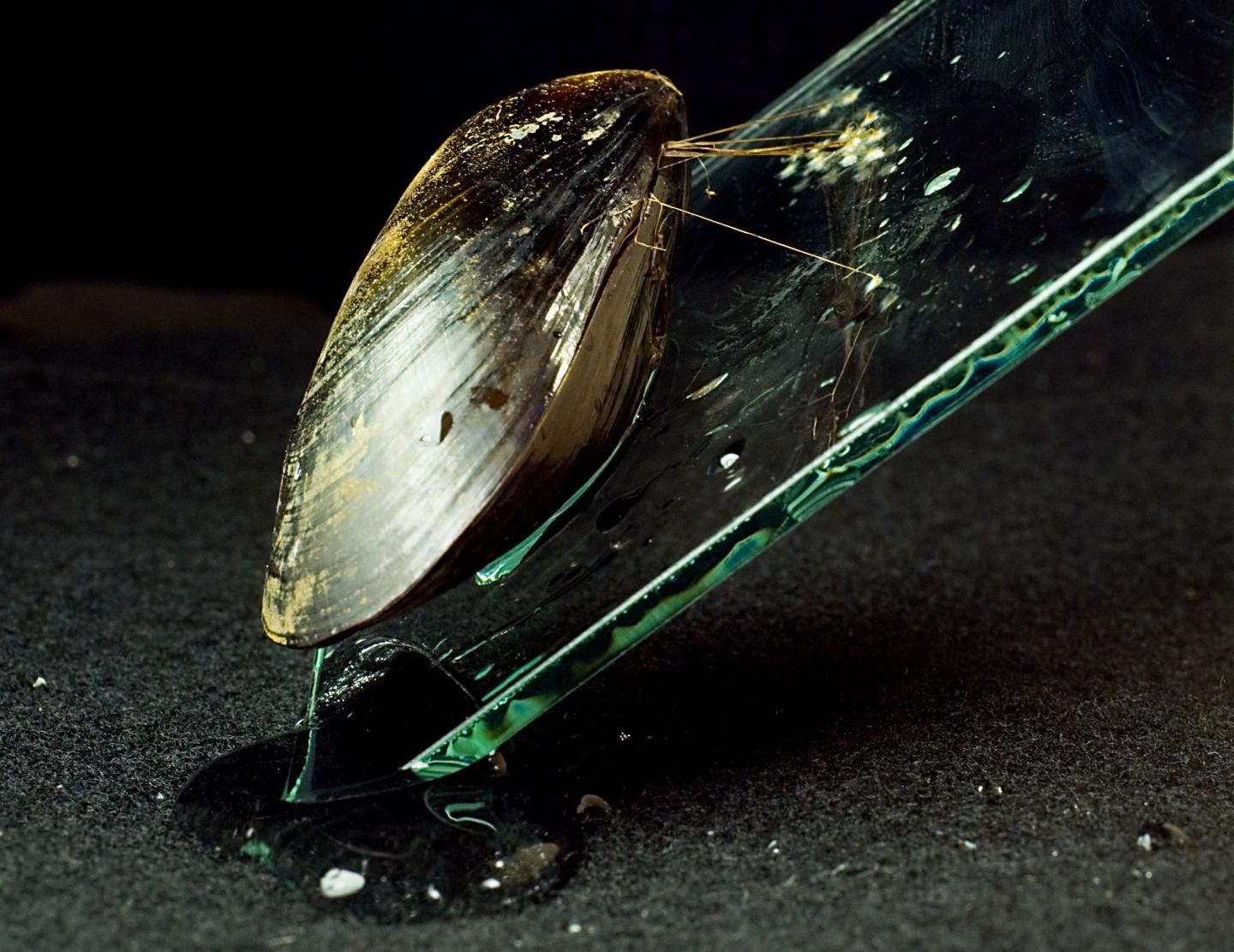
Mussels secrete sticky plaques that help them attach to wet surfaces, such as rocks on the beach. These adhesive structures are rich in iron, which is thought to help make the attachments strong yet flexible. Now, researchers reporting in Environmental Science & Technology have shown that mussels form weaker attachments in iron-deficient seawater, revealing a possible consequence of altered iron bioavailability in oceans.

As oceans become more acidic in a changing climate, iron dissolves and is less bioavailable to filter feeders, such as mussels, that strain iron particles from seawater. In mussels, iron helps cross-link proteins in the sticky plaques that attach to surfaces and adds mechanical toughness to the hair-like threads that link the plaque to the mollusk’s inner tissues. Jonathan Wilker and colleagues at Purdue University wondered how mussels’ ability to adhere to surfaces would be affected by changing iron levels in seawater.

To find out, the researchers cultured mussels in artificial seawater containing lower, normal and higher iron levels. The researchers grew the mussels in each water condition for three days, during which the creatures attached to aluminum plates. Then, the researchers cut off the threads near the shell and pulled upward on them, measuring the force needed to remove the plaque from the plate. As the concentration of iron in the water increased, so did the plaque’s stickiness, except for the highest iron level, at which adhesion slightly decreased. The team also observed that the plaques became smaller and darker as the iron concentration increased, and the porous microstructure of the plaques became more pronounced. This study is the first to examine how changing iron levels affect the performance of a biological material in a whole animal, the researchers say.

The authors acknowledge funding from the Office of Naval Research, the National Science Foundation and the Purdue Research Foundation.

###

The paper’s abstract will be available on July 29 at 8 a.m. Eastern time here: http://pubs.acs.org/doi/abs/10.1021/acs.est.0c02392

The American Chemical Society (ACS) is a nonprofit organization chartered by the U.S. Congress. ACS’ mission is to advance the broader chemistry enterprise and its practitioners for the benefit of Earth and its people. The Society is a global leader in providing access to chemistry-related information and research through its multiple research solutions, peer-reviewed journals, scientific conferences, eBooks and weekly news periodical Chemical & Engineering News. ACS journals are among the most cited, most trusted and most read within the scientific literature; however, ACS itself does not conduct chemical research. As a specialist in scientific information solutions (including SciFinder® and STN®), its CAS division powers global research, discovery and innovation. ACS’ main offices are in Washington, D.C., and Columbus, Ohio.

ACS encourages journalists to apply for press credentials for the ACS Fall 2020 Virtual Meeting & Expo by contacting [email protected].

To automatically receive news releases from the American Chemical Society, contact [email protected].

Follow us: Twitter | Facebook

Media Contact
Katie Cottingham
[email protected]
Tags: Chemistry/Physics/Materials SciencesClimate ChangeClimate ScienceMarine/Freshwater BiologyOceanographyZoology/Veterinary Science
Share13Tweet8Share2ShareShareShare2

Related Posts

Natural Hallucinogens: Evolution’s Ecological Tools, Not Mere Chemical Byproducts

June 25, 2026

This Famous Butterfly Revealed: Three Distinct Species Hidden in One

June 25, 2026

Scientists Attack Soybean Cyst Nematode by Starving Its Food Source

June 25, 2026

Decoding the Secret Code of a Crucial Immune Sensor

June 24, 2026
Please login to join discussion

POPULAR NEWS

  • Saying Goodbye to PGY-6: Pediatric Fellowship Realities

    103 shares
    Share 41 Tweet 26
  • Multi-Hospital Study Reveals Long Covid Burden Is Twice as High as Current Estimates

    92 shares
    Share 36 Tweet 23
  • Detection of EDCs in Breast Milk and Infant Urine Up to Six Months Highlights Early Exposure Risks

    77 shares
    Share 31 Tweet 19
  • New Drug Candidate Developed at McMaster Shows Potential for Treating Brain Cancer

    58 shares
    Share 23 Tweet 15

About

We bring you the latest biotechnology news from best research centers and universities around the world. Check our website.

Follow us

Recent News

Tracking Lanthanide-Labeled Microplastics in Plants

POSTECH Researchers Slash Cost of Reconstituted Cell-Free Systems by 95%

AI and Physics Collaborate to Design Advanced Hydrogen Storage Materials

Subscribe to Blog via Email

Success! An email was just sent to confirm your subscription. Please find the email now and click 'Confirm' to start subscribing.

Join 82 other subscribers
  • Contact Us

Bioengineer.org © Copyright 2023 All Rights Reserved.

Welcome Back!

Login to your account below

Forgotten Password?

Retrieve your password

Please enter your username or email address to reset your password.

Log In
No Result
View All Result
  • Homepages
    • Home Page 1
    • Home Page 2
  • News
  • National
  • Business
  • Health
  • Lifestyle
  • Science

Bioengineer.org © Copyright 2023 All Rights Reserved.