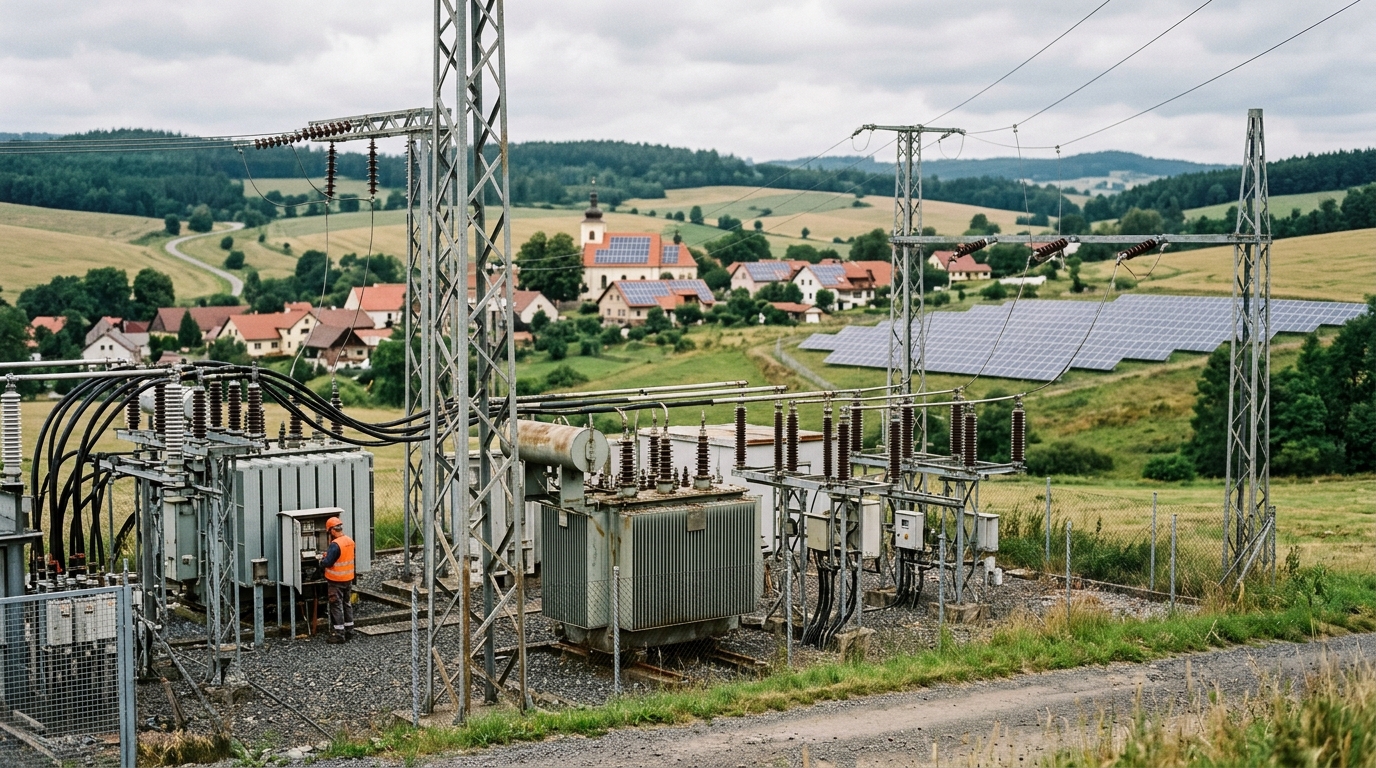
A new analysis of roughly 156,000 solar photovoltaic connection applications filed with the largest distribution company in the Czech Republic shows that the overwhelming majority of low-voltage solar projects were connected without any new grid investment, while a small, costly minority accounted for nearly all of the reinforcement spending. The study, published in Energy Reports by T. Králík and J. Berka, examined applications received by CEZ Distribuce between 2020 and 2024 and applied a cost-efficiency screening framework that converts the grid reinforcement triggered by each request into a single figure: euros of network investment per kilowatt of installed capacity.
The headline numbers are striking. Of the 1,493 megawatts of solar capacity approved at the low-voltage level, 1,393 megawatts, or 93 percent, required no additional project-specific reinforcement at the time of application. All grid-related investments for low-voltage solar connections during the period were tied to the remaining 100 megawatts, about 7 percent of connected capacity, and those investments amounted to roughly 323 million euros. Averaged across the entire low-voltage portfolio, that works out to about 216 euros per kilowatt, but when the same spending is divided only by the reinforcement-linked capacity, the figure rises to approximately 3,230 euros per kilowatt. The authors stress that the 216-euro figure is a capacity-weighted portfolio average whose denominator includes the 1,393 megawatts connected at zero marginal cost, so it should not be read as the cost intensity of the reinforcement-linked minority.
The zero-cost connections do not mean the network was free to build. The study notes that the necessary reinforcements had largely been implemented in earlier periods, when broader network development and asset renewal created hosting capacity that later absorbed new solar connections without immediate upgrades. This latent-capacity effect is not limited to photovoltaics; the authors point out that it also applies to the electrification of heating and transport, including electric-vehicle charging infrastructure. The finding illustrates how broadly targeted infrastructure investment, even when not designed for renewable integration, can inadvertently enable a substantial volume of decentralized generation at minimal incremental cost.
At the medium-voltage level, the picture is very different. CEZ Distribuce approved 7,571 megawatts of solar connections between 2020 and 2024, supported by about 263 million euros of investment measures, yielding an average specific connection cost of roughly 35 euros per kilowatt, nearly six times lower than the low-voltage average. A significant portion, 2,089 megawatts, was connected without any new investment, and a further 5,000 megawatts was connected through low-cost measures averaging just 3 euros per kilowatt, typically minor modifications such as replacing support structures with disconnectable variants. Only the remaining 571 megawatts required more substantial, capital-intensive investment.
Costs were also rising over time. The capacity-weighted average specific connection cost at the low-voltage level climbed from 114 euros per kilowatt in 2022 to 195 euros per kilowatt in 2023 and 216 euros per kilowatt in 2024. At the medium-voltage level, the indicator remained stable until 2023 and then jumped by nearly 50 percent in 2024. The authors interpret these trends as consistent with the hypothesis that readily available grid capacity is gradually being depleted as more projects connect, but they are careful not to claim causation: the dataset contains no time-resolved measure of hosting capacity at each location, so the increases could equally reflect changes in project mix, project size, or locational selection. The temporal patterns are therefore reported as descriptive observations, with capacity depletion treated as a plausible hypothesis rather than a demonstrated driver.
To turn these observations into a decision tool, the researchers built a screening metric around the levelized cost of electricity. The method compares the levelized cost of a proposed solar project with a reference benchmark price representing the cost of marginal dispatchable generation, and converts the resulting margin into a maximum admissible reinforcement cost in euros per kilowatt. In the reference case, which assumes a benchmark of 150 euros per megawatt-hour, a 20-year project lifetime, 1,000 full-load hours per year, a 6 percent discount rate, and solar investment costs of 800 euros per kilowatt at medium voltage and 1,600 euros per kilowatt at low voltage, the calculated thresholds come out at approximately 920 euros per kilowatt for medium-voltage connections and only 120 euros per kilowatt for low-voltage ones. The authors emphasize that these are scenario-specific screening points, not fixed capacity limits, and that the benchmark value of 150 euros per megawatt-hour is not a forecast of future prices.
Sensitivity analysis shows how fragile the low-voltage threshold is. Varying the benchmark between 100 and 200 euros per megawatt-hour, full-load hours between 900 and 1,100, project lifetime between 20 and 30 years, the discount rate between 4 and 8 percent, and solar capital costs by plus or minus 25 percent, the medium-voltage threshold remained positive under every variation, ranging from 347 to 1,494 euros per kilowatt. The low-voltage threshold, by contrast, fell to zero under adverse assumptions and reached only about 694 euros per kilowatt in the most favorable case tested. Under the reference and adverse assumptions, low-voltage reinforcement therefore has substantially less economic headroom than medium-voltage reinforcement, although the classification of any individual request remains scenario- and installation-specific.
A supplementary request-level extract of 150,713 low-voltage applications confirms that the screening metric operates at the level of individual requests, not just in aggregate. In that extract, 4,607 applications, or 3.1 percent, carried non-zero project-specific reinforcement costs, while 146,106 applications, or 96.9 percent, had zero marginal reinforcement cost. Among the reinforcement-linked cases, the cost distribution is strongly right-skewed: the median is about 1,904 euros per kilowatt, while the mean is about 5,458 euros per kilowatt, indicating that a small upper tail of very expensive cases pulls the average upward. At the reference threshold of 120 euros per kilowatt, which lies between the 10th percentile of 82 euros and the 25th percentile of 375 euros among reinforcement-linked applications, roughly 75 to 90 percent of those applications would be flagged for further assessment, corresponding to about 2.3 to 2.8 percent of all applications in the extract.
The study also examines who pays. Direct applicant contributions covered just 2.4 percent of recorded low-voltage project-specific reinforcement expenditure in 2022, 2.1 percent in 2023, and 2.0 percent in 2024, with the remaining roughly 97.9 percent entering the general regulated cost-recovery framework. The authors caution that this should not be read as a net subsidy of the same magnitude from non-solar to solar customers, because solar owners continue to contribute through fixed capacity-related charges, and quantifying a lifetime net transfer would require customer-level data the study does not have. A supplementary locational analysis adds a distributional dimension: villages accounted for 58.8 percent of reinforcement-linked low-voltage capacity and 61.8 percent of reinforcement capital expenditure, compared with 51.3 percent of capacity connected without reinforcement, and about 7.6 percent of requested village capacity was linked to reinforcement, versus 5.5 percent in small towns and 6.6 percent in larger towns. The authors describe this as a measurable but limited rural exposure that would make an unqualified rejection rule harder to defend, and they tie any screening mechanism to the principle of non-discriminatory network access under EU Directive 2019/944.
The framework comes with explicit limits. It evaluates only conventional reinforcement capital expenditure and does not quantify non-wire alternatives such as curtailment, flexible connection agreements, demand-side flexibility, or local storage. The capacity-proportional allocation of shared reinforcement costs is an accounting approximation that may over- or under-allocate costs between requests tied to the same project. The results come from a single distribution operator under one national regulatory regime, so external validation by other network companies is needed before generalizing. Under current Czech and EU law, economic inefficiency is not an independent ground for rejecting a technically admissible connection, so the proposed screening is presented as evidence for a possible future legislative or regulatory change rather than a power DSOs hold today. The authors also highlight the option value of reinforcement: a single measure often creates additional hosting capacity for later applicants, illustrated by a stylized case in which reinforcing a 500-meter low-voltage line for a 10-kilowatt request could enable roughly 20 to 40 kilowatts of additional generation capacity and about 60 kilowatts for consumption, an illustrative ratio of about 1:4 that depends on local network conditions and should not be treated as universal. Their recommendation is that a high cost figure should first trigger assessment of deferral, zero-export or limited-export connection, staged connection, or planned reinforcement, with rejection only as a last resort, and that any such mechanism be established through legislation and regulator-approved, publicly available rules.
Subject of Research: Cost-efficiency screening of solar power grid connection requests in Czech distribution networks
Article Title: Cost-efficiency screening of renewable energy connections in distribution networks: Evidence from a Czech DSO
Article References: Králík, T., & Berka, J. (2026). Cost-efficiency screening of renewable energy connections in distribution networks: Evidence from a Czech DSO. Energy Reports, 16, Article 109798. https://doi.org/10.1016/j.egyr.2026.109798
Image Credits: AI Generated
DOI: 10.1016/j.egyr.2026.109798
Keywords: solar power, distribution networks, grid reinforcement, connection costs, photovoltaics, Czech Republic, levelized cost of electricity, DSO, low voltage, medium voltage, energy transition, cost allocation
News Source: Denise Maddox. (November 5, 2026). Czech grid data reveal a small share of solar connections drives most reinforcement costs. Scienmag.