A conventional cytogenetic study of 30 captive Quasipaa spinosa frogs from one farm in Hunan Province, China, found a diploid chromosome number of 2n = 26 in both sexes. The sampled animals had nine pairs of metacentric chromosomes and four pairs of submetacentric chromosomes, with no heteromorphic chromosomes or secondary constrictions observed.
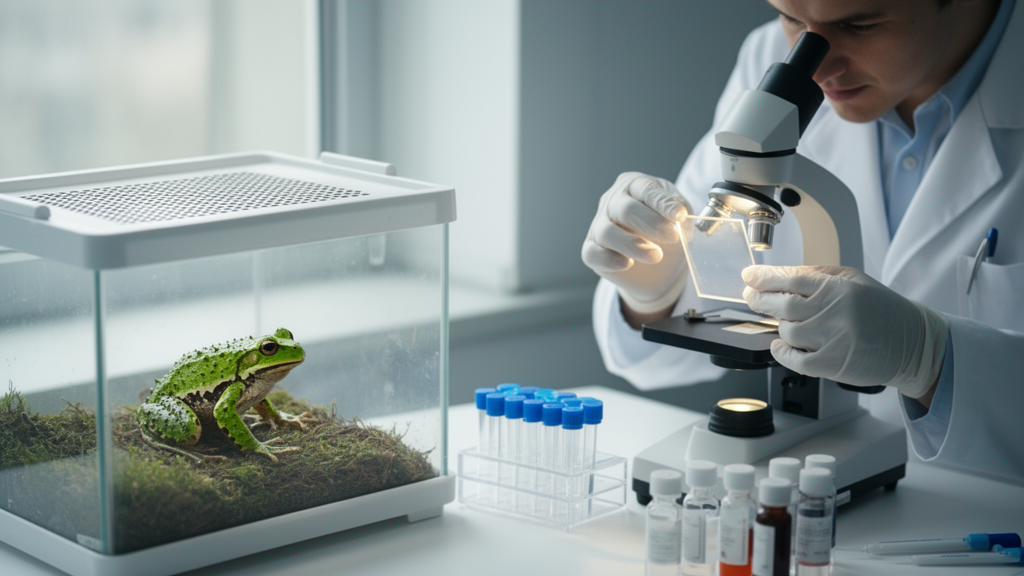
The animals comprised 15 healthy adult males and 15 healthy adult females, each weighing 90–100 g. They were obtained from a farm in Taiping Town, Shimen County, Hunan Province, at 29°58′42″N, 111°05′25″E. The protocol followed the ethics guidelines of the Animal Protection Committee of Hunan Agricultural University under licence LSK 202-3-D106. The investigators used bone-marrow preparations for chromosome counting, Giemsa staining and C-banding, and blood cultures to examine chromosome replication timing.
For the bone-marrow analysis, the animals received an intraperitoneal injection of 10 μg/g colchicine and were allowed to rest for four hours. They were then anaesthetized with 0.05% MS-222, and marrow was collected from the thighs. The harvested marrow was treated with 0.34% KCl at low osmolality for one hour and fixed in two changes of Carnoy’s solution. Cell suspensions were placed on slides, which underwent standard Giemsa staining and C-banding. Investigators captured 180 images with an Olympus BX5 digital camera and selected 20 clear images for chromosome analysis. Chromosomes were classified as metacentric or submetacentric according to the criteria of Green and Sessions.
The resulting karyotype was designated 4sm+9m. Chromosome pairs 2, 4, 8 and 10 were submetacentric, while the other nine pairs were metacentric. Relative lengths for the 13 chromosome pairs ranged from 15.38 ± 0.84 for chromosome 1 to 2.96 ± 0.85 for chromosome 13. Arm ratios ranged from 1.06 ± 0.03 for chromosome 12 to 2.39 ± 0.10 for chromosome 4.
Most chromosomes displayed C-banding positivity restricted to centromeric regions, with chromosomes 1–5 showing the strongest positivity. For the replication-banding component, blood was collected from the heart under anaesthesia and inoculated into human peripheral blood lymphoid medium at a ratio of 0.2 ml of blood per 5 ml of culture medium. Cultures were incubated for 90 hours at 28 °C in darkness. Bromodeoxyuridine, or BrdU, was added at 100 μg/ml nine hours before the end of incubation; fluorodeoxyuridine was added at 40 μg/ml for six hours; colchicine was added to a final concentration of 0.03 μg/ml for two hours; and acridine orange was added at 10 μg/ml one hour before harvesting.
After drying, the slides were soaked in 2×SSC solution at 40 °C, exposed to ultraviolet light from 8 cm away for 45 minutes and stained with 10% Giemsa at pH 6.8 for 15 minutes. The BrdU analysis distinguished early-, middle- and late-replication stages. During early replication, the investigators observed an approximately 1:1 ratio of dark-stained early-replicated bands and light-stained late-replicated bands. Dark-stained regions predominated in the middle stage, and chromosomes were almost entirely dark-stained in the late stage.
Replication timing across all 13 chromosomes ranged from very early to late phases. Male frogs showed stronger early replication bands than females, particularly in chromosomes 1–10. Females had weaker but more uniformly distributed bands, which intensified into larger blocks as replication progressed. The late-replication banding patterns suggested that neither sex exhibited heterozygosity. The investigators also reported that asynchronous replication was not observed during the late phase.
The Hunan karyotype was consistent with the findings of Long et al., who also reported nine metacentric and four submetacentric pairs. Earlier studies described different formulas for populations sampled elsewhere: Zheng and Hong reported 6sm+7m in Fujian, while Li and Wang reported 3sm+10m in Anhui. Those reports document variation among previously studied populations, but the present study sampled only one Hunan farm and did not directly test a population-wide geographic pattern. Comparisons with 33 populations of Quasipaa boulengeri in Sichuan likewise came from earlier research rather than from this experiment.
This animal-cell cytogenetic study provides chromosome-level information for the sampled Hunan frogs, including the 2n = 26 count, the 4sm+9m structure, centromeric C-banding in most chromosomes and three observed stages of BrdU-labelled replication in both sexes. Its scope does not establish chromosome patterns throughout the species’ natural range, and the results should not be interpreted as direct evidence of population decline, geographic differentiation or conservation status.
Subject of Research: Conventional cytogenetic analysis of Quasipaa spinosa from a Hunan farm
Article Title: Karyotype analysis of Quasipaa spinosa David, 1875 ( Anura , Dicroglossidae ) with conventional cytogenetic techniques
Article References: Zhang, L., Xiang, J., Li, J., Zhou, J., Hou, J., Huang, Y., & Li, H. (2024). Karyotype analysis of Quasipaa spinosa David, 1875 (Anura, Dicroglossidae) with conventional cytogenetic techniques. Comparative Cytogenetics, 18, 97-103. https://doi.org/10.3897/compcytogen.18.116806
Image Credits: AI Generated
DOI: 10.3897/compcytogen.18.116806
Keywords: Quasipaa spinosa, karyotype analysis, cytogenetics, chromosome number, metacentric chromosomes, submetacentric chromosomes, C-banding, BrdU replication banding, amphibian genetics, Karyotype, analysis, Quasipaa
News Source: Alan Morgan. (October 20, 2026). Cytogenetic study of 30 Hunan farm frogs finds 26 chromosomes and four submetacentric pairs. Scienmag.