Automated power injectors used in computed tomography (CT) do not always deliver the contrast volumes that radiologists prescribe, according to a bench study published in European Radiology Experimental. In a series of laboratory tests replicating seven clinical injection protocols, both a piston-driven injector and a peristaltic injector delivered excess iodinated contrast media, while saline flush volumes showed considerable variability with a tendency toward under-delivery. The piston-based system, in particular, deviated far more from its prescriptions than the peristaltic system, with contrast volume errors reaching 40 percent on the smallest pediatric protocol.
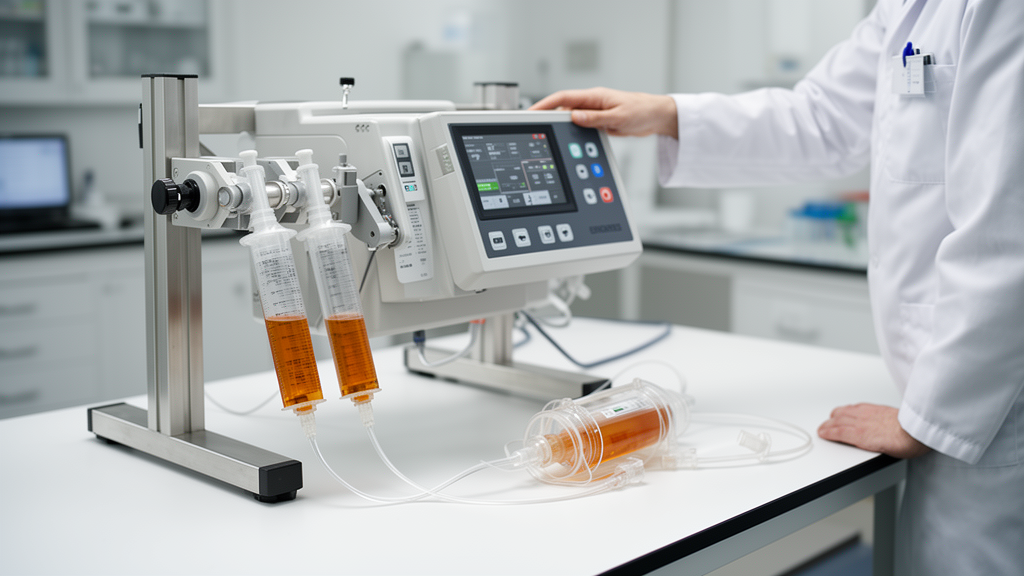
The study, conducted by researchers including Zahra Alyani Nezhad and Timothy P. Szczykutowicz, set out to quantify how accurately two major categories of CT power injectors deliver iodinated contrast media and saline flush volumes under clinically established protocols. Automated injectors have been standard in clinical practice for decades because iodinated contrast at high concentrations is too viscous to inject manually at clinical flow rates. Piston injectors push contrast from a syringe via a mechanical piston, while peristaltic injectors use rollers to advance contrast through tubing. Because contrast volume, saline volume, and flow rate are all directly controlled by the injector’s settings, the accuracy of these devices matters directly to image enhancement and patient contrast exposure.
Seven clinical injection protocols, ranging from pediatric to bariatric indications, were tested. These protocols incorporated varying flow rates of 2, 3, 5, and 6 mL/s, contrast volumes, saline volumes, and dilution ratios. Identical prescriptions were programmed into a piston-based MEDRAD Stellant CT Injection System and a peristaltic-based Ulrich CT motion Injector. Six replicate injections were prepared for each protocol on each device, with the injections performed into vials rather than through a catheter or simulated tissue.
The measurement approach relied on quantitative CT. The team first prepared iodine-saline calibration standards with known concentrations between 5 and 20 mg iodine per mL, based on typical clinical iodine concentrations, using iohexol 350 as the stock contrast agent. These standards were scanned on a Discovery HD750 multi-slice CT scanner at 120 kV, producing a calibration curve relating CT number, measured in Hounsfield units, to iodine concentration. The relationship was strongly linear, with a coefficient of determination of 0.997. Because the iodine concentrations resulting from the actual injections would have exceeded the scanner’s reconstructable range of 3,071 HU, each collected mixture was diluted to a clinically relevant target of 10 mg iodine per mL before analysis.
For each injection, the delivered fluid, including the saline line-integrity test bolus that is part of routine device setup, was collected, combined, stirred to homogeneity, and scanned. CT numbers of the mixtures were converted to iodine concentrations via the calibration curve, from which delivered contrast and saline volumes were back-calculated. Percent errors between expected and measured volumes were then determined, and Wilcoxon signed-rank tests assessed whether delivered volumes differed significantly from prescriptions. The researchers also constructed an uncertainty budget covering graduated cylinder reading error, pipetting error, residual beaker volume, and dilution uncertainty; these experimental errors proved negligible relative to the inverse prediction intervals from the calibration model, which dominated the final reported uncertainty.
The results revealed a clear asymmetry between the two injector types. For the peristaltic-based injector, contrast volume errors ranged from 4.0 to 10.0 percent, and saline flush errors from 0.6 to 9.2 percent. For the piston-based injector, contrast volume errors ranged from 9.9 to 40.0 percent, and saline flush errors from 1.5 to 50.2 percent. The largest peristaltic contrast error occurred with the Adult 70 mL protocol, where an excess of 6.90 mL was injected, while its most accurate injection was the Pediatric 3 mL protocol, with an excess of just 0.12 mL, or 4.0 percent. The piston injector showed the opposite pattern: its worst error was on the Pediatric 3 mL protocol, where an excess of 1.20 mL amounted to a 40.0 percent bias, and its best was the Adult 70 mL protocol, with an additional 6.96 mL corresponding to a 9.9 percent bias.
Saline flush performance told a similar story of variability. On the peristaltic injector, the largest flush error appeared in the Adult 170 mL protocol, a deficit of 4.60 mL or 9.2 percent, while the most accurate flush was in the Ped 12 mL protocol, an excess of 0.32 mL or 0.6 percent. On the piston injector, the Adult 170 mL protocol showed a deficit of 25.10 mL, a striking 50.2 percent bias, while the Ped 3 mL protocol came closest with a deficit of 0.74 mL or 1.5 percent. Wilcoxon signed-rank tests found significant differences between injected and expected volumes across most protocols, with p-values of 0.031 and 0.035, except for peristaltic saline flush in the Ped 12 mL, Adult 170 mL, and High Flow protocols, which did not reach significance.
The authors place their findings in the context of earlier work. A previous study by Chaya and colleagues evaluated the same injector models and found that the piston-based system achieved higher maximum and steady-state flow rates. Yet in the present experiments, despite that superior flow rate consistency, the piston injector delivered contrast less accurately than the peristaltic injector. The team also compared their results with work by McDermott and colleagues, who reported volume accuracy errors of up to about negative 2.5 percent for piston injectors and roughly 1 percent for peristaltic injectors, and who found piston injectors produced higher peak vascular enhancement. In the current study, both injectors delivered slightly higher contrast volumes than expected, a difference the authors attribute to variations in experimental methods and the broader range of pediatric and adult protocols tested. They also note that even at the highest flow rate of 6 mL/s, the iodine delivery rate in their high-flow protocol was 2.1 gI/s, within the achievable range reported for both devices, so iodine delivery rate limitation is not expected to explain their results.
The clinical implications could be meaningful. Drawing on a published relationship between contrast volume and hepatic enhancement, the authors estimate that a 16.8 percent bias in contrast volume with a piston-based adult 170 mL protocol corresponds to roughly a 15 percent change in enhancement magnitude. Because injection-related volume errors may go unrecognized in practice, imaging sites may empirically adjust their contrast protocols over time to compensate. When such optimized protocols are shared across institutions or applied after an injector is replaced, different systematic delivery errors could yield different enhancement outcomes. The authors also caution that although some peristaltic saline flush differences were not statistically significant, the magnitude and variability of the errors could still have clinical impact, and that the study may have been underpowered, with only six replicates per protocol, to detect meaningful differences.
Important limitations frame these conclusions. The experiments used a beaker setup without a catheter or human tissue simulation, and an inappropriate catheter size in clinical practice could restrict achievable flow rates and potentially worsen deviations. Only a limited set of commonly used protocols was evaluated, only a single unit of each injector type was tested, meaning the observed differences may reflect device wear, calibration, or manufacturing variability rather than inherent design differences, and the work was performed with room-temperature contrast, whereas some clinical scanners use contrast warmers. The findings should therefore be interpreted as comparisons between the tested units rather than definitive comparisons between injector categories. Even so, the authors conclude that both injectors delivered excess contrast while saline flush volumes showed variability, and they recommend routine performance verification across clinically relevant injection settings to ensure accurate and reliable contrast delivery, noting that unrecognized variability may affect enhancement consistency, contrast exposure, and diagnostic reliability.
Subject of Research: Accuracy of iodinated contrast and saline delivery by piston-driven and peristaltic CT power injectors measured in an in vitro bench study
Article Title: Accuracy of iodinated contrast and saline delivery using a piston-driven and a peristaltic power injector in CT—an in vitro study
Article References: Alyani Nezhad, Z., Salyapongse, A. M., Goetsch, C. J., Bladorn, R. M., Bartels, C. M., Schluter, K. L., Wagner, M. G., Toia, G. V., & Szczykutowicz, T. P. (2026). Accuracy of iodinated contrast and saline delivery using a piston-driven and a peristaltic power injector in CT—an in vitro study. European Radiology Experimental, 10(1), Article 143. https://doi.org/10.1186/s41747-026-00785-0
Image Credits: AI Generated
DOI: 10.1186/s41747-026-00785-0
Keywords: CT, power injectors, iodinated contrast media, saline flush, piston injector, peristaltic injector, in vitro study, contrast delivery accuracy, radiology, performance verification, Hounsfield units, contrast enhancement
News Source: Ophelia Keating. (October 30, 2026). CT Power Injectors Deliver More Contrast Than Prescribed in Bench Test. Scienmag.