For nearly four decades, one of the strangest quirks in molecular biology has remained stubbornly out of reach: the way a family of single-celled parasites, responsible for some of the world’s most devastating tropical diseases, processes their genetic instructions in a manner unlike almost any other organism on Earth. Now a collaboration between the University of Liège and Rockefeller University has captured the elusive machinery in action, revealing its three-dimensional structure at near-atomic precision and, in doing so, solving a long-standing puzzle in the biology of trypanosomatid parasites. The findings, published in Nature Communications, document for the first time how the so-called trans-spliceosome, a gigantic molecular assembly essential to parasite survival, organizes its components to carry out a reaction that these organisms cannot live without.
Trypanosomatids are a group of flagellated parasites with an outsized impact on human, animal and plant health. In humans, they are the causative agents of leishmaniasis, sleeping sickness (human African trypanosomiasis) and Chagas’ disease, a trio of neglected tropical diseases that together affect several million people worldwide. The diseases are burdensome not only because of their prevalence but because the available treatments are limited: existing drugs suffer from restricted efficacy, significant toxicity, or the steady emergence of resistance, leaving clinicians with few reliable options for the hardest-to-treat cases. The problem radiates well beyond the clinic. Other trypanosomatid species infect livestock, generating major economic losses in affected regions, while plant-infecting members of the group significantly reduce agricultural yields, threatening food security where they are endemic.
To understand why the new study matters, it helps to revisit how gene expression normally works. In the cells of humans and most other eukaryotes, genetic information stored in DNA is first copied into RNA, a working draft that must be processed before it can serve as the blueprint for building proteins. One of the essential processing steps is RNA splicing, during which non-coding sequences called introns are recognized and excised from the precursor RNA, leaving a mature messenger RNA ready to be translated into protein. This job is carried out by the spliceosome, a massive and dynamic ribonucleoprotein machine composed of small nuclear RNAs and dozens of associated proteins that has been studied intensively for decades.
Trypanosomatids play by a radically different set of rules. As Arnaud Vanden Broeck, a biologist who heads the Laboratory of RNA Structural Biology and Biochemistry at the University of Liège, explains, these organisms rely on a specialized process known as Spliced Leader (SL) RNA trans-splicing. Conventional intron splicing, ubiquitous in most eukaryotes, is extremely rare in trypanosomatids. Instead, virtually every messenger RNA in the parasite receives an identical short RNA sequence, the SL RNA, at its 5′ end. This common cap-like addition is indispensable: without it, the parasites’ messenger RNAs never reach their mature, functional form, and the cells cannot operate. The reaction therefore sits at a choke point in the parasite’s entire gene expression program.
Two features elevate this mechanism from a biological curiosity to one of the most compelling drug targets in parasitology. First, it is absolutely essential for the parasite’s survival; any molecule that reliably blocks the reaction should be lethal to the organism. Second, and crucially, the process does not exist in this form in human cells. A therapy aimed at the trans-splicing machinery could, in principle, neutralize the parasite while leaving the patient’s own cellular machinery untouched, a selectivity window that few current antiparasitic strategies can offer.
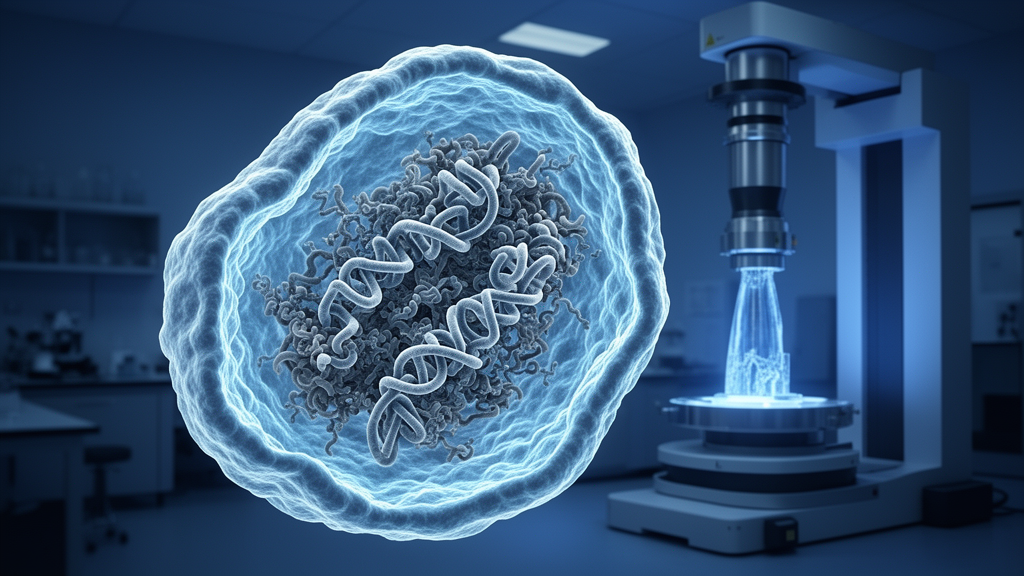
Despite the mechanism’s discovery nearly forty years ago, the physical machine that performs it, the trans-spliceosome, has remained largely a black box. Researchers knew what went in and what came out, but they did not know precisely how the various components were organized or how they cooperated to execute the chemical reaction. Capturing that level of detail requires seeing the machine in action, and the Liège-Rockefeller team turned to cryogenic electron microscopy (cryo-EM) to do it. In cryo-EM, samples are frozen so rapidly that water molecules solidify without forming damaging ice crystals, preserving molecules in near-native states. Hundreds of thousands of two-dimensional images of these frozen particles are then computationally reconstructed into high-resolution three-dimensional maps, allowing researchers to see molecular architecture directly rather than inferring it from indirect biochemical evidence.
Using this approach, the scientists succeeded in capturing two successive stages of the machine’s activity. The first structure shows the moment when the SL RNA is attached to the messenger RNA, the catalytic event at the heart of trans-splicing. The second captures the state immediately afterwards, once the reaction is complete. Together, these snapshots constitute a molecular movie of the reaction’s decisive phase, and they resolve, with unprecedented precision, the organization of the trans-spliceosome’s core, the way the participating RNAs are positioned relative to one another during the reaction, and the contributions of several proteins that are unique to trypanosomatids and absent from humans. The Article reporting the work is titled “Structural basis of step II spliced leader RNA trans-splicing in trypanosomatid parasites.”
The structures carry an evolutionary message as well as a practical one. While the trans-spliceosome shares some similarities with the conventional spliceosome found in human cells, it displays numerous distinctive adaptations that set it apart. The findings indicate that this very ancient molecular machine has been profoundly remodelled over evolutionary time to perform a different function, offering a window into how splicing machinery diversified across eukaryotic life. For evolutionary biologists, the trypanosomatid system thus serves as a living record of how nature repurposes old molecular tools for new jobs, a question that has animated comparative genomics and structural biology alike.
The near-atomic resolution achieved in the study also marks the end of a long pursuit. Determining the architecture of the trans-spliceosome has been a goal of the scientific community for decades, hindered by the technical challenges of isolating and freezing such a large, transient and dynamic complex. Achieving it required not only advances in cryo-EM hardware and image-processing algorithms but also careful biochemical preparation to trap the machine in specific functional states, the molecular equivalent of freezing a dancer mid-step and reconstructing the choreography from the resulting pose.
The therapeutic implications are the most immediately striking consequence of the work. Beyond advancing fundamental understanding of the evolution of life, as Vanden Broeck notes, the structures provide a concrete basis for rational drug design: with the machine’s atomic architecture in hand, researchers can begin designing molecules capable of specifically disrupting the trans-spliceosome in parasites while sparing human cells. In an era when sleeping sickness, Chagas’ disease and leishmaniasis remain difficult to treat and resistance continues to erode the usefulness of existing drugs, a structure-guided attack on a parasite-essential, human-absent molecular machine represents exactly the kind of encouraging avenue the field has been waiting for. What began as a forty-year-old mystery has now been converted into a blueprint.
Subject of Research: Near-atomic cryo-EM structure of the trans-spliceosome in trypanosomatid parasites
Article Title: Researchers reveal snapshots of a key molecular machine in tropical parasites
Article References: Researchers reveal snapshots of a key molecular machine in tropical parasites. (n.d.). Original publication
Image Credits: AI Generated
DOI: Not provided
Keywords: trypanosomatids, trans-splicing, spliced leader RNA, spliceosome, cryo-EM, sleeping sickness, Chagas disease, leishmaniasis, RNA processing, parasitology, drug targets, molecular biology
News Source: Drew Townsend. (October 15, 2026). Cryo-EM snapshots expose the molecular machine that keeps deadly tropical parasites alive. Scienmag.