Plant-based milks have conquered supermarket shelves, but many of them hide a nutritional weakness: they are low in protein and contain virtually none of the long-chain omega-3 fatty acids EPA and DHA that our cardiovascular systems, brains, and immune cells depend on. Now, a team of researchers from Paraguay and Argentina reports a way to fix both problems at once, using macadamia nuts as the base and a clever bit of edible-materials engineering to smuggle in two of the most fragile ingredients in food science — live probiotic bacteria and fish-derived omega-3s.
The study, published in Frontiers in Industrial Microbiology by Sandra Álvarez of the Universidad Nacional de Asunción, Victoria Florencia Alcolea Ersinger and Daniela Lorena Lamas of Argentina’s National Institute of Fisheries Research and Development (INIDEP), describes a functional beverage made from Macadamia integrifolia nuts and fortified with omega-3 fatty acids and the probiotic Lactiplantibacillus plantarum. The key innovation is an alginate-based encapsulation system: both the oil and the bacteria are wrapped in microscopic-to-millimetric calcium-alginate matrices that shield them from heat, oxygen, acid, and the preservative that keeps the drink shelf-stable.
The rationale begins with the nut itself. Proximate analysis of the macadamia kernels (cultivar HAES 344) showed a lipid content of about 69.6 percent, a protein content of 8.0 percent, and dietary fiber of 4.3 percent. Roughly seventy percent of the fatty acids were monounsaturated, dominated by oleic and palmitoleic acid — a profile linked to cardiovascular benefits. What the nuts conspicuously lack is EPA and DHA, the long-chain omega-3 polyunsaturated fatty acids found in marine oils. Notably, macadamia proteins are rich in arginine and carry a low lysine-to-arginine ratio, a combination that earlier studies have associated with favorable lipid metabolism.
To close that omega-3 gap, the researchers turned to a sustainable source: refined cod liver oil obtained from fish by-products, containing 9.56 percent EPA and 29.13 percent DHA. Before encapsulation, the oil was rigorously characterized against international standards. Its peroxide value of 4.50 meq O2/kg and p-anisidine value of 8.88 both fell within Codex Alimentarius limits, yielding a total oxidation (TOTOX) index of 17.88 — comfortably below the voluntary GOED guideline of 26. That baseline freshness matters enormously, because early volatile aldehydes in oxidized fish oil would taint a mild, subtly flavored nut milk with fishy off-notes before encapsulation ever had a chance to protect it.
The encapsulation process itself is elegantly simple, which is precisely what makes it industrially attractive. Sodium alginate, a gel-forming polysaccharide extracted from brown seaweed, was hydrated overnight and emulsified with the fish oil at a 1:3 oil-to-continuous-phase ratio using a high-shear homogenizer. Dropping this emulsion into a 0.1 M calcium chloride solution triggered ionic cross-linking, instantly gelling each droplet into a bead. After drying at 30 °C, the beads measured roughly 3 millimeters in diameter with a sphericity index of 0.97 — essentially perfect spheres — and retained 93.4 percent of their oil load. The probiotic cells were encapsulated similarly, using a pre-emulsion of xanthan gum and sodium alginate dripped into calcium chloride.
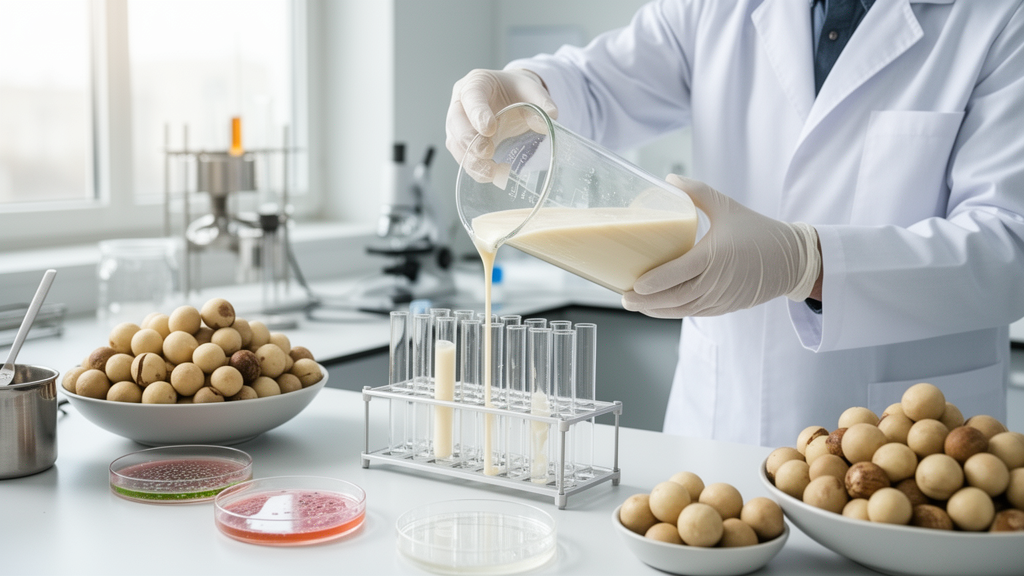
The beverage production line followed a scalable, kitchen-to-pilot workflow: soaking the nuts for three or four hours, thermal treatment at 90 °C to kill microbes and deactivate lipid-degrading enzymes, wet grinding, filtration, addition of carboxymethylcellulose as a stabilizer, stevia and chocolate flavoring for palatability, pasteurization, and homogenization. Two nut-to-water ratios were tested, and the 1:4 ratio clearly won, delivering about 66 milliliters of extract per 100 grams of nuts compared with roughly 50 milliliters at 1:2 — a difference attributed to deeper hydration and softening of the nut matrix. Crucially, the probiotic capsules and omega-3 ingredients were added only after pasteurization and cooling, sparing them from thermal damage.
The numbers that emerged are striking. Crude protein in the final beverages reached 2.12 to 3.18 percent, essentially matching commercial cow’s milk (2.90 percent) and dwarfing the analyzed almond beverage’s meager 0.48 percent. A single 240-milliliter serving delivered 425 milligrams of EPA plus DHA in the emulsified version and 446 milligrams in the encapsulated version — approximately 85 to 89 percent of the minimum recommended daily intake. Meanwhile, the drink stayed lean: despite the nuts’ high fat content, total lipids in the finished beverage hovered around 1 percent, and energy content came to about 60 kilocalories per glass, versus 91 for cow’s milk and 31 for almond milk.
The probiotic results may be the most impressive part. Simulated gastric challenge tests showed the encapsulated L. plantarum thriving at pH 3 and 4 for four hours, with viable counts above 10^8 CFU per milliliter — only the brutal pH 2 condition proved lethal. The strain also survived bile salt concentrations from 0.1 to 0.6 percent, tolerating the 0.3 percent threshold considered critical in probiotic screening. Throughout 15 days of refrigerated storage, viable counts declined only modestly, from about 7 log CFU/mL to 6.0 log CFU/mL, remaining above the 10^6 CFU/mL minimum generally accepted for probiotic efficacy. Remarkably, this persistence occurred even in the presence of 0.1 percent potassium sorbate, a weak-acid preservative that can stress bacterial membranes — evidence that the calcium-alginate shell was doing its job as a protective microenvironment.
Microbiological safety held up as well. Enterobacteriaceae, fecal coliforms, and E. coli were never detected in any sample, and after 15 days none of the indigenous microbial populations exceeded limits for minimally processed foods under Spanish legislation referenced by the authors. The team also framed the work with a formal quality-engineering lens, identifying critical process parameters — pasteurization at 90 °C for 10 minutes, and aseptic cold filling followed by 4 °C storage — and enumerating critical quality attributes including physical homogeneity, oxidative stability, EPA and DHA content, and probiotic viability. The final formulation showed no visible phase separation or sedimentation across the full two-week storage window.
The authors are careful about what remains unproven. Sensory acceptance was not formally tested, so whether chocolate and stevia truly mask any residual marine notes is an open question. Probiotic leakage from the alginate beads was not quantified, storage was assessed for only 15 days, and protein quality metrics such as PDCAAS or DIAAS — which would capture amino acid balance and digestibility — were not measured, though macadamia protein’s first limiting amino acid, tryptophan, suggests a lower biological value than dairy. Even so, the study demonstrates that a single plant matrix can be engineered to deliver dairy-level protein, near-complete daily omega-3 requirements, and stomach-hardy probiotics in one glass, providing a concrete template for pilot-scale development of the next generation of functional dairy alternatives.
Subject of Research: Development of a functional macadamia nut beverage enriched with omega-3 fatty acids and encapsulated probiotics using alginate-based edible coatings
Article Title: Novel functional macadamia nuts (Macadamia integrifolia) beverage: omega-3 and probiotic lactobacilli incorporated into alginate edible coatings
Article References: Álvarez, S., Alcolea Ersinger, V. F., & Lamas, D. L. (2026). Novel functional macadamia nuts (Macadamia integrifolia) beverage: omega-3 and probiotic lactobacilli incorporated into alginate edible coatings. Frontiers in Industrial Microbiology, 4, Article 1888197. https://doi.org/10.3389/finmi.2026.1888197
Image Credits: AI Generated
DOI: 10.3389/finmi.2026.1888197
Keywords: macadamia nut beverage, omega-3 fatty acids, EPA, DHA, probiotics, Lactiplantibacillus plantarum, alginate encapsulation, plant-based milk, functional foods, fish oil, probiotic viability, food science
News Source: Drew Townsend. (October 15, 2026). Scientists Brew a Probiotic, Omega-3-Packed Milk Alternative from Macadamia Nuts. Scienmag.