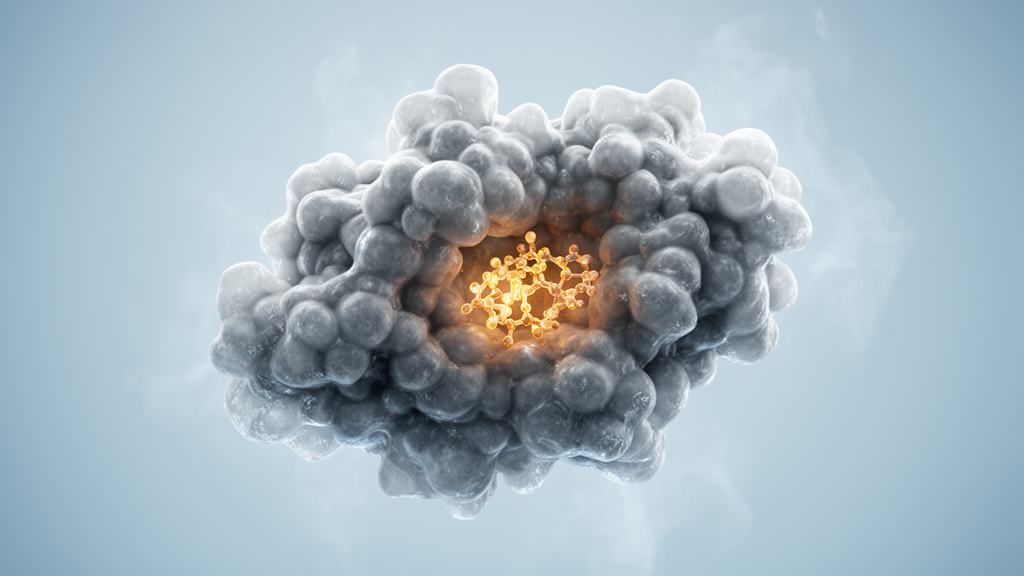
Deep inside certain soil bacteria, a molecular machine assembles the chemical backbone of one of medicine’s most elegant anticancer weapons. Now, for the first time, scientists have caught that machine on camera. A joint research group led by Ryo Tanifuji and Hiroki Oguri of the University of Tokyo, together with Yoshikazu Tanaka of Tohoku University, has visualized SacC, the enzyme responsible for constructing the intricate five-ring core of safracin B, a bacterial compound whose scaffold is shared with trabectedin, the drug used to treat soft tissue sarcoma. The achievement, published in the Journal of the American Chemical Society, is more than a structural biology milestone. It demonstrates a workflow that could be applied to a broad family of related enzymes, opening new routes to optimizing existing drugs and designing entirely new ones.
Trabectedin, also known by its development name ecteinascidin 743, is a marine-derived compound approved for the treatment of soft tissue sarcoma and, in combination regimens, for recurrent ovarian cancer. Its therapeutic power comes from a dense, highly substituted pentacyclic framework that binds DNA in ways few other molecules can. That framework begins its life not in a pharmaceutical plant but in the metabolism of bacteria, where the enzyme SacC performs a feat that would make a synthetic chemist envious. In a single catalytic pass, SacC executes a seven-step cascade, forging two new carbon-to-carbon bonds and closing the rings that define the scaffold’s rigid three-dimensional architecture.
The contrast between laboratory synthesis and enzymatic construction is stark, and it is what drives much of the excitement around this work. As Tanifuji explains, synthesizing such a complex scaffold artificially takes many carefully staged steps, tight control of reaction conditions, and a good deal of patience. A bacterial enzyme, by comparison, accomplishes the same transformation in water, at room temperature, in one pass, and with every stereochemical detail rendered correctly. Capturing the structural basis of that efficiency has long been a goal for chemists and biologists alike, because understanding how the enzyme manages its cascade could allow researchers to borrow its tricks for the design of new catalysts and drug candidates.
Getting there, however, meant overcoming two formidable technical obstacles. The first concerns the nature of the enzyme family to which SacC belongs. These enzymes operate like factory assembly lines, passing an unfinished molecule from one catalytic station to the next. To accommodate that workflow, their protein parts swing around considerably during the reaction cycle. That flexibility is essential for function but disastrous for imaging. When thousands of enzyme molecules are frozen for structural analysis, each one is caught in a slightly different pose, and averaging their images blurs the fine molecular details that researchers most want to see. The second obstacle was even more basic: SacC proved prone to clumping together in solution, a behavior that makes a sample essentially impossible to image at all.
The research team attacked both problems simultaneously, approaching the challenge from the twin directions of chemistry and structural biology. Wearing their chemist hats, the researchers designed and synthesized small molecules that imitated the unfinished intermediates the enzyme produces during its cascade reaction. These probe molecules were engineered to trap the enzyme in a defined working state, effectively pinning the molecular machinery at a specific point in its cycle so that it could be photographed. On the structural biology side, the team searched for a way to stabilize the enzyme and prevent the aggregation that had defeated earlier attempts.
The turning point, Tanifuji recalls, came after a long stretch in which the project seemed impossible. The enzyme simply would not behave in solution, and without a well-dispersed sample there was nothing to image. The breakthrough arrived with the identification of a small partner protein called SacE, encoded within the same stretch of bacterial genome as SacC itself. When SacE was present, the behavior of the enzyme in solution improved dramatically, transforming an intractable, clumping sample into one suitable for high-resolution structural work. The finding also carries biological significance, suggesting that this small helper protein plays a genuine role in keeping the giant assembly-line enzyme soluble and functional inside the cell.
With both problems solved, the researchers flash-froze their samples in a thin layer of vitreous ice and imaged them using a cryo-electron microscope at Tohoku University. Cryo-electron microscopy, or cryo-EM, works by rapidly freezing protein molecules in their native state and then recording thousands of individual particle images, from which a three-dimensional model is computationally reconstructed. In this case, the resolution of the reconstructed model was high enough to reveal molecular details at near-atomic level, allowing the team to see how the enzyme’s domains are arranged and where the trapped probe molecule sits within the catalytic machinery.
The structure the team obtained captures an early moment in the enzyme’s catalytic cycle, the point at which the building block has just been loaded onto the machinery. The later steps, in which the rings are closed and the finished product is released, remain out of focus for now. Tanifuji notes that capturing those downstream states is the team’s next target, and he expects it will require both better probe molecules and new computational approaches for sorting the images, so that enzymes frozen in different poses can be separated and reconstructed individually rather than averaged into blur.
The implications of the work extend well beyond safracin B. SacC belongs to the family of nonribosomal peptide synthetases, giant modular enzymes that bacteria and fungi use to assemble many of the world’s most important natural-product drugs, including antibiotics, immunosuppressants, and anticancer agents. The strategy demonstrated here, combining covalent probe trapping with stabilization by a small partner protein, offers a template for visualizing other members of this family that have resisted structural analysis. If the approach proves as broadly applicable as the researchers hope, it could accelerate the rational engineering of these enzymatic assembly lines, allowing scientists to tweak the products they make with the same precision that the enzymes themselves display.
For now, the frozen images of SacC represent something rare in chemistry: a direct glimpse of a molecular factory at work, captured in the act of building a scaffold that saves lives. The seven-step cascade that turns simple bacterial building blocks into the core of an anticancer drug has been an object of fascination for synthetic chemists for decades. Seeing the machine that performs it, atom by atom, brings the field one step closer to understanding, and ultimately imitating, one of nature’s most sophisticated synthetic achievements.
Subject of Research: Structural biology of the safracin B enzyme SacC by cryo-electron microscopy
Article Title: Frozen in action: visualizing how a cancer drug scaffold is built
Article References: Frozen in action: visualizing how a cancer drug scaffold is built. Original publication (Bibliographic details unavailable.)
Image Credits: AI Generated
DOI: Not provided
Keywords: cryo-EM, SacC, trabectedin, safracin B, nonribosomal peptide synthetase, natural products, enzyme structure, cancer drug, University of Tokyo, Tohoku University, Frozen, action
News Source: Nathaniel Bowman. (October 19, 2026). Cryo-EM freezes bacterial enzyme mid-action as it builds a cancer drug scaffold. Scienmag.