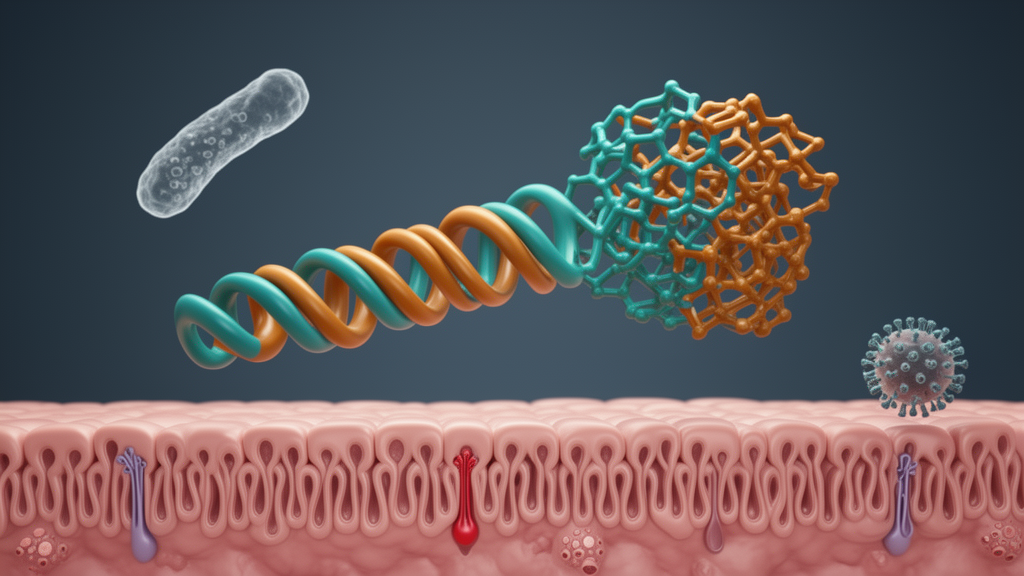
Respiratory infections in which a virus and a bacterium strike at the same time are among the most difficult clinical scenarios in pulmonary medicine, and a team of peptide researchers now proposes a purely computational answer to that problem. In a study published in Future Journal of Pharmaceutical Sciences, Ghazal Ghaznavi, Navid Nezafat, Cambyz Irajie, Fernando Berton Zanchi, Aida Solhjoo and Amir Savardashtaki describe the rational design of a chimeric antimicrobial peptide that stitches together functional regions of two human innate immune peptides, LL-37 and human neutrophil peptide-1, into a single molecule intended to act against both viral and bacterial respiratory pathogens. The work is entirely in silico: no peptide was synthesized, no microbe was challenged, and the authors state explicitly that experimental antimicrobial assays will be required to validate any biological activity.
The motivation rests on a familiar therapeutic gap. Current treatments for respiratory infections typically target pathogens individually, so a patient carrying both a virus and a bacterium receives agents that do not account for the synergistic interactions between them. The authors point to human respiratory syncytial virus, human rhinovirus and influenza viruses as the most common viral agents of respiratory illness, while Streptococcus pneumoniae and Staphylococcus aureus stand out as major bacterial contributors to community-acquired pneumonia and secondary infections. Mixed viral–bacterial infections not only worsen clinical outcomes but also increase reliance on antibiotics, accelerating antimicrobial resistance. Antiviral and antibiotic drugs, despite real progress, remain limited by narrow pathogen specificity, rapid emergence of resistance and reduced efficacy in mixed infections.
Antimicrobial peptides offered the raw material for the design. These molecules are key components of innate immunity, secreted mainly by epithelial and immune cells, and they act largely by disrupting microbial membranes, a mechanism that kills pathogens quickly while making resistance less likely to develop. Many also modulate immune responses. LL-37, the only human cathelicidin and the active fragment of hCAP-18 encoded by the CAMP gene, is produced by neutrophils, epithelial cells, macrophages and lymphocytes, with expression strongly induced during infection and inflammation. It accumulates at inflamed sites, particularly the lungs, where it has been reported to protect against pathogens including S. pneumoniae, Mycobacterium tuberculosis, Pseudomonas aeruginosa, influenza virus, RSV and human rhinovirus. Its efficacy depends on amphipathicity, cationic charge and a conserved core region essential for antiviral activity against influenza and RSV.
HNP-1, the prototypical human alpha-defensin produced predominantly by neutrophils, brings complementary properties. Its structure is stabilized by three disulfide bonds, and it was first identified for directly inactivating viruses such as herpes simplex virus 1 and influenza A, with more recent reports of inhibition of SARS-CoV-2. Its antibacterial action includes membrane disruption and interference with nucleic acid and protein synthesis in gram-negative bacteria, while activity against gram-positive pathogens such as S. aureus involves binding to lipid II and critical residues including tryptophan-26. The two peptides are naturally co-released from neutrophils and display what the literature calls double cooperativity, in which HNP-1 attenuates the cytotoxic effects of LL-37 by stabilizing membrane integrity upon membrane binding, balancing antimicrobial efficacy with host cell protection. Earlier work, however, tested the native peptides as a mixture rather than as a single engineered construct.
To build the chimera, the team retrieved the amino acid sequences of LL-37 and HNP-1 from the UniProt Knowledgebase under accession numbers P49913 and P59665, then used the NCBI Conserved Domain Database to locate functional regions. The analysis revealed that LL-37 contains an antiviral region spanning residues 31 to 131 and an antibacterial region covering residues 137 to 163, while HNP-1 contributes a single conserved alpha-defensin domain at residues 66 to 94. These domains were fused with a rigid EAAAK linker, chosen because it maintains structural independence between fused domains and minimizes steric interference, preserving native folding and functional integrity of each segment. The construct arranges the LL-37 antiviral region and the antibacterial domains so that a single chain can, in principle, engage viral envelopes and bacterial membranes within the same respiratory microenvironment.
Before any structural work, the designers ran the sequences through a battery of prediction servers. Physicochemical properties came from ExPASy ProtParam, antibacterial potential from the AntiBP2 support vector machine classifier, and antiviral activity from VirVACPRED, whose integrated machine learning model reports an accuracy of 89.7 percent, sensitivity of 86.4 percent and specificity of 91.2 percent. Toxicity was screened with the CSM-Toxin structure-based predictor and solubility with SoluProt, a gradient boosting model trained on experimentally validated solubility datasets in Escherichia coli. Secondary structure was predicted with JPred4, and helical wheel projections from NetWheels visualized amphipathicity. It is worth stressing that all of these outputs are predictions from sequence-derived features, not measurements of antimicrobial activity in any biological system.
A central step was mutational optimization. Using the Cologne University Protein Stability Analysis Tool, which predicts the effect of single amino acid substitutions from torsion angle distributions and atom-based statistical potentials, the team introduced stability-enhancing mutations into the construct. The wild-type sequence was modified into a mutant variant whose substitutions clustered in conserved regions predicted to influence folding, charge distribution and hydrophobicity. The instability index fell from 35.10 to 30.12, and post-mutation analysis indicated enhanced structural stability alongside preserved solubility and predicted non-toxicity. Mutants that showed improved stability, favorable safety predictions and enhanced predicted antimicrobial activity were carried forward as the optimized construct.
Structural modeling and validation followed. Three-dimensional structures were predicted with AlphaFold2 via ColabFold, ranked by predicted local distance difference test confidence, and validated on the SAVES v6.0 metaserver and ProSA-web. The ERRAT quality factor rose from 73.23 percent in the wild type to 91.54 percent in the mutant, and Ramachandran analysis showed residues in the most favored regions increasing from 79.1 to 82.3 percent while disallowed conformations dropped from 3.4 to 2.0 percent. The authors note these values fall short of thresholds typical for globular proteins, a deviation they attribute to the short, flexible nature of antimicrobial peptide constructs. Verify3D scores declined slightly from 50.30 to 41.32 percent but remained within acceptable limits, and the ProSA Z-score moved from minus 6.09 to minus 5.058, within the range observed for experimentally determined structures of comparable size.
Molecular dynamics simulations in GROMACS 2022 with the CHARMM36 force field then probed dynamic behavior in aqueous solution over 200 nanoseconds of production time, following 100-nanosecond equilibrations under NVT and NPT conditions at 310.15 kelvin. The mutant’s root-mean-square deviation settled near 2.5 nanometers for the first 40 nanoseconds and stabilized after roughly 70 nanoseconds, while root-mean-square fluctuation profiles showed reduced fluctuations for the mutant relative to the wild type. Mean hydrogen bond counts were nearly identical at 397.37 and 397.31, and the mutant’s radius of gyration decreased from about 3.4 to 1.8 nanometers during the first 70 nanoseconds before holding steady. Solvent-accessible surface area declined for both peptides up to 90 nanoseconds and then plateaued, with average values of 105.46 and 117.16 square nanometers for wild type and mutant respectively.
On the strength of these computational results, the authors conclude that the LL-37/HNP-1 fusion peptide is a promising broad-spectrum candidate for respiratory co-infections, with possible future applications in inhalable or nanoparticle-based delivery systems. The single-chain design, they argue, would simplify formulation, production and delivery compared with administering two peptides separately, and the rigid linker strategy preserves each domain’s folding. Yet the evidence base remains entirely predictive: functional activity against RSV, human rhinovirus, S. pneumoniae and S. aureus was scored by machine learning servers, stability was assessed in simulated water boxes, and toxicity was estimated from structural signatures. The gap between a favorable in-silico profile and a molecule that safely and effectively clears mixed respiratory infections in patients is wide, encompassing synthesis, enzymatic stability in lung tissue, host immune effects and efficacy testing. The study’s real contribution is a documented computational framework and an optimized candidate sequence awaiting the laboratory experiments that will determine whether its predicted promise survives contact with biology.
Subject of Research: Computational design of a chimeric LL-37/HNP-1 antimicrobial peptide against respiratory co-infections
Article Title: Rational design of a dual-function, LL-37/HNP-1, chimeric antimicrobial peptide: a broad-spectrum AMP against respiratory co-infections
Article References: Ghaznavi, G., Nezafat, N., Irajie, C., Zanchi, F. B., solhjoo, A., & Savardashtaki, A. (2026). Rational design of a dual-function, LL-37/HNP-1, chimeric antimicrobial peptide: a broad-spectrum AMP against respiratory co-infections. Future Journal of Pharmaceutical Sciences, 12(1), Article 91. https://doi.org/10.1186/s43094-026-01023-5
Image Credits: AI Generated
DOI: 10.1186/s43094-026-01023-5
Keywords: antimicrobial peptides, LL-37, HNP-1, respiratory co-infections, RSV, human rhinovirus, Streptococcus pneumoniae, Staphylococcus aureus, molecular dynamics, AlphaFold2, peptide design, in silico study
News Source: Kristina Jarvis. (October 28, 2026). Computational Design Yields Chimeric LL-37/HNP-1 Peptide Candidate for Respiratory Co-Infections. Scienmag.