


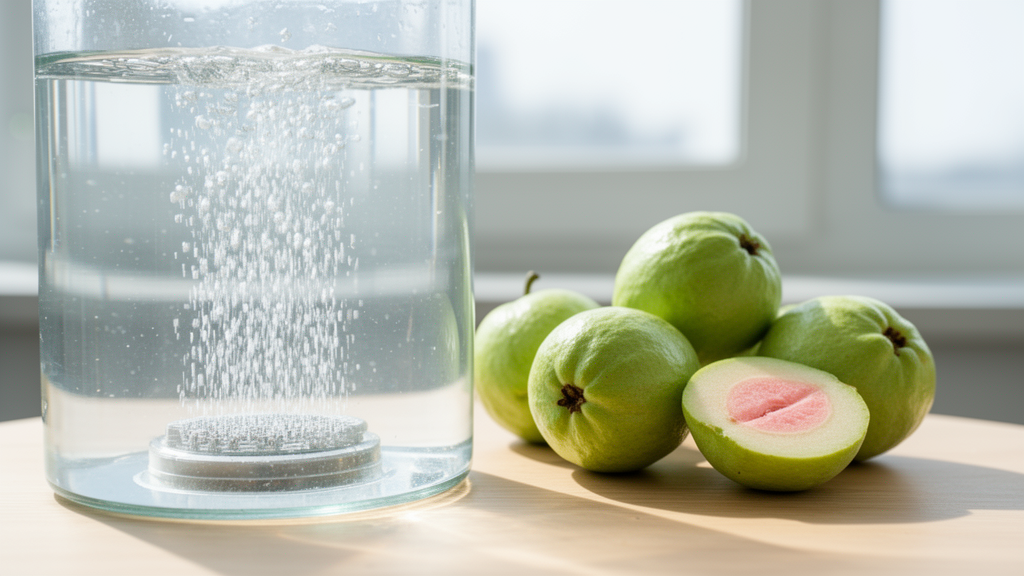
Guava is one of the most delicate fruits on the shelf, and its worst enemy is a fungus that hides until after harvest. Anthracnose, driven mainly by Colletotrichum gloeosporioides sensu lato, appears as sunken brown or black spots on the peel once the fruit has left the orchard, and postharvest losses of guava are estimated at 20 to 40 percent of total production. A new laboratory study from South Africa now reports that water infused with microscopic ozone bubbles can slow both the fungus and the fruit’s own decline, offering a possible alternative to chlorine washing.
The research, published in the journal Food, Nutrition and Health, was carried out by Harold K. Malahlela of Stellenbosch University and colleagues. It tested air micro-nano bubble water and ozone micro-nano bubble water against the fungal pathogen in laboratory cultures and on ‘Fan Retief’ guava fruit, comparing both with the industry-standard sanitizer sodium hypochlorite. Micro-nano bubbles are gaseous cavities smaller than 100 micrometres, generally at the micro to nanometre scale, and they carry unusual physicochemical advantages: a large specific surface area, prolonged stability in water, highly negative surface charge, high mass transfer efficiency and the ability to generate reactive free radicals such as hydroxyl radicals, which are linked to their antimicrobial activity.
The team first confirmed the identity of the pathogen. A fungal isolate previously recovered from diseased, symptomatic guava tissue was verified by extracting its DNA and amplifying the internal transcribed spacer region of nuclear ribosomal DNA with the universal primer pair ITS1 and ITS4. The resulting amplicons were 500 base pairs long, matching a reference isolate, which the authors say supports accurate identification free of contamination. The isolate was confirmed as C. gloeosporioides sensu lato, a species complex of more than 20 distinct species that includes C. fructicola and C. alienum, and the main reported cause of anthracnose in guava and other tropical fruits such as banana, papaya, cashew and mango.
The bubbles themselves were generated with a commercial nano-bubbler mixing either ambient air or 99.99 percent pure ozone into autoclaved municipal water at room temperature. The average bubble diameter was 141.1 plus or minus 18.4 nanometres for air-MNB and 99.8 plus or minus 6.6 nanometres for ozone-MNB, with bubble concentrations of 1.34 times 10 to the eighth particles per millilitre and 6.88 times 10 to the seventh particles per millilitre respectively. The ozone bubbles also changed the water’s chemistry: ozone-MNB water had a pH of 2.71 and an oxidation-reduction potential of 919.0 plus or minus 12.3 millivolts, compared with pH 7.0 and 667.0 plus or minus 2.6 millivolts for air-MNB, properties the researchers later linked to disinfection performance.
In the laboratory phase, spore suspensions of the fungus were exposed to 200 milligrams per litre sodium hypochlorite for five minutes, or to air-MNB or ozone-MNB water for 30 minutes each, with untreated spores serving as controls. Viability was assessed with confocal laser scanning microscopy after staining with a LIVE/DEAD viability kit, in which red fluorescence marks spores that have lost membrane integrity and green marks intact ones. Sodium hypochlorite was the clear leader, leaving roughly 76.45 percent of spores dead. Ozone-MNB followed with about 54.44 percent dead spores, air-MNB with about 39.27 percent, and the control with about 8 percent. Expressed as viability, about 60.73 percent of air-MNB spores and 45.56 percent of ozone-MNB spores remained viable, versus 23.55 percent after hypochlorite.
Scanning-transmission electron microscopy added a structural dimension. Untreated spores showed typical morphology, with a well-defined cell wall, intact plasma membrane and clearly visible organelles including the nucleus and mitochondrion. Spores treated with hypochlorite or either bubble water showed subcellular disorganization, characterised by degradation of mitochondrial structures and increased vacuolization. The authors interpret the mitochondrial degradation as mitophagy removing damaged mitochondria, which could reduce production of adenosine triphosphate essential for fungal survival, while the vacuoles may represent a stress defence response, since vacuoles are multifunctional organelles involved in cell homeostasis and storage. They note that the precise fungicidal mechanism of MNB water remains unresolved, though hypothesised effects include membrane disruption and leakage, lipid peroxidation, DNA damage and protein modification, and they call for transcriptomic and proteomic work to pin it down.
The in vivo test used artificially wounded ‘Fan Retief’ guavas inoculated with 10 microlitres of a spore suspension at 1 times 10 to the sixth spores per millilitre, then immersed in the treatments. Lesion diameters were measured over 12 days of storage at 13 degrees Celsius and 90 plus or minus 2 percent relative humidity. After three days, only sodium hypochlorite significantly reduced lesion diameter; neither bubble water showed significant inhibition at that point. But ozone-MNB’s efficacy increased with time, and by day 6 the lesion diameter in ozone-MNB-treated guavas was comparable to that achieved by hypochlorite, roughly 4.5 millimetres, both significantly lower than the control at 9.17 plus or minus 0.25 millimetres and air-MNB at 7.03 plus or minus 0.24 millimetres. That pattern continued through days 9 and 12. The authors caution that although hypochlorite showed higher fungicidal activity overall, ozone-MNB presents what they describe as a safer alternative approach for practical application.
Quality results came from a separate batch of non-inoculated fruit, pre-treated, packed in non-hermetic polyethylene clamshells and stored for 21 days under the same conditions. Ozone-MNB stood out across nearly every metric. Weight loss, which the authors attribute partly to reduced transpiration, reached 25.89 plus or minus 2.00 percent in untreated fruit by the end of storage but only 9.20 plus or minus 2.40 percent under ozone-MNB. Respiration rate, an indicator of senescence, started at 28.07 plus or minus 0.53 millilitres of carbon dioxide per kilogram per hour, climbed in all groups, and peaked at 70.54 plus or minus 0.56 in controls by day 7, while ozone-MNB fruit showed the lowest respiration throughout, suggesting slowed ripening.
Colour and sugar-acid balance told a similar story. Hue angle fell significantly in all treatments as storage progressed, reflecting chlorophyll degradation and the onset of yellowing, but after 21 days ozone-MNB fruit retained a higher hue angle of 77.51 plus or minus 2.45 degrees than controls at 72.20 plus or minus 2.46, hypochlorite at 75.14 plus or minus 0.53 or air-MNB at 76.36 plus or minus 1.23. Chroma values at day 21 were also higher for both bubble treatments, at about 49.1, than for control and hypochlorite fruit. The ratio of total soluble solids to titratable acidity rose sharply at day 14 in all groups, consistent with starch-to-sugar conversion during ripening, but untreated fruit reached the highest ratio at 23.20, versus 19.77 for hypochlorite, 18.32 for air-MNB and 15.87 for ozone-MNB, again indicating slower ripening in the bubble-treated fruit.
The study has clear limits that readers should keep in view. The disease work was conducted on artificially inoculated, wounded fruit under controlled storage, not on naturally infected fruit in commercial supply chains, and the pathogen was identified only to the sensu lato level, with the authors recommending species-specific primers for finer resolution. The disinfection comparisons also rest on different contact times, five minutes for hypochlorite against 30 minutes for the bubble waters, reflecting standard practice rather than a like-for-like test. The authors themselves note that the choice of gas for bubble generation, the fruit type, storage conditions and application method all influence outcomes, and that earlier studies with other gases and fruits produced contrasting results on soluble solids. Still, within those boundaries, the findings suggest that ozone micro-nano bubble water, a technology already explored for wastewater treatment and produce disinfection, could one day help guava growers cut chemical residues while keeping their fruit firmer, greener and slower to ripen.
Subject of Research: Antifungal and fruit-quality effects of air and ozone micro-nano bubble water pre-treatments against Colletotrichum gloeosporioides sensu lato on guava
Article Title: Micro-nano bubble water pre-treatments: antifungal action against Colletotrichum gloeosporioides sensu lato, curative control of anthracnose and impact on guava fruit quality
Article References: Malahlela, H. K., Meitz-Hopkins, J. C., Belay, Z. A., Mphahlele, R. R., & Caleb, O. J. (2026). Micro-nano bubble water pre-treatments: antifungal action against Colletotrichum gloeosporioides sensu lato, curative control of anthracnose and impact on guava fruit quality. Food, Nutrition and Health, 3(1), Article 26. https://doi.org/10.1007/s44403-026-00070-3
Image Credits: AI Generated
DOI: 10.1007/s44403-026-00070-3
Keywords: guava, anthracnose, Colletotrichum gloeosporioides, micro-nano bubbles, ozone, sodium hypochlorite, postharvest disease, fruit quality, spore viability, food safety, Stellenbosch University, chlorine alternatives
News Source: Alan Morgan. (October 30, 2026). Ozone bubble water curbs guava anthracnose and slows fruit ripening. Scienmag.



