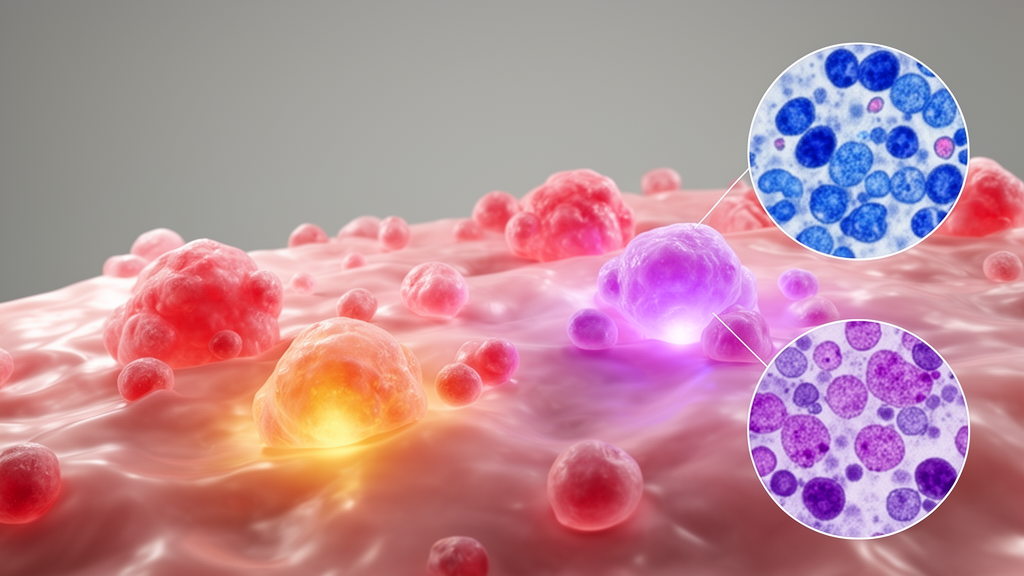
Peritoneal metastasis, the spread of colorectal cancer to the lining of the abdominal cavity, is linked to substantial illness and poor clinical outcomes, yet its evolutionary origins and molecular drivers have remained poorly understood. A new study published in the Journal of Translational Medicine maps how these deposits emerge, using whole-exome sequencing on 49 matched samples of primary tumors, peritoneal metastases, and lymph node metastases from 11 colorectal cancer patients, alongside single-cell RNA sequencing of 14 paired samples from three patients.
The phylogenetic analyses revealed that dissemination is frequently polyclonal: in 8 of the 11 patients, multiple tumor cell populations had seeded the peritoneum rather than a single clone. Computational reconstruction with the tool MACHINA identified metastasis-to-metastasis seeding in five patients, meaning that established peritoneal deposits themselves gave rise to further metastatic lesions. Notably, lymphatic spread did not appear to be the predominant route by which cancer cells reached the peritoneum in this cohort.
Perhaps the most striking finding concerns timing. In 9 of the 11 patients, metastatic dissemination had occurred early, before the primary tumor became clinically detectable. This suggests that in many cases the peritoneal deposits seen in the clinic are not late complications of advanced disease but the products of seeding events that took place silently, potentially long before diagnosis.
The study also identified driver genes associated with peritoneal metastasis, including KRAS, SMAD4, and RNF43, and detected potentially actionable alterations across patients, including events confined to specific sites or regions within the abdomen.
At the single-cell level, the transcriptomic analyses uncovered substantial heterogeneity among metastatic deposits within individual patients, meaning that different peritoneal lesions in the same person can harbor distinct cellular compositions. The researchers also found an enrichment of COL11A1-positive fibroblasts in peritoneal metastasis lesions, suggesting these cells help create a microenvironment that is permissive to metastatic growth. The authors conclude that the findings delineate the evolutionary patterns, genomic features, and microenvironmental heterogeneity of colorectal cancer peritoneal metastases, and offer insights into potential therapeutic vulnerabilities. As a small study of 11 patients, its observations will need validation in larger cohorts before they can inform clinical practice.
Subject of Research: Evolutionary patterns and genomic landscape of colorectal cancer peritoneal metastasis
Article Title: Mutational landscape and evolutionary patterns of peritoneal metastases in colorectal cancer
Article References: Wang, Y., Shen, Y., Zheng, J., Xu, X., Xu, G., Xu, L., Ni, Z., Wang, C., Zhu, Y., Qin, N., & Sun, J. (2026). Mutational landscape and evolutionary patterns of peritoneal metastases in colorectal cancer. Journal of Translational Medicine. https://doi.org/10.1186/s12967-026-09122-w
Image Credits: AI Generated
DOI: 10.1186/s12967-026-09122-w
Keywords: colorectal cancer, peritoneal metastasis, whole-exome sequencing, single-cell RNA sequencing, phylogenetics, KRAS, SMAD4, RNF43, tumor evolution, tumor microenvironment, COL11A1 fibroblasts, metastasis-to-metastasis seeding
News Source: Nathaniel Bowman. (October 28, 2026). Colorectal cancer peritoneal metastases often arise early and polyclonally, sequencing study finds. Scienmag.