• HOME
  • NEWS
  • EXPLORE
    • CAREER
      • Companies
      • Jobs
    • EVENTS
    • iGEM
      • News
      • Team
    • PHOTOS
    • VIDEO
    • WIKI
  • BLOG
  • COMMUNITY
    • FACEBOOK
    • INSTAGRAM
    • TWITTER
Saturday, December 27, 2025
BIOENGINEER.ORG
No Result
View All Result
  • Login
  • HOME
  • NEWS
  • EXPLORE
    • CAREER
      • Companies
      • Jobs
        • Lecturer
        • PhD Studentship
        • Postdoc
        • Research Assistant
    • EVENTS
    • iGEM
      • News
      • Team
    • PHOTOS
    • VIDEO
    • WIKI
  • BLOG
  • COMMUNITY
    • FACEBOOK
    • INSTAGRAM
    • TWITTER
  • HOME
  • NEWS
  • EXPLORE
    • CAREER
      • Companies
      • Jobs
        • Lecturer
        • PhD Studentship
        • Postdoc
        • Research Assistant
    • EVENTS
    • iGEM
      • News
      • Team
    • PHOTOS
    • VIDEO
    • WIKI
  • BLOG
  • COMMUNITY
    • FACEBOOK
    • INSTAGRAM
    • TWITTER
No Result
View All Result
Bioengineer.org
No Result
View All Result
Home NEWS Science News Biology

Colonization of the Antilles by South American fauna: Giant sunken islands as a passageway

Bioengineer by Bioengineer
May 18, 2021
in Biology
Reading Time: 2 mins read
0
IMAGE
Share on FacebookShare on TwitterShare on LinkedinShare on RedditShare on Telegram

IMAGE

Credit: © Cornée et al.

Fossils of land animals from South America have been found in the Antilles, but how did these animals get there? According to scientists from the CNRS, l’Université des Antilles, l’Université de Montpellier and d’Université Côte d’Azur, land emerged in this region and then disappeared beneath the waves for millions of years, explaining how some species were able to migrate to the Antilles. This study will be published in June 2021 issue in Earth-Science Reviews.

Fossils of land animals from the Antilles, including mammals and amphibians, have their closest relatives in South America. The crossing of the Caribbean Sea from South America was therefore possible, but how?

As swimming across the continent must be ruled out, given that several hundred kilometres separate the South American continent from the Antilles, the dispersal of this fauna has been attributed either to natural rafts coming out of the continent’s flooded rivers, or to the existence of land bridges that are now submerged.

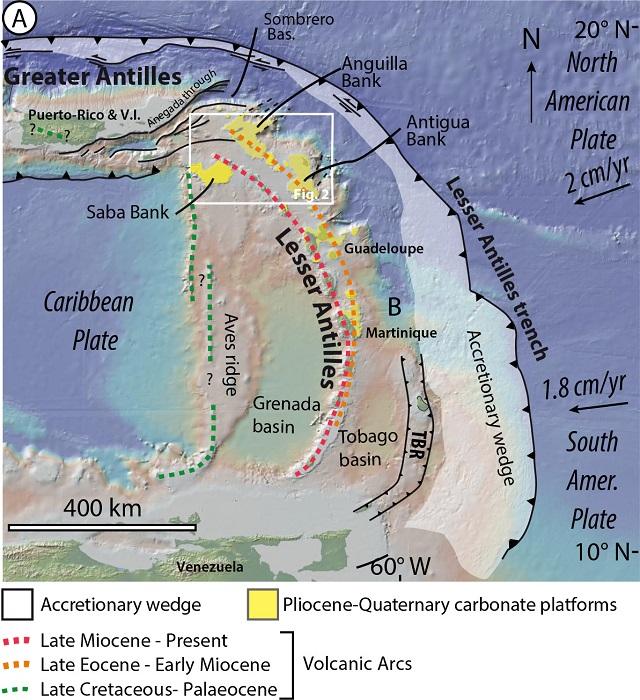
A scientific project involving geologists, palaeontologists and geophysicists1 is now solving some of the mysteries related to these terrestrial species in the Antilles. The researchers have reconstructed the geography of the northern Lesser Antilles over the last 40 million years and have shown that the movements of the tectonic plates at the junction between the Lesser Antilles, the Greater Antilles and the Aves Ridge (an underwater mountain), have several times given birth to archipelagos and islands quite close to each other, which were then swallowed up in the course of time.

In addition to tectonic movements, the glacial-interglacial cycles for 1.5 million years (Quaternary) have favoured the appearance and disappearance of archipelagos. Indeed, during these cycles, the sea level decreases or increases according to the storage of water in the ice caps or their melting (the duration of these cycles is about 100,000 years). The formation of these archipelagos could thus have favoured terrestrial connections between the Aves Ridge, the Greater Antilles and the Lesser Antilles.

Scientists will now extend their studies southward, between Guadeloupe and South America, to reconstruct the past geography of the entire Caribbean Plate, in order to define more precisely the nature of the terrestrial species’ dispersal paths between the Americas.

###

Media Contact
Elie Stecyna
[email protected]

Original Source

http://www.cnrs.fr/en/colonisation-antilles-south-american-fauna-giant-sunken-islands-passageway

Related Journal Article

http://dx.doi.org/10.1016/j.earscirev.2021.103617

Tags: BiologyEarth ScienceEcology/EnvironmentPaleontologyPlate Tectonics
Share12Tweet8Share2ShareShareShare2

Related Posts

Pichia kluyveri Compounds Combat Cacao Pathogen Moniliophthora roreri

Pichia kluyveri Compounds Combat Cacao Pathogen Moniliophthora roreri

December 27, 2025
blank

Drought Stress: PHD Gene Expression in Alfalfa

December 26, 2025

Temperature and Heat Penetration in Canned vs. Pouched Whelk

December 26, 2025

Unveiling Genetic Factors Affecting Milk Fat in Holsteins

December 26, 2025
Please login to join discussion

POPULAR NEWS

  • Robotic Waist Tether for Research Into Metabolic Cost of Walking

    NSF funds machine-learning research at UNO and UNL to study energy requirements of walking in older adults

    71 shares
    Share 28 Tweet 18
  • Nurses’ Views on Online Learning: Effects on Performance

    70 shares
    Share 28 Tweet 18
  • Exploring Audiology Accessibility in Johannesburg, South Africa

    51 shares
    Share 20 Tweet 13
  • Unraveling Levofloxacin’s Impact on Brain Function

    54 shares
    Share 22 Tweet 14

About

We bring you the latest biotechnology news from best research centers and universities around the world. Check our website.

Follow us

Recent News

Framework for Sustainable Equatorial Forest Management Unveiled

Sustainable Equatorial Forest Management: A Decision-Making Framework

Umbilical Cord Milking: Harvesting Cells for Regeneration

Subscribe to Blog via Email

Enter your email address to subscribe to this blog and receive notifications of new posts by email.

Join 71 other subscribers
  • Contact Us

Bioengineer.org © Copyright 2023 All Rights Reserved.

Welcome Back!

Login to your account below

Forgotten Password?

Retrieve your password

Please enter your username or email address to reset your password.

Log In
No Result
View All Result
  • Homepages
    • Home Page 1
    • Home Page 2
  • News
  • National
  • Business
  • Health
  • Lifestyle
  • Science

Bioengineer.org © Copyright 2023 All Rights Reserved.