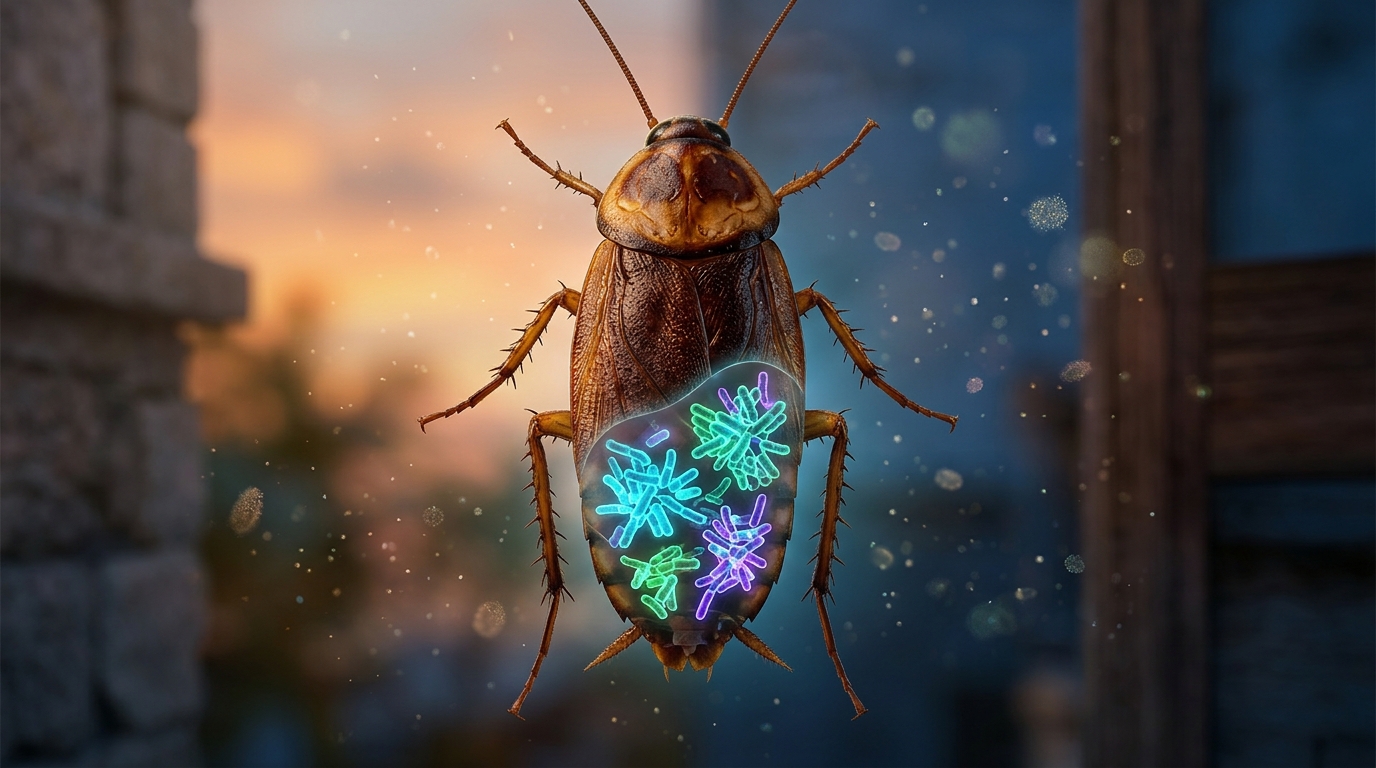
Researchers recovered 123 Enterobacteriaceae isolates from the digestive tracts of 90 American cockroaches (Periplaneta americana) trapped in households and food outlets across the city, and found that 69 percent of the isolates were resistant to at least one antibiotic. More striking still, every single isolate met the definition of multidrug resistance, meaning it resisted at least one antimicrobial agent in three or more antibiotic classes.
The study, published in the journal Discover Life, was led by Fulgence N. Mpenda, Delphinus K. Deogratias and Modester D. Nkungu of the University of Dar es Salaam. Between March and April 2024, the team trapped cockroaches at 30 restaurants, 30 multi-dwelling households and 30 single-family dwelling households in ten neighborhoods, including Tandika, Ubungo, Mbezi, Tegeta, Kinondoni, Mbagala, Tuangoma, Gongolamboto, Masaki and Buza. Sites were chosen on the basis of sanitation conditions, human activity and observed cockroach infestation. Each insect was placed in a sterile bottle immediately after capture and transported to the university microbiology laboratory for analysis.
In the laboratory, the researchers took no chances with contamination. The external bodies of the cockroaches were washed with tap water, rinsed in sterile saline, disinfected in 70 percent ethanol for five minutes, and then rinsed again to remove alcohol traces. Only then were the digestive tracts removed with sterilized entomological instruments and their contents dispersed into sterile saline. The gut suspensions were cultured on MacConkey agar and purified on Eosin methylene blue agar, with identification confirmed through Gram staining and a battery of biochemical tests including indole, methyl red, Voges Proskauer, citrate and motility assays.
The bacterial haul was dominated by Klebsiella species, which accounted for 53 percent of the 123 isolates, followed by Escherichia coli at 30 percent and Enterobacter species at 17 percent.
Susceptibility testing using the Kirby-Bauer disk diffusion method against twelve antibiotics spanning eight classes produced a sobering resistance map. Ciprofloxacin, azithromycin and gentamicin each faced resistance from 54 percent of isolates. Only norfloxacin, at 40 percent, and ceftriaxone, at 29 percent, retained comparatively better activity against the cockroach-derived bacteria.
Because the twelve tested drugs covered eight antibiotic classes, the team could stratify isolates by how many classes they defeated. Nearly a third of the isolates, 29.3 percent, were resistant to agents in all eight classes, while 20.3 percent resisted seven classes and 22 percent resisted five. Applying the standard definition of multidrug resistance, resistance to at least one agent in three or more classes, all 123 isolates qualified. Resistance patterns were broadly similar across restaurants and both household types, and across the three bacterial genera, suggesting that resistant organisms circulate widely through the urban environment rather than clustering in one kind of site.
To probe the genetic basis of these phenotypes, the team extracted bacterial DNA and used polymerase chain reaction with gene-specific primers to screen for seven resistance determinants commonly reported in Enterobacteriaceae: blaTEM, blaCTX-M, tet(A), catA1, sul1, dfrA1 and aac(3)-IV. The folate pathway gene dfrA1 appeared in 100 percent of the multidrug-resistant isolates, sul1 in 84 percent and tet(A) in 53 percent, while the aminoglycoside resistance gene aac(3)-IV was rare, detected in just 3 percent. Statistical analysis with Pearson’s chi-square tests showed that blaTEM, aac(3)-IV, catA1 and tet(A) were each significantly associated with the corresponding phenotypic resistance, with the aac(3)-IV gene showing the strongest association with aminoglycoside resistance.
The authors are careful about what these findings do and do not prove. The study design, they write, does not establish whether cockroaches actually transmit resistant bacteria or resistance genes between environmental and human-associated settings. Because environmental and clinical isolates were not compared, and because antimicrobial exposure and transmission pathways were not assessed, the source and epidemiological role of the insects remain open questions. The sample of 90 cockroaches was collected during a single season in one city, only culturable Enterobacteriaceae were examined, and the targeted PCR approach could not determine the genetic context or mobility of the detected genes. Whole-genome sequencing and comparative analysis of cockroach-associated, environmental, food-associated and clinical isolates, the authors suggest, would be needed to clarify whether cockroaches are epidemiologically important reservoirs or vectors.
Cockroaches inhabit sewage systems, waste disposal areas, kitchens, toilets and food storage spaces, and their feeding behavior and mobility make them effective mechanical carriers of microorganisms between contaminated environments and human living spaces. The authors argue that environmental surveillance deserves a place in broader antimicrobial resistance monitoring frameworks, alongside improved sanitation, proper waste management, rational antibiotic use and effective pest control.
Subject of Research: Antimicrobial resistance profiles of Enterobacteriaceae isolated from the gut of American cockroaches in Dar es Salaam, Tanzania
Article Title: Antimicrobial resistance profiles of Enterobacteriaceae in Periplaneta americana from Dar es Salaam
Article References: Mpenda, F. N., Deogratias, D. K., & Nkungu, M. D. (2026). Antimicrobial resistance profiles of Enterobacteriaceae in Periplaneta americana from Dar es Salaam. Discover Life, 56(1), Article 53. https://doi.org/10.1007/s11084-026-09776-y
Image Credits: AI Generated
DOI: 10.1007/s11084-026-09776-y
Keywords: antimicrobial resistance, Enterobacteriaceae, Periplaneta americana, cockroaches, Dar es Salaam, multidrug resistance, resistance genes, PCR, Kirby-Bauer disk diffusion, One Health, Tanzania, public health
News Source: Morgan Morrow. (November 4, 2026). Cockroaches in Dar es Salaam carry multidrug-resistant gut bacteria. Scienmag.