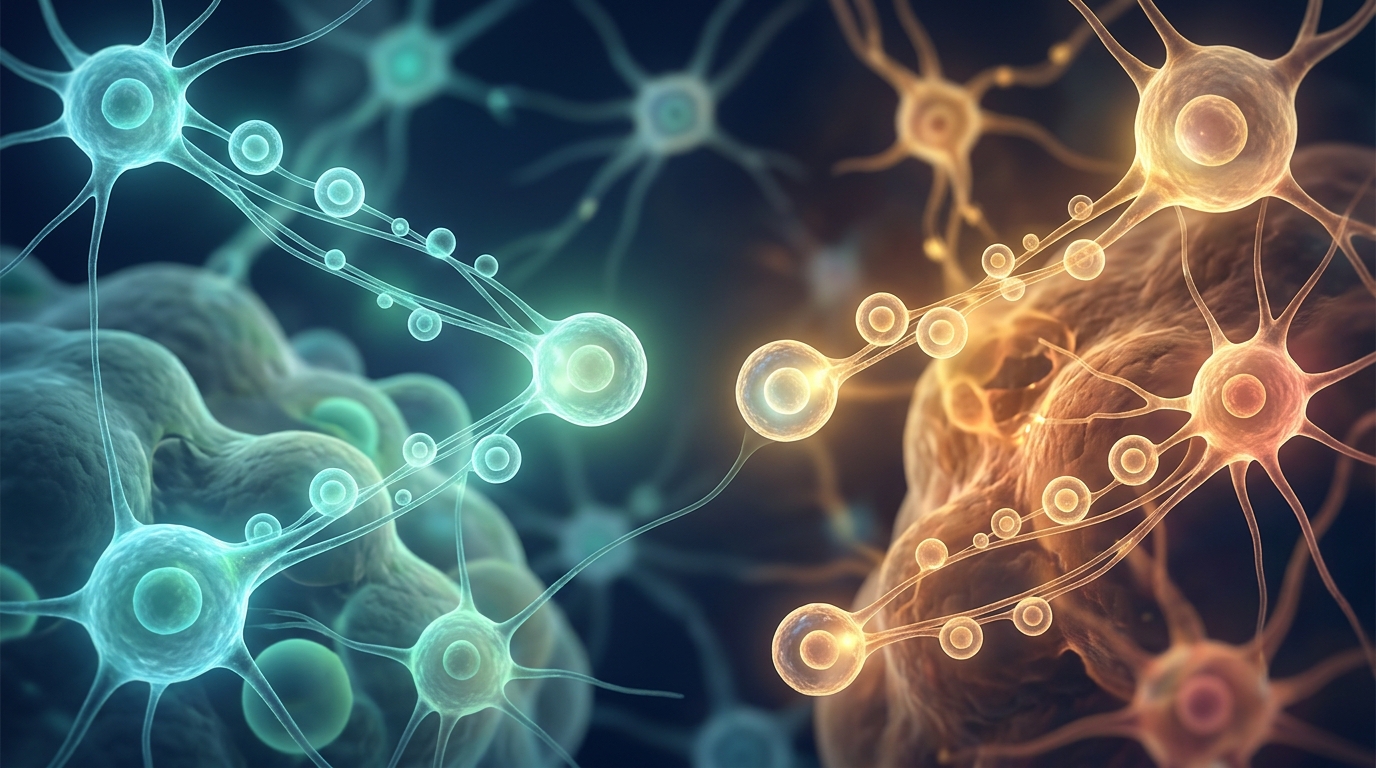
Migrasomes, the vesicular structures that form at the tips of retraction fibers as cells crawl across tissue, are stepping into the spotlight of central nervous system research. A new review published in Cellular and Molecular Neurobiology argues that these tiny cellular messengers can act as both pathogenic drivers and protective factors in brain disease, and that their behavior is not fixed at birth but shaped by circumstance. The paper, made available as a peer-reviewed accepted manuscript with a permanent DOI, lays out a theoretical framework intended to guide future interventions in neurodegenerative disease, acute brain injury and brain tumors.
The review, authored by Xiaoman Deng, Yiyuan Wang, Xuan Sha, Yiming Xu, Santian Wu, Kexin Zhang, Yi Wu and Nianhong Wang, systematically maps the opposing roles that migrasomes play across three broad categories of neurological disorder. Rather than treating these organelles as uniformly harmful or uniformly helpful, the authors propose what they call a context-dependent model of functional polarity. In this model, the effect of a migrasome is jointly determined by the cell type that produced it, the molecular cargo it carries, and the disease microenvironment in which it operates. That framing, the authors write, is meant to move the field beyond simple binary thinking and toward precise modulation of migrasome behavior.
Biologically, migrasomes are distinctive. They form specifically at the termini of retraction fibers left behind during cell migration, and they actively sort and release a diverse range of molecular cargoes. This active sorting makes them a vehicle for intercellular communication, allowing one cell to hand off biochemical information to another. Because the central nervous system relies heavily on tightly regulated signaling between neurons, glia and immune cells, the arrival of migrasomes as a recognized communication channel has drawn increasing attention from researchers studying how brain diseases develop and progress.
The dual nature of these structures is the review’s central theme. The authors emphasize that this functional polarity is not an intrinsic property of the migrasome itself. Instead, it emerges from the interplay between the originating cell, the cargo composition and the surrounding pathological environment, a combination that can flip the outcome from damage to defense or the reverse.
Beyond the mechanistic analysis, the review evaluates the translational potential of migrasomes in three distinct roles. First, they are considered as novel diagnostic biomarkers, since the molecular signatures they carry could reflect the state of the cells that released them and the disease conditions they encountered. Second, they are examined as therapeutic targets, on the premise that modulating migrasome formation, cargo loading or uptake could alter disease trajectories. Third, they are assessed as engineered delivery vehicles, a possibility that follows directly from their natural function as intercellular cargo transporters.
The authors also confront the key challenges that stand between laboratory observation and clinical application. While the review does not present new experimental data, it critically analyzes the mechanisms that could underlie functional polarity, offering a conceptual scaffold for researchers who want to design experiments that distinguish protective migrasomes from pathogenic ones. The stated aim is to establish a theoretical framework for the precise modulation of migrasomes to enable targeted interventions in central nervous system diseases, a goal the authors acknowledge requires resolving how context controls outcome.
The article has already recorded 79 accesses, a modest but early signal of interest in a topic that sits at the intersection of cell biology, neuroscience and translational medicine. The journal, Cellular and Molecular Neurobiology, focuses on cellular and molecular mechanisms relevant to nervous system function and dysfunction.
What makes the review notable for the broader scientific community is its refusal to assign migrasomes a single moral valence.
For now, the review functions as a map rather than a manual. It delineates where migrasomes have been implicated across neurodegenerative diseases, acute brain injury and brain tumors, and it flags the mechanistic questions that remain open. The context-dependent model it proposes is a hypothesis to be tested, not a settled conclusion, and the authors position it as a starting point for the precise, cell-type-aware and environment-aware interventions they believe the field should pursue next.
Subject of Research: The dual pathogenic and protective roles of migrasomes in central nervous system diseases and their potential as biomarkers, therapeutic targets and delivery vehicles.
Article Title: Migrasomes in Central Nervous System Diseases: Dual Roles as Pathogenic Drivers and Protective Factors
Article References: Deng, X., Wang, Y., Sha, X., Xu, Y., Wu, S., Zhang, K., Wu, Y., & Wang, N. (2026). Migrasomes in Central Nervous System Diseases: Dual Roles as Pathogenic Drivers and Protective Factors. Cellular and Molecular Neurobiology. https://doi.org/10.1007/s10571-026-01807-6
Image Credits: AI Generated
DOI: 10.1007/s10571-026-01807-6
Keywords: migrasomes, central nervous system, neurodegenerative diseases, acute brain injury, brain tumors, extracellular vesicles, intercellular communication, retraction fibers, biomarkers, drug delivery, cell biology, review
News Source: Cassandra Pierce. (November 4, 2026). Migrasomes Can Drive or Protect the Brain Depending on Context, Review Finds. Scienmag.