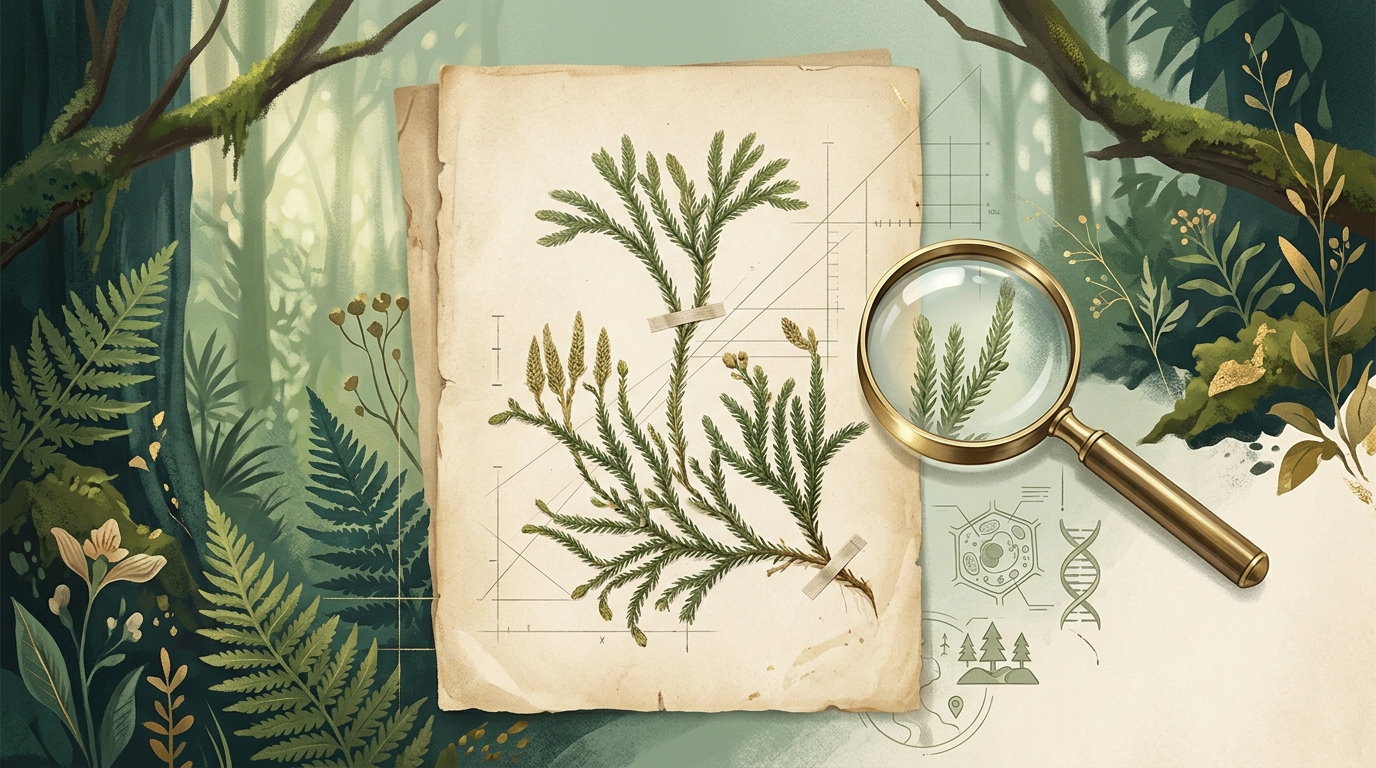
Deep inside the Herbarium Collection of the Croatian Natural History Museum in Zagreb, 115 herbarium sheets holding 221 clubmoss specimens have just been brought into order after years of curation. The material, spread across the museum’s Herbarium of Higher Plants and the Trinajstić Herbarium, spans 127 years of collecting and 99 inventory numbers, and it now offers conservation scientists a previously untapped archive of where clubmosses grew in Croatia and when.
The work matters because clubmosses are not an obscure group on paper. All Croatian clubmoss species fall under Annex V of the EU Habitats Directive, which covers species of community interest whose taking in the wild and exploitation may be subject to management measures. In Croatia, commercial collection of Huperzia selago, Lycopodium annotinum and Lycopodium clavatum is regulated under the Ordinance on the collection of native wild species, while Diphasiastrum complanatum and Lycopodiella inundata are strictly protected, listed respectively as Data Deficient and Critically Endangered in the national Ordinance on Strictly Protected Species.
Curation began with the uncurated part of the collection, where 73 herbarium sheets with 146 specimens were found and assigned 60 new inventory numbers. Every sheet was checked for insect damage, remounted on acid-free paper and placed in new acid-free folders, and species were determined or confirmed using the determination keys of Tutin et al. (1993) and Nikolić (2020). After processing, the Herbarium of Higher Plants holds 83 clubmoss sheets with 164 specimens and 70 inventory numbers, while the Trinajstić Herbarium holds 32 sheets with 57 specimens and 29 inventory numbers.
Data from the newly inventoried sheets were entered into the Flora Croatica Database, whose herbarium module makes the records publicly searchable by inventory number, species, family, collector or locality. Each sheet received a printed label with its inventory number, and records for previously inventoried specimens were verified against the original labels to correct errors. The finished sheets were arranged alphabetically by species, frozen at -18 °C for 48 hours as a preventative conservation measure and treated with camphor tablets before being returned to their collections.
The taxonomic picture that emerges is uneven in an informative way. Lycopodium clavatum leads with 34 inventory numbers and 34 herbarium sheets, followed by Huperzia selago with 28 inventory numbers and 30 sheets and Lycopodium annotinum with 22 inventory numbers and 28 sheets. Counted by individual specimens, however, Huperzia selago dominates with 76 specimens, ahead of Lycopodium annotinum with 46 and Lycopodium clavatum with 45. The rarer species appear thinly: Diphasiastrum complanatum with 6 inventory numbers and Lycopodiella inundata with 5, mirroring their scarcity in the Croatian landscape, where one is Data Deficient and the other Critically Endangered.
One species stands out for being there at all. Diphasiastrum alpinum does not occur in Croatia, yet the collection holds four of its inventory numbers comprising 16 herbarium specimens, mostly in the Trinajstić Herbarium, a reminder that the herbaria also document flora beyond the country’s borders. The collection contains all clubmoss species known from Croatia, which makes the gaps within those species all the more telling for conservation work.
Chronological analysis shows that collecting intensity peaked twice: in the first decades of the 20th century in the Herbarium of Higher Plants, and in the 1960s and 1970s in the Trinajstić Herbarium, where most specimens were gathered between 1962 and 1976 during the first two decades of Prof. Ivo Trinajstić’s work at the Faculty of Forestry, University of Zagreb. The oldest clubmoss in the Herbarium of Higher Plants is a Lycopodium clavatum collected in 1898; the most recent is a Huperzia selago from 2025. In the Trinajstić Herbarium, only a Lycopodium clavatum from 1958 and a Huperzia selago from 1980 fall outside that mid-century burst.
Geographically, the material is dominated by Croatia, which accounts for 60 inventory numbers, or 60.6 percent, followed by Slovenia with 18 (18.2 percent), Austria with nine (9.1 percent) and Germany with four (4 percent). Bosnia and Herzegovina, France, Italy, Romania, Slovakia and Sweden each contribute a single inventory number. Ten inventory numbers could not be geocoded because label information was too imprecise or illegible, and for two of them not even the country of origin could be determined. The authors note that the material is predominantly old and does not cover the entire known distribution area of clubmosses in Croatia; Diphasiastrum complanatum, for instance, is widespread on the Slavonian mountains of Papuk and Psunj but absent from the collection for that area.
The people behind the sheets are also now documented. Sixteen collectors are represented, led by Ivo Trinajstić with 16 inventory numbers, followed by M. Vrbek with nine (four collected with S. Buzjak), M. Šnap with seven, A. R. Picher with six and Ivo Pevalek with four; 44 inventory numbers have no recorded collector. Nine identifiers determined the material, with Trinajstić again leading at 24 inventory numbers, and the identifier is unknown for 41 inventory numbers, only one of them in the Trinajstić Herbarium.
The conservation payoff is concrete. When Croatia prepared its Habitats Directive reports on the conservation status of species for 2013–2018 and 2019–2024, the clubmosses in this collection had not yet been curated and were left out of the analyses. Had they been fully curated in time, population data reported in 1 × 1 km grids and distribution data in 10 × 10 km grids would probably have gained additional grids, and the derived range would have differed accordingly. The caveat is that older, less precise data were not considered in those reports, and such specimens predominate here, although some material, like a Diphasiastrum complanatum collected in 1990 on Žumberak, is recent enough to qualify. Curated herbarium records also feed IUCN extinction risk assessments, where Diphasiastrum complanatum was assessed as Data Deficient in Croatia in 2005, and they serve as hard evidence that a species occurred in a given area at a specific point in time, an increasingly valuable record as habitat loss, climate change, pollution and invasive species reshape the landscape. The clearest gap is Lycopodiella inundata, documented at only one Croatian location, cret Blatuša, in 1920, making continued collecting across Croatia the authors’ central recommendation for turning this curated archive into a living picture of clubmoss distribution.
Subject of Research: Curation and analysis of clubmoss herbarium specimens at the Croatian Natural History Museum and their use in nature conservation
Article Title: Clubmosses ( Lycopodiaceae , Lycopodiales ) in the Herbarium Collection of the Croatian Natural History Museum (CNHM): implications for nature conservation
Article References: Boršić, I., & Buzjak, S. (2026). Clubmosses (Lycopodiaceae, Lycopodiales) in the Herbarium Collection of the Croatian Natural History Museum (CNHM): implications for nature conservation. Natural History Collections and Museomics, 3, Article e212299. https://doi.org/10.3897/nhcm.3.212299
Image Credits: AI Generated
Keywords: clubmosses, Lycopodiaceae, herbarium, Croatian Natural History Museum, Habitats Directive, species conservation, Flora Croatica Database, Lycopodium clavatum, Huperzia selago, Diphasiastrum complanatum, Lycopodiella inundata, IUCN assessment
News Source: Margaret Porter. (November 4, 2026). Century-old clubmoss specimens in Croatian herbarium could sharpen EU conservation reports. Scienmag.