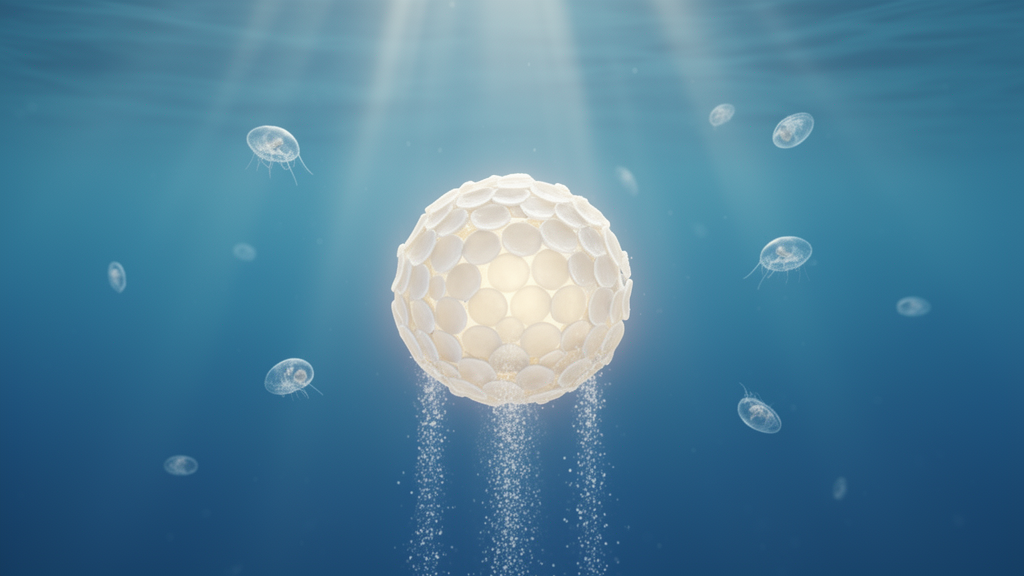
Deep in the world’s oceans, microscopic golden-brown algae have been quietly building tiny calcium carbonate exoskeletons for millions of years. Now, a team of Italian researchers believes these organisms—known as coccolithophores—could hold the key to a new generation of carbon capture and storage technology. In a study published in Frontiers in Photobiology, scientists from the University of Padova and the National Institute of Oceanography and Applied Geophysics (OGS) screened three coccolithophore strains under enriched nutrient and carbon conditions, searching for the most promising candidate for industrial-scale carbon dioxide removal.
Coccolithophores are unusual among microalgae because they partition captured carbon into two distinct reservoirs. Like other photosynthetic microorganisms, they fix CO2 into organic tissues through photosynthesis. But they also precipitate carbon into micrometric plates of calcium carbonate (CaCO3) called coccoliths, which together form an exoskeleton known as the coccosphere. Because the carbon locked in the mineral phase corresponds to roughly 12 percent of the CaCO3 mass, these organisms have the potential to sequester more carbon than microalgae lacking this calcifying strategy. In nature, coccolithophores account for approximately 20 percent of oceanic primary productivity and contribute up to half of the roughly 1.6 petagrams of calcite produced annually in the pelagic zone.
What makes coccolithophores especially attractive for carbon capture and storage (CCUS) is the fate of their mineral carbon. In most microalgal systems, CO2 captured during growth is eventually released back to the atmosphere when biomass degrades or is consumed. By contrast, a substantial fraction of carbon in coccolithophores precipitates as CaCO3 and is stored over long timescales in deep-sea sediments, providing a unique form of carbon sequestration among microalgae. Their complex coccolith architecture also offers potential for nanotechnology, biomedicine, and sustainable materials, promoting reuse within a circular economy.
Despite this promise, comprehensive knowledge of coccolithophore biotechnological potential remains limited. These algae typically thrive in oligotrophic ocean waters, which may have constrained research into their response to nutrient-rich conditions. However, some opportunistic taxa—such as Chrysotila roscoffensis and Gephyrocapsa huxleyi (formerly Emiliania huxleyi)—are well adapted to turbulent, eutrophic environments and seasonally form large oceanic blooms. The research team selected one strain of G. huxleyi and two strains of C. roscoffensis, chosen based on published evidence of successful cultivation in bioreactors, reports of intense natural blooms in high-nutrient environments, and high calcification capacity.
The experimental design tested three conditions: a slightly modified f/2 medium as a baseline, an enhanced macronutrient supply (N70) with nitrogen raised to 70 mg/L and phosphorus to 8 mg/L, and a carbon-replete condition (N70 + C) that added daily spikes of sodium bicarbonate (NaHCO3) delivering approximately 13 mg of carbon per liter per day. The researchers chose bicarbonate addition rather than continuous CO2 bubbling because coccolithophores are sensitive to bubbling, and bicarbonate offers a more stable dissolved inorganic carbon pool while avoiding rapid CO2 outgassing. At the observed pH values above 8, bicarbonate ions dominate the medium’s carbonate chemistry.
The results revealed a striking pattern. For all three strains, nutrient enrichment alone (N70) did not increase total mass, confirming that carbon availability remained the pivotal limiting factor. But adding bicarbonate changed everything. One C. roscoffensis strain (CS2) proved the most promising overall, exhibiting the highest dry weight of 1,172.7 ± 42.2 mg/L and total CO2 absorption of 1,210.7 ± 3.1 mg/L, compared to G. huxleyi at 569.4 ± 20.5 mg/L and 329.9 ± 11.9 mg/L respectively. The CS2 strain also maintained a stable ratio between particulate inorganic carbon (PIC) and particulate organic carbon (POC) during cultivation—an attractive trait for future large-scale applications.
The two species responded to carbon supplementation in fundamentally different ways. G. huxleyi preferentially increased calcification, producing a PIC:POC ratio of 2.1 ± 1.1 under enhanced carbon supply—unusually high compared with the maximum of 1.38 previously reported in the literature. This means the optical density increases in G. huxleyi cultures primarily reflected coccolith production rather than organic biomass growth. The researchers verified this through a clever decalcification experiment: when they dissolved the calcium carbonate from G. huxleyi cultures using acid, the measured optical density dropped from 1.75 to 0.45, confirming that detached coccoliths had biased optical readings. In contrast, C. roscoffensis strains showed substantial gains in both organic and inorganic fractions, with CS2 recording the highest organic biomass accumulation of 480.8 ± 17.3 mg/L.
Nutrient consumption data reinforced these interpretations. The C. roscoffensis strains consumed far more nitrogen than G. huxleyi under carbon-replete conditions—up to 47.4 ± 1.7 mg/L for CS2 compared to just 7.4 ± 2.2 mg/L for G. huxleyi. Phosphorus was almost completely depleted (approximately 100 percent) for both C. roscoffensis strains under N70 + C, consistent with the onset of phosphorus limitation for further growth. Statistical analysis using two-way ANOVA confirmed that organic biomass was strongly affected by strain, nutrient condition, and their interaction (all p < 0.001), with only the C. roscoffensis strains exhibiting marked biomass increases under carbon supplementation.
Notably, CS2 stored approximately 311 mg/L of CO2 in its inorganic fraction—more than the 225 mg/L calculated for G. huxleyi despite G. huxleyi’s higher PIC:POC ratio and greater coccolith production. This finding suggests that C. roscoffensis combined higher organic yield with stable inorganic carbon storage, producing the greatest overall CO2 capture among the tested strains. The researchers emphasize that their CO2 estimates are conservative, particularly for species that actively shed coccoliths like G. huxleyi, since detached plates remaining in the culture medium were not explicitly quantified.
The study underscores two practical lessons for coccolithophore cultivation: raising macronutrients alone is insufficient without concurrent increases in bioavailable carbon, and careful control of carbonate chemistry and pH is essential to balance photosynthesis against calcification. The findings also illustrate the value of strain selection within a species—CS2 showed higher nutrient conversion efficiency and greater PIC:POC stability across conditions, making it a promising candidate for forthcoming experiments. Coupled with literature reports showing promising results for related species in photobioreactors and outdoor raceway ponds, the research corroborates that the genus Chrysotila deserves further study as a candidate for large-scale applications where permanent inorganic carbon sequestration is the desired outcome. Beyond carbon storage, optimized coccolithophore productivity could unlock applications in biomedicine, construction, nanotechnology, and sustainable materials—turning these microscopic ocean architects into versatile tools for a circular economy.
Subject of Research: Coccolithophore strain screening for carbon capture and storage applications
Article Title: Harnessing coccolithophores for carbon capture and storage: exploring nutrient enrichment for future biotechnological applications
Article References: Palandri, E., Sforza, E., Ait Abbas, S., Relitti, F., De Vittor, C., Carrara, A., & Bordiga, M. (2026). Harnessing coccolithophores for carbon capture and storage: exploring nutrient enrichment for future biotechnological applications. Frontiers in Photobiology, 4, Article 1742840. https://doi.org/10.3389/fphbi.2026.1742840
Image Credits: AI Generated
DOI: 10.3389/fphbi.2026.1742840
Keywords: coccolithophores, carbon capture, microalgae, CCUS, biotechnology, calcium carbonate, Chrysotila roscoffensis, Gephyrocapsa huxleyi, Harnessing, carbon, capture, storage
News Source: Sloane Callahan. (October 17, 2026). Coccolithophores: Tiny Ocean Algae Could Become Carbon Capture Powerhouses. Scienmag.