Carbon fiber-reinforced polymer composites are prized for their strength and stiffness, but their thermoset matrices make end-of-life recycling notoriously difficult. A new study in the Journal of Materials Science compares a recyclable vitrimer matrix, derived from CO2, against a conventional epoxy in carbon fiber composites, measuring mechanical, thermomechanical and recycling performance head to head.
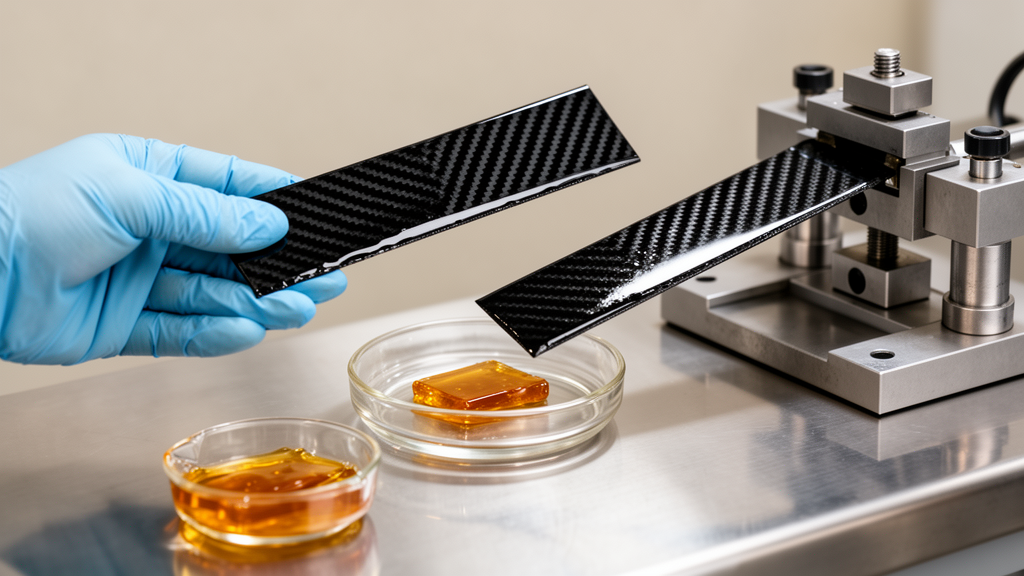
Vitrimer composites were fabricated by hot compression molding. Unlike conventional thermosets, vitrimers can undergo topological rearrangement through bond exchange reactions, which allows the material to be repaired and reprocessed while retaining a crosslinked network. This chemistry is what makes the matrix recyclable, and it is the central motivation for testing whether such a matrix can keep pace with standard epoxy in structural performance.
In tensile testing, the vitrimer/carbon fiber composites reached a tensile strength of 495 MPa and a Young’s modulus of 39 GPa. The conventional epoxy/carbon fiber composites measured 514 MPa and 41 GPa respectively. The authors describe these values as comparable, indicating that swapping the thermoset matrix for a CO2-derived vitrimer costs relatively little in tensile performance.
Flexural testing told a more differentiated story. The vitrimer composite recorded a flexural strength of 385 MPa and a flexural modulus of 42 GPa, while the epoxy composite reached 667 MPa and 45 GPa. The study attributes this gap to matrix softening and interfacial debonding caused by bond exchange reactions, the very molecular rearrangements that give vitrimers their reprocessability.
Dynamic mechanical analysis reinforced that picture. The vitrimer composite showed a reduced storage modulus and an earlier onset of the glass transition temperature compared with the epoxy composite, signifying increased molecular mobility in the vitrimer matrix. In practical terms, the recyclable network begins to soften at lower temperatures, which is favorable for reprocessing but can limit high-temperature structural use.
Scanning electron microscope analysis of fracture surfaces revealed matrix cracking and fiber pull-out in the vitrimer composites, in contrast to the brittle failure observed in the epoxy composite. These morphological differences are consistent with the weaker flexural results and point to a different damage-tolerance character in the recyclable system.
Recycling performance was then put to the test. Recycled vitrimer/carbon fiber composites retained a flexural strength of 256 MPa and a flexural modulus of 40 GPa. The loss of strength relative to the original material was attributed to fiber breakage occurring at the initial failure, meaning the reprocessing step itself did not destroy the carbon fiber reinforcement.
Taken together, the results show that vitrimer composites combine strong mechanical integrity with reprocessability. The authors conclude that this combination offers potential cost advantages in recycling and extends the suitability of these materials for high-performance carbon fiber composite applications, even though flexural properties and thermomechanical stability currently trail the conventional epoxy benchmark.
Subject of Research: Recyclable CO2-derived vitrimer versus conventional epoxy matrices in carbon fiber composites
Article Title: Comparison of CO2-derived vitrimer and conventional epoxy in carbon fiber composites: mechanical, thermomechanical, and recycling performance
Article References: Kumar, V., Kuang, W., Wang, J., Yoon, S., Eagan, J. M., & Joshi, S. S. (2026). Comparison of CO2-derived vitrimer and conventional epoxy in carbon fiber composites: mechanical, thermomechanical, and recycling performance. Journal of Materials Science. https://doi.org/10.1007/s10853-026-13939-7
Image Credits: AI Generated
DOI: 10.1007/s10853-026-13939-7
Keywords: vitrimer, carbon fiber composites, epoxy, recycling, tensile strength, flexural strength, dynamic mechanical analysis, bond exchange, glass transition temperature, hot compression molding, CO2-derived polymers, SEM analysis
News Source: Denise Maddox. (October 28, 2026). CO2-derived vitrimer epoxy matches conventional carbon fiber composites in tensile strength while adding recyclability. Scienmag.