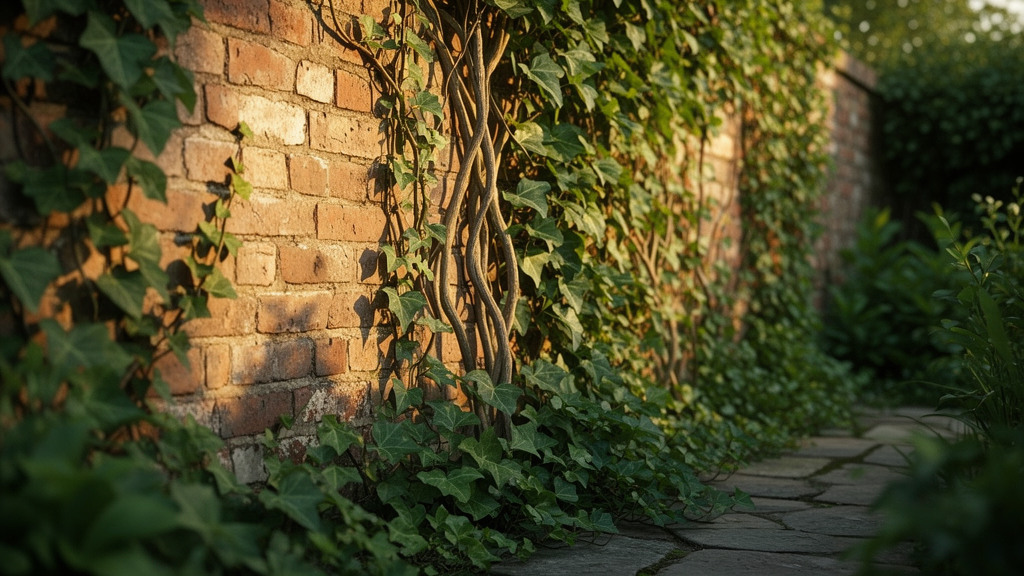
Vertical greening has become one of the most visible tools in modern urban design, transforming concrete walls, pergolas, and trellises into living surfaces that cool buildings, filter air, and soften hard landscapes. Yet landscape architects have long lacked a rigorous, quantitative answer to a deceptively simple question: how long will a given climbing plant take to cover a given wall? A new study published in BMC Plant Biology by Pinger Yu, Zhuoran Li, and colleagues at South China Agricultural University tackles that question head-on, tracking the growth of four ornamental climbers over 150 days and building predictive models that link coverage area to both time and the plants’ own morphology.
The research team worked with four species that are staples of subtropical vertical landscaping: creeping fig (Ficus pumila), Japanese honeysuckle (Lonicera japonica), the climbing vine Parthenocissus dalzielii, and the flame vine (Pyrostegia venusta). Over the course of a 150-day growth experiment, the researchers quantified a suite of traits including stem elongation, branching number, climbing behavior, the distribution of stems and leaves along the support, and, critically, the total area the plants covered. Statistical analysis showed that stem growth and branching increased significantly over time across all four species, with pronounced allometric growth, meaning that different parts of the plant scaled disproportionately with one another as the vines matured.
The headline finding is that each species deploys a fundamentally different coverage strategy. Parthenocissus dalzielii consistently achieved the largest coverage area of the four, a statistically significant advantage that marks it as the clear choice for rapid wall greening. Japanese honeysuckle, by contrast, displayed a significantly positive allometric exponent between cover area and main-stem length, coupled with strong elongation growth and leaves concentrated in the upper canopy. In plain terms, honeysuckle races upward first and fills in later, a strategy the authors suggest suits pergolas and trellises where overhead shade is the goal.
Creeping fig tells the opposite story. Its cover area showed a significantly negative allometric exponent relative to main-stem length, but the species developed the densest stem-leaf structure of any plant in the trial. Rather than racing to the top of a wall, Ficus pumila invests in packing foliage tightly against the surface, producing the kind of thick, self-clinging green curtain prized for blank facades. The flame vine Pyrostegia venusta grew relatively slowly over the experimental period, implying that landscapes relying on its spectacular orange floral display will need a longer establishment window before full coverage is achieved.
On the modeling side, the researchers built two families of predictive equations. The first, a coverage area-time model, predicts how much wall a plant will cover as a function of growth duration. Linear models best fitted the coverage trajectories of creeping fig and Parthenocissus dalzielii, whose steady expansion translated into near-constant rates of area gain. Power models, in which coverage accelerates or decelerates nonlinearly with time, best described Japanese honeysuckle and the flame vine, capturing the way these species’ expansion patterns shift as elongation and branching interact.
The second family of models proved far more powerful. When the researchers replaced time with morphological traits as predictor variables, the models explained substantially more of the variation in coverage area. A four-variable power model performed best for all four species, and the analysis identified lateral branch length and basal stem diameter as the principal determinants of coverage, followed by lateral branch number and internode length. This hierarchy makes intuitive botanical sense: long lateral branches sweep across new surface area, while a thicker base supports the mechanical demands of a heavier canopy, but the study is among the first to quantify these relationships explicitly for vertical greening species.
The practical implications are considerable. Because trait-based models outperformed time-based models in both predicting coverage area and characterizing how coverage forms, nursery growers and landscape designers could, in principle, estimate a young plant’s future wall coverage simply by measuring a few stems and branches, without waiting months to observe the outcome. That opens the door to faster quality control in nurseries, more accurate planting specifications in design contracts, and evidence-based species selection matched to the specific greening target, whether that is a fast-covered wall, a shaded pergola, or a dense evergreen facade.
Beyond horticulture, the study contributes to a broader ecological conversation about liana and climber biology. Allometric growth, the mathematical relationship between the sizes of different plant parts, is a cornerstone of plant ecology, and the species-specific exponents documented here illustrate how closely related climbing habits can mask divergent architectural strategies. Understanding how climbers partition growth between main stems, lateral branches, and foliage along a vertical support offers new insight into the spatial expansion tactics that make vines such successful competitors in both natural forests and built environments.
The work, funded by the National Natural Science Foundation of China, also establishes what the authors describe as a scientific foundation for quantitatively evaluating the landscape performance of vertical greening. As cities worldwide intensify their commitments to green infrastructure, models that convert plant measurements into coverage forecasts could become standard tools in the landscape industry. For now, the message for practitioners is refreshingly concrete: choose Parthenocissus dalzielii when speed matters, Japanese honeysuckle for overhead structures, creeping fig for dense coverage, and allow the flame vine the patience its slower growth demands.
What began as a 150-day experiment with four vines ends as a template for predictive vertical greening. By demonstrating that a handful of measurable morphological traits can forecast coverage performance better than time alone, the South China Agricultural University team has turned an age-old gardening intuition, that the plant matters more than the calendar, into a quantitative framework ready for the walls of the world’s rapidly greening cities.
Subject of Research: Growth dynamics and coverage area modeling of four ornamental climbing plant species
Article Title: Growth dynamics and coverage area models for four climbers: based on time and morphological traits
Article References: Yu, P., Li, Z., Weng, S., Huang, Y., Xu, F., Feng, M., & Zheng, S. (2026). Growth dynamics and coverage area models for four climbers: based on time and morphological traits. BMC Plant Biology. https://doi.org/10.1186/s12870-026-10007-9
Image Credits: AI Generated
DOI: 10.1186/s12870-026-10007-9
Keywords: climbers, vertical greening, allometric growth, coverage area, Ficus pumila, Lonicera japonica, Parthenocissus dalzielii, Pyrostegia venusta, morphological traits, growth models, lianas, urban greening
News Source: Alan Morgan. (October 15, 2026). Climbing Plants Reveal Species-Specific Strategies for Rapid Wall Coverage. Scienmag.