In the dense understory of a European beech forest, the difference between life and death can be measured in centimeters. A new long-term study from the University of Göttingen has revealed that beech seedlings which are only slightly taller than their immediate neighbors at the end of their first year of life enjoy a dramatically higher probability of survival two decades later. The finding, published in the Journal of Ecology, offers one of the most striking demonstrations yet that the earliest moments of a tree’s life can echo through the forest canopy for generations.
The research, led by Professor Christian Ammer of Göttingen University’s Faculty of Forest Sciences and Forest Ecology, spanned more than 25 years of continuous field observation. The team monitored over 2,000 naturally germinated beech seedlings at two research sites in Southern Germany, following their fates from the moment they emerged from the leaf litter. Of the 2,214 seedlings tracked, only 679 survived the full observation period — less than a third of the original cohort. That brutal attrition, the researchers emphasize, was driven not by human intervention or external disturbance but by competition among the seedlings themselves, all of the same species and roughly the same age.
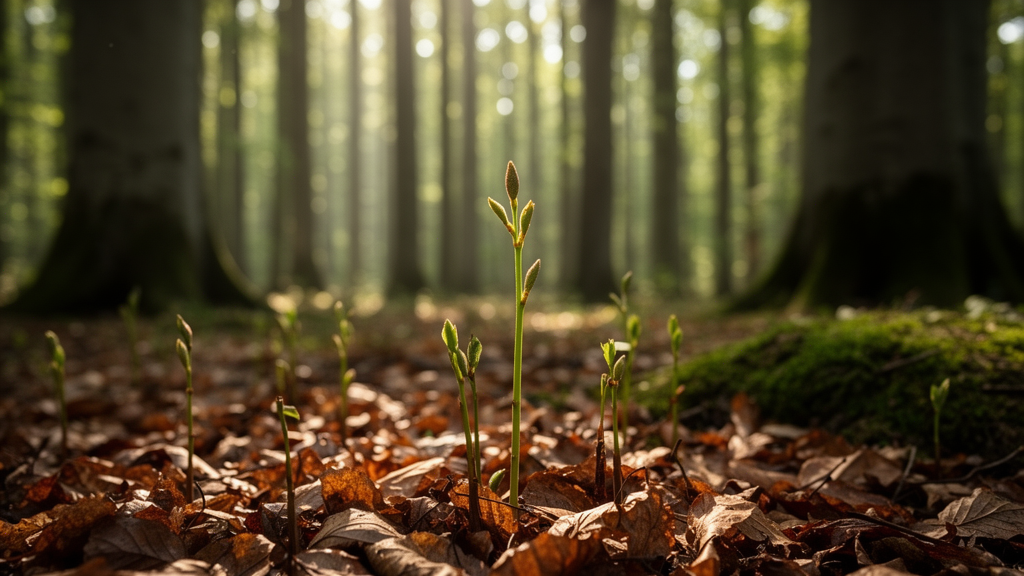
The intensity of this competition is amplified in so-called mast years, periods when trees and shrubs produce an unusually abundant crop of fruits, nuts, and seeds. In a mast year, the forest floor can be carpeted with thousands of germinating seedlings per square meter, all drawing on the same limited pool of light, water, and soil nutrients. The result is a botanical race that begins almost immediately: every millimeter of height gained in the first growing season translates into a slightly better position in the struggle for the sunlight filtering through the canopy above.
What makes the Göttingen study remarkable is the sheer modesty of the advantage that proved decisive. Differences of just one or two centimeters in seedling height at the end of the first year — differences invisible to a casual observer walking through the woods — turned out to be remarkably persistent. Seedlings that were slightly larger than their immediate neighbors in the year of germination typically maintained their relative size advantage year after year. It was very rare for a smaller seedling to catch up with a larger one. Once a tree fell behind in the race, it tended to stay behind, gradually shaded out by its marginally taller rivals until it died.
This pattern connects to one of the oldest and most elegant principles in forest science: the self-thinning of even-aged stands. It has been known for decades that groups of trees of the same age and species thin out over time in nature, even without any human management, and that this process follows mathematical laws. As individual trees grow, the stand reaches a density beyond which it cannot support all its members, and mortality removes the weakest individuals in a predictable way. What ecologists did not know, however, was which of the many seedlings appearing in a given year would ultimately win out. The new results suggest that the lottery is largely decided at the starting line.
The study also uncovered a second, even earlier source of advantage: the seeds themselves. In a parallel greenhouse experiment, the researchers showed that seedlings grown from heavier beech nuts were larger and had greater biomass than those grown from lighter seeds. This means that seed size appears to contribute directly to the initial growth advantage, compounding the effect over time. A heavier nut provides more stored energy reserves, allowing the emerging seedling to push taller in its first season, stake its claim to light, and establish the momentum that carries it through the following decades of competition.
From an ecological and evolutionary perspective, the findings carry significant weight. If a seedling’s fate is substantially sealed within its first year, then the conditions of that first year — seed provisioning, microsite quality, the identity and size of immediate neighbors — exert an influence that persists long after the seedling stage has passed. Maternal effects, such as the resources a mother tree invests in individual nuts, could therefore shape the composition of the next forest generation far more strongly than previously appreciated. In mast years, when thousands of seeds compete in the same patch of ground, even subtle differences in seed mass may determine which genetic lineages make it into the canopy.
The practical implications extend to forestry and forest management as well. Natural regeneration is increasingly relied upon as a low-cost, climate-adapted strategy for establishing the next generation of forests, particularly for European beech, one of the continent’s dominant broadleaf species. Understanding that early size hierarchies are essentially locked in could help managers predict which regeneration cohorts will succeed, assess the likely outcomes of different stand structures, and decide when interventions such as thinning the overstory to release seedlings might be worthwhile. It also underscores the value of protecting seed sources that produce well-provisioned, heavy seeds.
Professor Ammer, who led the research, noted that the process of self-thinning among same-aged trees of a single species follows mathematical laws, yet the identity of the eventual winners had remained unknown until now. The trees followed in the study have now reached approximately 15 meters in height, and the team points out that it remains to be seen how these individuals will develop under ongoing climate change. Whether the growth advantages identified in the study will persist despite the extreme weather conditions expected in the coming decades — prolonged droughts, heat waves, and late frosts — is a question the researchers say needs to be researched and understood for the future.
For now, the study stands as a vivid reminder that in nature, the race is often won or lost before most observers even notice it has begun. A beech seedling that emerges a couple of centimeters ahead of its siblings in its first autumn is not merely slightly taller; it has, in effect, secured a head start that may protect it for the next twenty-five years and beyond. The forest floor in a mast year may look like chaos — a green haze of thousands of identical-looking seedlings — but the Göttingen team’s quarter-century of patient measurement reveals an underlying order: size matters from the very start, and the smallest of early advantages can grow, season by season, into the difference between a towering canopy tree and a forgotten stem that never made it out of the shade.
Subject of Research: Long-term effects of early seedling and seed size differences on beech tree survival and growth
Article Title: Trees: On your marks, get set, grow!
Article References: Trees: On your marks, get set, grow!. (n.d.). Original publication
Image Credits: AI Generated
DOI: Not provided
Keywords: beech, seedlings, forest ecology, self-thinning, mast years, seed size, competition, Journal of Ecology, University of Göttingen, natural regeneration, tree survival, long-term study
News Source: Alan Morgan. (October 14, 2026). Tiny Head Starts Decide Which Beech Trees Survive for Decades. Scienmag.