Salt is quietly strangling one of the world’s most beloved fruit trees. Mango, a tropical staple worth billions of dollars annually, is notoriously sensitive to salinity, and as seawater intrusion and irrigation with brackish water intensify across arid regions, growers are running out of options. Now a team of Egyptian researchers has shown that two humble, inexpensive treatments—glycine betaine, a natural osmoprotectant, and algae extract, a seaweed-derived biostimulant—can dramatically rescue young mango rootstocks from salt damage, and that the best treatment depends on which rootstock a nursery chooses. The findings, published in BMC Plant Biology, offer a practical, low-cost playbook for mango propagation in an increasingly salty world.
The research team, led by Mohamed S. Gawish of Damietta University together with colleagues from Tanta University, Al-Azhar University, the Horticulture Research Institute, and Kafrelshaikh University, focused on two of Egypt’s most widely used mango rootstocks: Sokkary and Gahrawy. These are the rootstocks onto which commercial mango scions are grafted, meaning their ability to cope with salt in the soil and irrigation water directly determines whether a young orchard thrives or fails. The scientists irrigated potted seedlings of both rootstocks with ordinary tap water or with seawater diluted to 1500 or 3000 parts per million, levels that mimic the saline irrigation water increasingly common in coastal and delta agriculture.
The damage from salt was swift and measurable. Salinity significantly reduced plant height, stem diameter, leaf area, and chlorophyll content, while also lowering the crucial potassium-to-sodium ratio in leaf tissue. That ratio matters because potassium fuels enzyme activity and stomatal function, whereas sodium accumulates to toxic levels, disrupting membranes and starving plants of the nutrients they need. Under the harshest treatment, 3000 ppm seawater, untreated seedlings of both rootstocks managed to reach only 24 to 25 centimeters in height—stunted specimens of what healthy mango nursery stock should be.
Beneath the visible stunting, the researchers documented the molecular fingerprints of salt stress. Levels of malondialdehyde, a marker of lipid peroxidation in cell membranes, climbed as salt concentrations rose, as did hydrogen peroxide, a reactive oxygen species that damages proteins and DNA. In response, the seedlings ramped up their antioxidant enzyme systems, the plant equivalent of an emergency repair crew. These biochemical indicators confirmed that the seedlings were under genuine oxidative siege, not merely growing slowly, and gave the team a quantitative baseline against which to judge the biostimulant treatments.
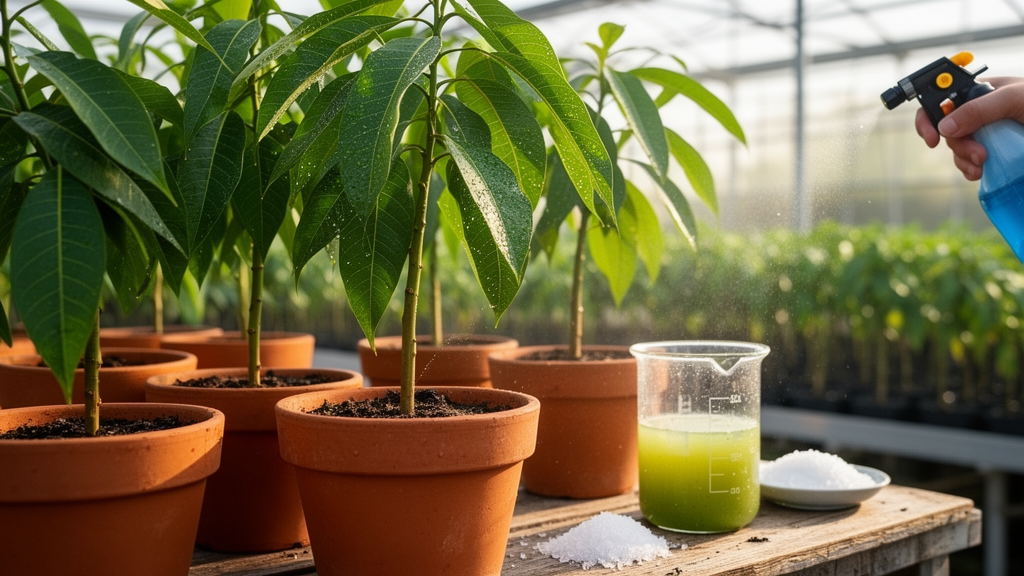
Then came the rescue. When the researchers sprayed the seedlings with glycine betaine or algae extract, the results were striking. At 3000 ppm seawater, glycine betaine application on Gahrawy seedlings and algae extract application on Sokkary seedlings restored plant height to 42.25 and 40.00 centimeters respectively—nearly doubling the height of untreated salt-stressed plants. Glycine betaine, a small quaternary ammonium compound that plants naturally accumulate under stress, works as an osmolyte, helping cells retain water and stabilize proteins and membranes even when external salt concentrations would otherwise pull moisture out of tissues.
The two rootstocks, however, told different stories. Gahrawy proved to be the intrinsically tougher customer, retaining more potassium in its leaves at 2.174 percent, producing more of its own endogenous glycine betaine at 2.91 micromoles per gram of dry weight, and showing stronger baseline antioxidant capacity, measured as 40.23 percent DPPH radical scavenging. Sokkary, by contrast, was more salt-sensitive on its own but responded far more vigorously to biostimulant applications, particularly glycine betaine under severe salinity. This genotype-by-treatment interaction is the study’s central insight: there is no universal fix, and matching the biostimulant to the rootstock is what unlocks the full benefit.
The numbers behind glycine betaine’s performance are compelling. In Gahrawy seedlings irrigated with 1500 ppm seawater, glycine betaine treatment pushed plant height to 50.0 centimeters, and at the severe 3000 ppm level it reduced leaf sodium accumulation by up to 51 percent. That sodium exclusion is critical, because limiting how much salt enters and accumulates in leaves is one of the primary mechanisms by which plants tolerate saline conditions. The treatment also improved osmotic adjustment, ion homeostasis, and chlorophyll stability, meaning treated plants could keep photosynthesizing under conditions that would normally bleach their leaves and shut down carbon fixation.
Algae extract worked through a complementary route. Rather than primarily boosting osmotic protection, the seaweed-derived spray enhanced antioxidant activity, reaching 53.0 percent DPPH scavenging in treated plants, while promoting leaf expansion and vascular development. Seaweed extracts are known to contain a cocktail of bioactive compounds, including cytokinins, betaines, polysaccharides, and micronutrients, which can stimulate growth and prime plant defense systems. The anatomical analyses in this study added a structural dimension: treated plants developed improved vascular tissue organization, suggesting that the extract helped seedlings maintain the plumbing needed to transport water and nutrients even as salt threatened to disrupt it.
Perhaps most intriguingly, the team’s microscopic examination of leaf and stem anatomy revealed genotype-specific structural adaptations associated with salinity tolerance. Differences in tissue organization between Sokkary and Gahrawy help explain why the two rootstocks respond differently to both salt and the biostimulants. Such anatomical evidence is often missing from biostimulant studies, which tend to stop at biochemical measurements, but it provides a mechanistic bridge between what happens at the cellular level and what a grower sees in the nursery bed. The fact that structural adaptations differed between genotypes reinforces the conclusion that salt tolerance in mango is a multi-layered trait, woven from ion regulation, antioxidant chemistry, and physical architecture all at once.
For mango growers and nursery operators in Egypt and across the salinity-prone tropics, the practical implications are immediate. Foliar sprays of glycine betaine or algae extract are inexpensive, easy to apply, and compatible with existing nursery routines, making them far more accessible than genetic engineering or expensive soil remediation. The study suggests a simple decision rule: pair Gahrawy rootstock with glycine betaine and lean on its inherent salt tolerance, or choose Sokkary and boost it with algae extract or glycine betaine when salinity is unavoidable. As climate change pushes seawater further inland and freshwater for irrigation grows scarcer, such sustainable, genotype-matched biostimulant strategies may become essential tools for keeping mango orchards—and the livelihoods that depend on them—alive in salty ground.
Subject of Research: Effects of glycine betaine and algae extract on salinity tolerance of two mango rootstocks
Article Title: Genotype performance, biochemical and anatomical response of two mango rootstocks to glycine betaine and algae extract under salinity stress
Article References: Gawish, M. S., Abo-Ogiala, A. M., Abdel-Aziz, E. A., Ahmed, E.-E. A., El-Enien, M. S. A., & Salama, A.-M. (2026). Genotype performance, biochemical and anatomical response of two mango rootstocks to glycine betaine and algae extract under salinity stress. BMC Plant Biology, 26(1), Article 1661. https://doi.org/10.1186/s12870-026-09893-w
Image Credits: AI Generated
DOI: 10.1186/s12870-026-09893-w
Keywords: mango rootstocks, salinity stress, glycine betaine, algae extract, antioxidant enzymes, oxidative stress, Sokkary, Gahrawy, plant physiology, biostimulants, climate resilience, BMC Plant Biology
News Source: Alan Morgan. (October 14, 2026). Seawater Sprays and Algae Extracts Help Mango Rootstocks Beat Salt Stress. Scienmag.