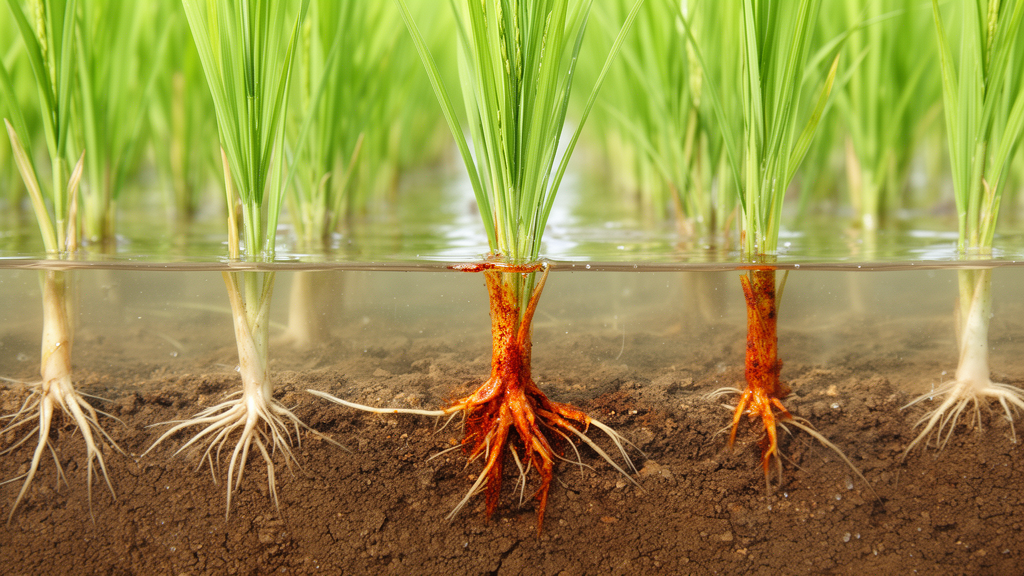
Beneath every flooded rice paddy lies a chemical battleground where carbon is either locked away for centuries or converted into greenhouse gases within days. A new study published in Plant and Soil has revealed that one of the most important arbiters of this contest is something almost invisible to the naked eye: a thin, rust-colored coating of iron minerals called iron plaque that forms on rice roots. The research, led by Yuyao Luo, Fei Huang and Hui Tong and their colleagues at Guangdong University of Technology, South China Agricultural University and partner institutions, shows that this coating is not the permanent carbon vault scientists once hoped it might be. Instead, it behaves as a phase-dependent regulator, first preserving soil organic carbon and then, as flooding deepens, handing that carbon over to microbes that release it as carbon dioxide and methane.
Iron plaque forms because rice, like other wetland plants, must cope with waterlogged soils that are starved of oxygen. Rice roots leak small amounts of oxygen into the surrounding soil through a tissue called aerenchyma, a process known as radial oxygen loss. This oxygen oxidizes soluble ferrous iron, Fe(II), in the soil, precipitating it as ferric oxides and hydroxides directly on the root surface. The resulting plaque is chemically reactive: its iron oxides can adsorb and co-precipitate dissolved organic molecules, forming what researchers describe as iron-bound soil organic carbon, or Fe-SOC. For years, this mechanism has been viewed as a promising carbon sequestration pathway, a so-called rusty sink that could help paddy soils store carbon and slow climate change. The new findings complicate that optimistic picture considerably.
The team designed a controlled experiment comparing rice plants with pre-induced iron plaque, labeled IP, against a non-pre-induced control group, labeled CK, both grown under flooded paddy soil conditions. Over a 28-day incubation, they tracked an unusually comprehensive set of variables: the abundance of iron plaque, the activity of carbon-degrading enzymes, the emission rates of carbon dioxide and methane, the quantity of iron-bound organic carbon, the structure of the microbial community, and the abundance of functional genes involved in iron reduction and methane cycling. This combination of chemical, enzymatic and molecular measurements allowed them to watch the iron-carbon drama unfold in real time rather than infer it from a single snapshot.
The headline result is striking. The presence of iron plaque increased soil carbon dioxide emissions by 27.4 percent and methane emissions by 31.2 percent, both statistically significant differences. In other words, the very structure that traps carbon on root surfaces also appears to stimulate the microbial machinery that converts carbon into greenhouse gases. The mechanism, according to the data, runs through iron-reducing bacteria. Copy numbers of Geobacter-related iron-reducing bacteria were 32.5 percent higher in rhizosphere soil and 19.9 percent higher on roots in the iron plaque treatment compared with the control. These bacteria respire ferric iron instead of oxygen, and in doing so they dissolve the very iron oxides that hold organic carbon in place.
The fate of the iron-bound carbon pool told a story in two acts. During the first three days of the experiment, iron-bound soil organic carbon in the plaque treatment climbed to 2.86 grams per kilogram, significantly higher than in the control. This was the preservation phase: freshly formed iron oxides were scavenging carbon from the soil solution and locking it into mineral-associated forms. But from day 3 to day 28, that pool collapsed by 62.3 percent. As flooding drove the soil increasingly anoxic, iron-reducing bacteria gained the upper hand, dissolving the iron minerals and releasing their carbon cargo. Once freed, that organic matter became food. Carbon-degrading enzyme activities rose by 13.7 to 37.2 percent in the plaque treatment, indicating that the microbial community had shifted into a catabolic mode, actively breaking down complex organic molecules.
This sequence reveals a fundamental trade-off at the heart of iron-carbon coupling in wetland soils. Iron plaque is simultaneously a carbon preservative and a carbon destabilizer, and which role dominates depends on the redox state of the soil. In the early days after plaque formation, when oxygen leakage from roots keeps the immediate root surface relatively oxidized, iron oxides accumulate and carbon retention wins. As the floodwater seals the soil from the atmosphere and microbial respiration consumes remaining oxygen, the balance tips. Ferric iron becomes the preferred electron acceptor for anaerobic microbes, and the plaque dissolves from the outside in, releasing previously protected carbon into an active microbial food web that ends in carbon dioxide and methane.
The molecular data reinforce this interpretation. Geobacter species are well-known dissimilatory iron reducers, organisms that couple the oxidation of organic matter or hydrogen to the reduction of Fe(III) minerals. Their proliferation in the rhizosphere of plaque-bearing plants is exactly what one would expect when an abundant supply of ferric iron is available as an electron acceptor. Meanwhile, the elevated enzyme activities suggest that the released organic carbon, having been concentrated on mineral surfaces, may arrive in a form that microbes can access efficiently once the minerals dissolve. The authors’ conclusion that iron plaque acted as a phase-dependent regulator rather than a permanent carbon sink follows directly from this chain of evidence.
The implications reach well beyond the laboratory. Paddy fields cover vast areas of Asia and are among the largest anthropogenic sources of atmospheric methane, a greenhouse gas roughly 28 times more potent than carbon dioxide over a century. Rice paddies also hold enormous stocks of soil organic carbon, and iron-associated stabilization has been proposed as a mechanism that could be managed to enhance that storage. The new study suggests that such management would need to account for redox dynamics. Practices that keep soils more oxidized, such as alternate wetting and drying or midseason drainage, might extend the preservation phase of iron-bound carbon and suppress the iron-reducing bacteria that unlock it. Conversely, prolonged continuous flooding, while favorable for methane production in general, appears to accelerate the destabilization of the iron-carbon pool specifically.
There is also a cautionary lesson for carbon accounting. If models treat iron-bound organic carbon in wetland soils as a stable, permanent pool, they may substantially overestimate the sequestration potential of these systems. The 62.3 percent decline observed over just 25 days in this experiment illustrates how quickly mineral-associated carbon can be remobilized when conditions change. Any credible assessment of soil carbon storage in rice systems, or in freshwater wetlands more broadly, must therefore incorporate the coupled iron and carbon cycles and the microbial communities that link them, rather than treating mineral stabilization as a one-way street.
The research, published on 27 August 2026 in Plant and Soil with the DOI 10.1007/s11104-026-09023-3, was supported by the National Science Foundation of China and regional science foundations in Guangdong. Its authors emphasize that the findings highlight the need to consider redox-dependent iron and carbon cycling when evaluating soil organic carbon storage and greenhouse gas emissions in paddy soils. For a crop that feeds half the world’s population and occupies a central place in the global carbon budget, understanding that the rusty armor on rice roots can flip from shield to source is a genuinely consequential step forward. Future work will likely explore how cultivar choice, silicon nutrition, water management and iron amendments might be tuned to keep the plaque in its protective phase for longer, buying time for carbon in the soil while keeping methane in the ground.
Subject of Research: Iron plaque-mediated microbial iron cycling and its trade-off effects on soil organic carbon preservation and greenhouse gas mineralization in flooded paddy soil
Article Title: Root Fe plaque mediates microbial Fe cycling: trade-off effects on soil organic carbon preservation and mineralization in flooded paddy soil
Article References: Luo, Y., Chen, J., Liu, C., Chen, M., Li, X., Wang, Z., Qiao, J., Huang, F., & Tong, H. (2026). Root Fe plaque mediates microbial Fe cycling: trade-off effects on soil organic carbon preservation and mineralization in flooded paddy soil. Plant and Soil. https://doi.org/10.1007/s11104-026-09023-3
Image Credits: AI Generated
DOI: 10.1007/s11104-026-09023-3
Keywords: iron plaque, rice paddy soil, soil organic carbon, iron-reducing bacteria, Geobacter, methane emissions, carbon dioxide emissions, iron-bound organic carbon, rhizosphere, redox cycling, carbon sequestration, soil microbiology
News Source: Alan Morgan. (October 14, 2026). Rust Coats on Rice Roots Turn from Carbon Vaults into Greenhouse Gas Engines. Scienmag.