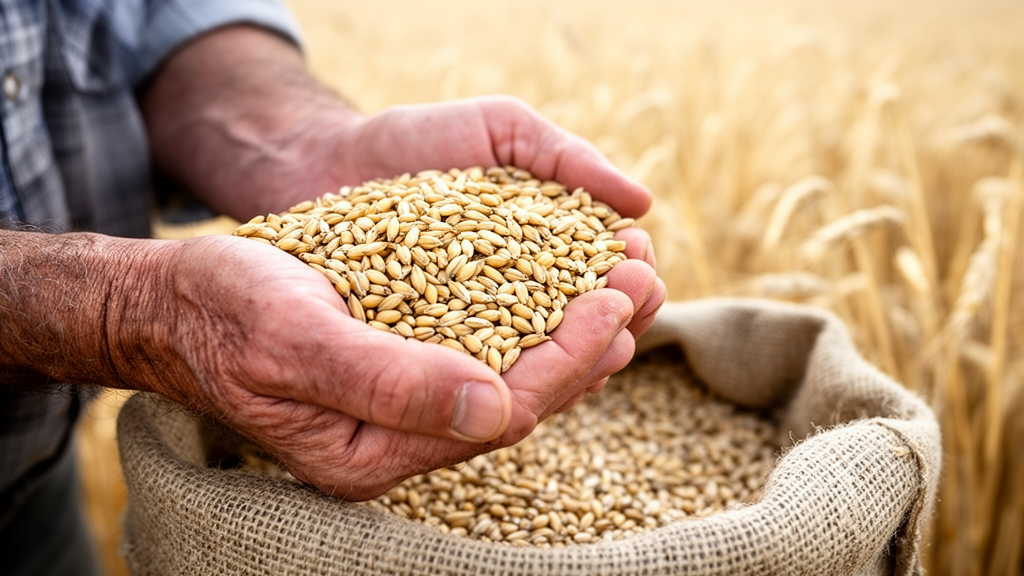
Not all grains on a barley spike are created equal. Grains at the top of the ear and those at the base can differ dramatically in size and weight, even when they are genetic siblings sharing the same plant, the same soil, and the same sunlight. For centuries, farmers and breeders have noticed this positional inequality, but the genetic machinery behind it has remained stubbornly opaque. Now, a team of researchers at Yangzhou University, working with colleagues at the Xizang Academy of Agriculture and Animal Husbandry Sciences, has delivered the most detailed picture yet of how spatial hierarchy shapes grain development in barley, and their findings point to a surprising culprit: asymmetric carbon metabolism during the grain filling stage.
The study, published in Theoretical and Applied Genetics, tackles a trait the authors call grain uniformity, defined as the consistency of grain size among sibling grains within a sample. Uniformity matters far more than it might first appear. In barley, a crop grown on millions of hectares worldwide and prized above all for malting, uneven grain sizes complicate everything from yield estimation to the malting process itself, where kernels of different sizes germinate and modify at different rates. Despite its agronomic importance, the genetic basis of grain uniformity had been almost entirely unexplored, in barley and in cereals generally.
To crack the problem, the researchers deployed a two-pronged strategy that combines population genetics with high-resolution transcriptomics. On the genetic side, they performed a genome-wide association study, or GWAS, on 334 barley accessions, scanning the genomes of this diverse panel for DNA variants that correlate with measures of grain uniformity. This analysis identified six quantitative trait loci, or QTLs, distributed across four of barley’s seven chromosomes: 1H, 2H, 4H, and 5H. These loci represent genomic neighborhoods where natural variation in the barley gene pool influences how consistently grains develop within a single spike.
But knowing where the relevant genes sit on the genome is only half the battle. To understand what those genes actually do, the team turned to spatiotemporal transcriptomics, comparing two barley cultivars that sit at opposite ends of the uniformity spectrum. One cultivar produces grains that are remarkably consistent in size regardless of their position on the spike; the other produces a striking mix of plump apical grains and underfilled basal ones. By dissecting grains from different positions on the spike at different developmental stages and sequencing their RNA, the researchers could watch the molecular drama of grain filling unfold separately in each cultivar.
The results were dramatic. In the non-uniform cultivar, the researchers counted 3,314 genes that were differentially expressed between apical and basal grains at the grain filling stage. In the uniform cultivar, the same comparison yielded only 222 such genes. That is roughly a fifteen-fold difference in transcriptional divergence between grains occupying different positions on the same spike. In other words, in the non-uniform cultivar, the top and bottom of the ear are essentially running two different developmental programs, while in the uniform cultivar, grains everywhere on the spike are marching to nearly the same molecular beat.
What were those thousands of divergent genes doing? Functional analysis revealed that the positional differences clustered around three interconnected metabolic pathways: starch biosynthesis, sugar transport, and trehalose-6-phosphate signaling. All three converge on the same fundamental question that every developing grain faces: how much carbon, in the form of sugars delivered from the photosynthesizing leaves, can it capture and convert into starch, the storage polymer that makes up most of the grain’s final dry weight. Grains that win the competition for carbon fill completely; grains that lose remain shrunken and light.
The involvement of trehalose-6-phosphate, or T6P, is particularly intriguing for crop scientists. T6P is a small signaling sugar that has emerged in recent years as a master regulator of carbon allocation in plants, essentially telling tissues how much sucrose is available and whether to commit to growth and starch synthesis. It does this in part by post-translationally activating ADP-glucose pyrophosphorylase, the rate-limiting enzyme of starch biosynthesis. Recent field trials have even shown that spraying a membrane-permeable T6P precursor on wheat can increase yields, making the pathway a hot target for crop improvement. The new barley study suggests that uneven T6P signaling along the spike may be one of the mechanisms by which a plant inadvertently rations carbon unequally among its grains.
Sugar transport adds another layer to the story. Sugars manufactured in the leaves travel to the developing grains through the phloem, and their final delivery into the grain depends on membrane transport proteins, including members of the SWEET family, which have been shown in maize and rice to be essential for seed filling. If apical and basal grains differ in the expression of these transporters, they effectively differ in their ability to import the sugars flowing past their doorstep. Combined with differences in starch biosynthetic capacity downstream, this creates a competitive hierarchy in which position on the spike translates directly into developmental fate, a phenomenon that echoes the well-documented superior and inferior grain systems of rice panicles.
On the breeding side, the study offers a practical deliverable. The researchers identified four candidate genes located near stable GWAS signals on chromosome 1H, the chromosome carrying the most robust associations with grain uniformity in their panel. From this region they developed a dCAPS marker, a type of PCR-based genetic marker that allows breeders to track the favorable allele in breeding populations without needing to sequence the whole gene. Markers of this kind convert a complex, hard-to-measure trait like uniformity into a simple DNA test, potentially accelerating the selection of barley lines that fill their grains evenly across the entire spike.
The identification of the grain filling stage as the critical window is itself a meaningful finding. Grain development in cereals proceeds through recognizable phases, and the new data pinpoint the filling phase, when starch deposition is at its peak, as the moment when positional inequality is written into the transcriptome. This gives physiologists a defined target: interventions, whether genetic or agronomic, aimed at equalizing carbon supply during filling are most likely to pay off. It also connects barley to a broader literature in wheat and maize, where kernel position effects on grain size and quality have been documented but similarly resistant to genetic dissection.
What makes the study conceptually exciting is its framing of grain heterogeneity as a spatial hierarchy problem rather than a simple yield problem. A barley spike is not a bag of independent seeds; it is an organized axis with inherent apical-basal polarity, and the plant’s own vascular architecture imposes gradients of resource delivery along that axis. The genes uncovered in this study appear to modulate how strongly each grain’s development depends on its position, and the contrast between the two cultivars shows that this dependence is heritable and variable. In the uniform cultivar, the spatial program has been largely flattened; in the non-uniform one, it runs at full strength.
For breeders, the implications extend beyond barley. Grain uniformity touches yield performance and end-use quality across the cereals, and the loci identified here on chromosomes 1H, 2H, 4H, and 5H provide starting points for comparative genomics with wheat and rice, where syntenous regions may harbor orthologous uniformity genes. The candidate genes on 1H, once functionally validated, could reveal whether the underlying mechanism involves sugar sensing, transporter activity, or developmental patterning of the spike itself. Each possibility suggests a different breeding strategy, from editing transporter expression to reshaping spike architecture.
The work also arrives at a moment when barley research is looking toward the future, with community initiatives sketching out decadal visions for the crop’s improvement amid changing climates and growing demand. Uniform grain fill is not just a cosmetic trait; uneven grains represent unrealized yield, and the carbon that a plant invests in underfilled grains is carbon wasted. By showing that the difference between a uniform and a non-uniform spike can be a fifteen-fold difference in positional gene expression, centered on the very pathways that control carbon flow, the Yangzhou team has transformed a longstanding agronomic observation into a molecular roadmap. The next step, functional validation of the chromosome 1H candidates and deployment of the dCAPS marker in breeding programs, will determine how quickly that roadmap translates into barley fields where every grain gets an equal share.
Subject of Research: Genetic and transcriptomic basis of spatial hierarchy-dependent grain uniformity in barley
Article Title: A multi-omic dissection of spatial hierarchy-dependent grain development in barley (Hordeum vulgare L.)
Article References: A multi-omic dissection of spatial hierarchy-dependent grain development in barley (Hordeum vulgare L.). (n.d.). https://doi.org/10.1007/s00122-026-05414-3
Image Credits: AI Generated
DOI: 10.1007/s00122-026-05414-3
Keywords: barley, grain uniformity, GWAS, QTL, transcriptomics, grain filling, starch biosynthesis, sugar transport, trehalose-6-phosphate, SWEET transporters, dCAPS marker, plant breeding
News Source: Alan Morgan. (October 15, 2026). Barley’s Hidden Grain Hierarchy: Genes That Decide Which Seeds Win. Scienmag.