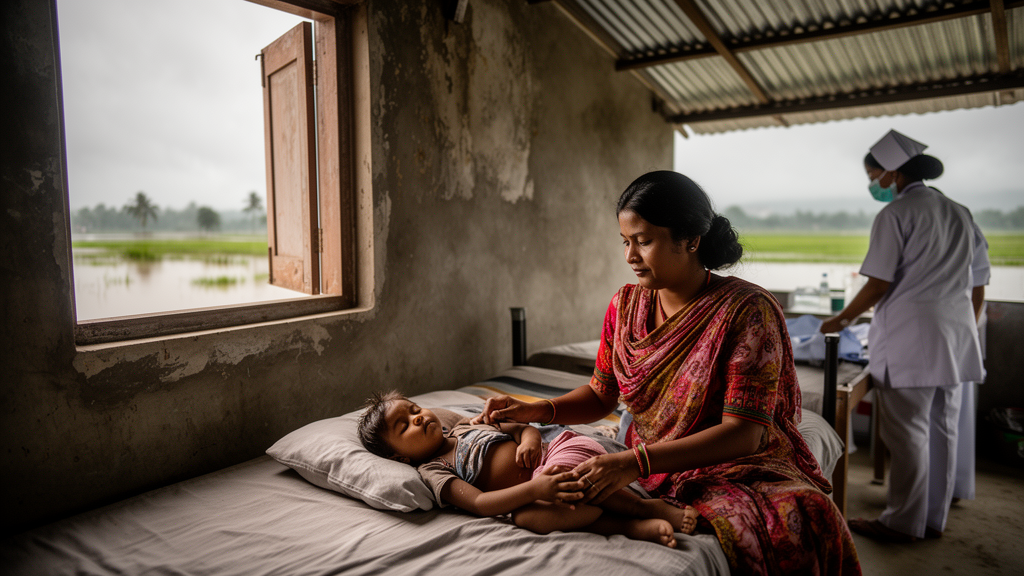
This research, published in BMC Public Health, analyzed data from 8,573 under-five children participating in the 2022 Bangladesh Demographic and Health Survey. The study aimed to quantify the relationship between broad climate vulnerability indicators and the occurrence of common childhood ailments, specifically fever, acute respiratory infection symptoms, or diarrhea, within the two weeks preceding the survey administration. The overall prevalence of recent morbidity within this population was found to be 33.0%, indicating a substantial public health challenge in the region.
The methodology employed in this study involved linking child-level survey records with Climate Vulnerability Index data. This index was sourced from the Local Government Initiative on Climate Change (LoGIC) project, which is supported by the United Nations Development Programme (UNDP) Bangladesh. The use of district identifiers allowed the researchers to correlate localized climate risk profiles with health outcomes at the individual child level. The statistical framework utilized was multivariable logistic regression, which was specifically configured to account for complex sampling designs, including primary sampling unit (PSU) clustering, stratification, and sample weights, ensuring that the estimates were robust and representative of the broader population surveyed.
The primary finding of the study centers on the disparity in morbidity rates based on climate vulnerability status. In the initial bivariate analysis, it was observed that the proportion of children experiencing recent morbidity was highest among those residing in areas classified as having high climate vulnerability. Upon applying multivariable logistic regression to adjust for various confounding factors—including child-specific characteristics, parental demographics, household attributes, and broader regional classifications—the association remained highly significant. Specifically, children residing in high climate vulnerability areas exhibited significantly higher adjusted odds of morbidity compared to their counterparts in low vulnerability areas, yielding an adjusted odds ratio (aOR) of 1.20, with a 95% confidence interval calculated at 1.07–1.35.
The study further detailed that specific age groups showed differential susceptibility; children aged less than 12 months and those between 12 and 35 months exhibited higher odds of morbidity when compared to the 36–59 months age bracket.
Beyond climate exposure, the research also identified several other significant factors influencing child health outcomes. Parental education level, maternal age at the time of first birth, the specific geographic region of residence, and religious affiliation were all found to be significantly associated with child morbidity. These findings underscore the multifactorial nature of childhood health in Bangladesh, where environmental stressors intersect with established socio-economic determinants of health. The inclusion of these covariates in the multivariable model demonstrates the study’s comprehensive approach to isolating the specific effect of climate vulnerability from other known health predictors.
The scope of this cross-sectional study is limited by its design, which captures a snapshot of health status at a single point in time. While it identifies associations, it does not establish direct causality between climate vulnerability and morbidity, as is typical for cross-sectional designs.
The implications of these results are substantial for public health policy and adaptation planning in Bangladesh. The study concludes that recent morbidity affects approximately one in three under-five children in the country. The clear, statistically significant association between district-level climate vulnerability and this health burden necessitates a strategic shift in how climate risk is addressed. Integrating climate vulnerability evidence into child health planning, strengthening primary health care infrastructure, and developing targeted adaptation strategies specifically for highly vulnerable geographic areas are presented as critical imperatives.
Subject of Research: The association between district-level climate vulnerability and child morbidity in Bangladesh using data from the 2022 Bangladesh Demographic and Health Survey.
Article Title: Climate vulnerability and child morbidity in Bangladesh: evidence from a nationally representative public health survey
Article References: Roy, D., Methun, M. I. H., Ahmed, E., Ahmed, T. T., & Hossen, M. A. (2026). Climate vulnerability and child morbidity in Bangladesh: evidence from a nationally representative public health survey. BMC Public Health. https://doi.org/10.1186/s12889-026-29702-1
Image Credits: AI Generated
DOI: 10.1186/s12889-026-29702-1
Keywords: Climate Change, Public Health, Child Morbidity, Bangladesh, Climate Vulnerability, Epidemiology, Health Disparities, UNDP, Climate, vulnerability, child, morbidity
News Source: Sloane Callahan. (October 28, 2026). Climate Vulnerability Linked to Increased Child Morbidity in Bangladesh Study Reveals. Scienmag.