• HOME
  • NEWS
  • EXPLORE
    • CAREER
      • Companies
      • Jobs
    • EVENTS
    • iGEM
      • News
      • Team
    • PHOTOS
    • VIDEO
    • WIKI
  • BLOG
  • COMMUNITY
    • FACEBOOK
    • INSTAGRAM
    • TWITTER
Thursday, August 20, 2026
BIOENGINEER.ORG
No Result
View All Result
  • Login
  • HOME
  • NEWS
  • EXPLORE
    • CAREER
      • Companies
      • Jobs
        • Lecturer
        • PhD Studentship
        • Postdoc
        • Research Assistant
    • EVENTS
    • iGEM
      • News
      • Team
    • PHOTOS
    • VIDEO
    • WIKI
  • BLOG
  • COMMUNITY
    • FACEBOOK
    • INSTAGRAM
    • TWITTER
  • HOME
  • NEWS
  • EXPLORE
    • CAREER
      • Companies
      • Jobs
        • Lecturer
        • PhD Studentship
        • Postdoc
        • Research Assistant
    • EVENTS
    • iGEM
      • News
      • Team
    • PHOTOS
    • VIDEO
    • WIKI
  • BLOG
  • COMMUNITY
    • FACEBOOK
    • INSTAGRAM
    • TWITTER
No Result
View All Result
Bioengineer.org
No Result
View All Result
Home NEWS Science News Chemistry

Climate change affects the likelihood of armed conflict

Bioengineer by Bioengineer
June 24, 2022
in Chemistry
Reading Time: 2 mins read
0
Climate change affects the likelihood of armed conflict
Share on FacebookShare on TwitterShare on LinkedinShare on RedditShare on Telegram

Climate change influences the likelihood and duration of armed conflicts in Africa. This is the result of a study carried out by a team from the INGENIO Institute, a joint centre of the Universitat Politècnica de València (UPV) and the Consejo Superior de Investigaciones Científicas (CSIC), together with the University of Rome III and the University of Urbino Carlo Bo, published in the latest issue of the journal Economía Política.
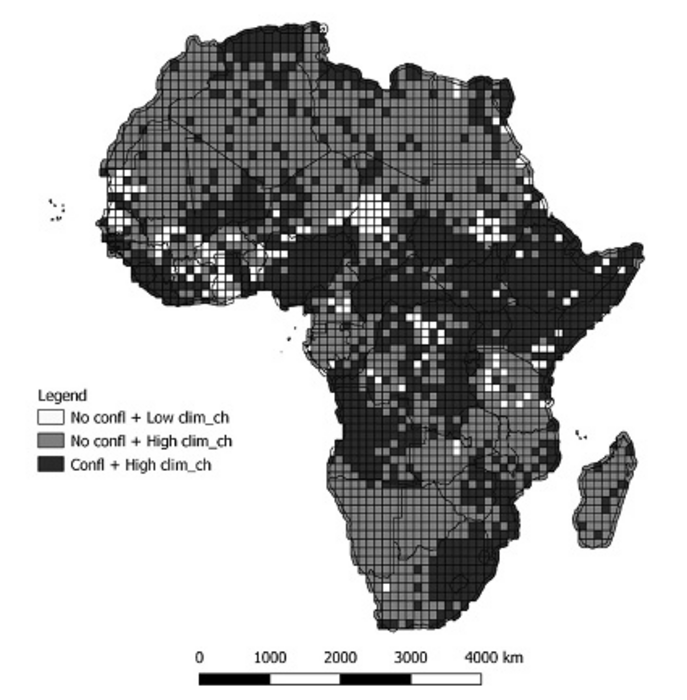
Climate change affects the likelihood of armed conflict

Credit: UPV

Climate change influences the likelihood and duration of armed conflicts in Africa. This is the result of a study carried out by a team from the INGENIO Institute, a joint centre of the Universitat Politècnica de València (UPV) and the Consejo Superior de Investigaciones Científicas (CSIC), together with the University of Rome III and the University of Urbino Carlo Bo, published in the latest issue of the journal Economía Política.

The team of researchers based their study on data from the African continent from 1990 to 2016. Using a negative binomial regression mathematical model, they assessed whether certain climatic phenomena, in combination with the socio-economic characteristics of the areas studied, affected the likelihood of a conflict breaking out and, if it did, its duration.

Among its findings, the study states that a prolonged increase in temperature and precipitation increases the probability of conflict beyond the affected area by four to five times, specifically in populations up to a radius of about 550 km.

The study also concludes that, in Africa, food shortages due to drought increase the possibility of conflict, especially if water shortages persist for at least three years. Conversely, excess rainfall triggers conflict, but in a very short period of time.

Implications for adaptative policies

“The results we have obtained have far-reaching implications for territorial policies on the African continent. For example, changes in climatic conditions influence the likelihood of conflict over large areas, which means that the design of climate adaptation policies must consider the particularities of each territory,” says Davide Consoli, a researcher at the INGENIO Institute and one of the authors of the study.

The INGENIO, University of Rome and University of Urbino team also points out that the persistence of violence requires the implementation of climate change adaptation strategies designed in combination with peacekeeping measures, especially in those areas most prone to armed conflict.

“These measures are essential in the design and implementation of adaptive strategies for climate resilience. In fact, poorly designed adaptation interventions can exacerbate existing inequalities and increase the risk of conflict,” concludes Consoli.


Journal

Economía y Política

DOI

10.1007/s40888-022-00271-x

Method of Research

Data/statistical analysis

Subject of Research

Not applicable

Article Title

Climate change and armed conflicts in Africa: temporal persistence, non-linear climate impact and geographical spillovers

Article Publication Date

10-Jun-2022

Share12Tweet8Share2ShareShareShare2

Related Posts

SETI Institute Team Develops New Method to Locate Space Resources

SETI Institute Team Develops New Method to Locate Space Resources

August 20, 2026
New Insights Reveal How the Atlantic Circulation Changes and Moves

New Insights Reveal How the Atlantic Circulation Changes and Moves

August 19, 2026

Organobismuth Transporter Enables Regioselective α-Arylation of Diverse Carbonyl Compounds

August 19, 2026

Quantum Simulators Gain Reliable Error Estimates

August 19, 2026

POPULAR NEWS

  • New benchmarks measure how effectively neuromorphic devices emulate biological brains

    29 shares
    Share 12 Tweet 7
  • Scientists map B7-H3 across tumour stroma, blood vessels and immune cells

    29 shares
    Share 12 Tweet 7
  • Oxygen vacancies enable rapid ion transport in advanced battery materials

    29 shares
    Share 12 Tweet 7
  • Study uncovers overlooked DNA mutation pattern linked to colorectal cancer

    29 shares
    Share 12 Tweet 7

About

We bring you the latest biotechnology news from best research centers and universities around the world. Check our website.

Follow us

Recent News

New benchmarks measure how effectively neuromorphic devices emulate biological brains

Scientists map B7-H3 across tumour stroma, blood vessels and immune cells

Oxygen vacancies enable rapid ion transport in advanced battery materials

Subscribe to Blog via Email

Enter your email address to subscribe to this blog and receive notifications of new posts by email.

Join 85 other subscribers
  • Contact Us

Bioengineer.org © Copyright 2023 All Rights Reserved.

Welcome Back!

Login to your account below

Forgotten Password?

Retrieve your password

Please enter your username or email address to reset your password.

Log In
No Result
View All Result
  • Homepages
    • Home Page 1
    • Home Page 2
  • News
  • National
  • Business
  • Health
  • Lifestyle
  • Science

Bioengineer.org © Copyright 2023 All Rights Reserved.