• HOME
  • NEWS
  • EXPLORE
    • CAREER
      • Companies
      • Jobs
    • EVENTS
    • iGEM
      • News
      • Team
    • PHOTOS
    • VIDEO
    • WIKI
  • BLOG
  • COMMUNITY
    • FACEBOOK
    • INSTAGRAM
    • TWITTER
Thursday, July 30, 2026
BIOENGINEER.ORG
No Result
View All Result
  • Login
  • HOME
  • NEWS
  • EXPLORE
    • CAREER
      • Companies
      • Jobs
        • Lecturer
        • PhD Studentship
        • Postdoc
        • Research Assistant
    • EVENTS
    • iGEM
      • News
      • Team
    • PHOTOS
    • VIDEO
    • WIKI
  • BLOG
  • COMMUNITY
    • FACEBOOK
    • INSTAGRAM
    • TWITTER
  • HOME
  • NEWS
  • EXPLORE
    • CAREER
      • Companies
      • Jobs
        • Lecturer
        • PhD Studentship
        • Postdoc
        • Research Assistant
    • EVENTS
    • iGEM
      • News
      • Team
    • PHOTOS
    • VIDEO
    • WIKI
  • BLOG
  • COMMUNITY
    • FACEBOOK
    • INSTAGRAM
    • TWITTER
No Result
View All Result
Bioengineer.org
No Result
View All Result
Home NEWS Science News Technology

Climate benefit and ecological cost trade-offs for ocean iron fertilization

Bioengineer by Bioengineer
July 30, 2026
in Technology
Reading Time: 2 mins read
0
Climate benefit and ecological cost trade-offs for ocean iron fertilization
Share on FacebookShare on TwitterShare on LinkedinShare on RedditShare on Telegram

blank

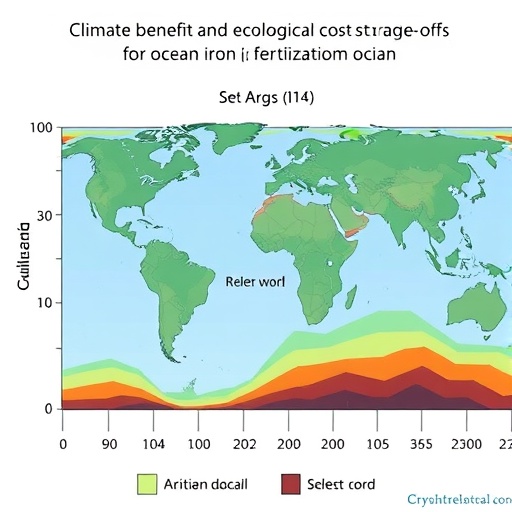
Ocean iron fertilization (OIF) is being discussed as a potential carbon dioxide removal (CDR) strategy1. Yet the trade-offs between climate benefits and ecological costs remain poorly understood2,3,4. Here we use a process-rich ocean biogeochemical model with validated representations of marine biodiversity and biogeochemistry5 to quantify fertilization potential and ecosystem impact across ten ocean biomes over 60 years. We find regional disparities in climate ecosystem trade-offs: biomes with comparable CDR efficiency have contrasting ecological outcomes. The Southern Ocean and the equatorial Pacific achieve the highest efficiencies through distinct pathways: the former through non-local downstream carbon export, the latter through local export with downstream loss, as fertilized blooms deplete macronutrients in source water, suppressing non-local productivity. Consequently, equatorial fertilization reduces energy flows to higher trophic levels, expands oxygen-minimum zones (OMZs) and reduces macrozooplankton biomass. These ecosystem impacts are potentially avoidable by shifting deployment to higher latitudes. Post-fertilization recovery experiments reveal ecosystem resilience in the Southern Ocean but persistent perturbations in the equatorial Pacific owing to regional iron retention. Balancing climate benefits and ecological risks yields three tiers: the Southern Ocean (higher efficiency/lower risk); the equatorial Pacific and global fertilization (higher efficiency/higher risk); and the subtropics (lower efficiency/moderate risk). Sixty years of fertilization yield net CDR of 1.1–5.3 ppm, with more than half re-emitted within decades post-fertilization. The disconnect between local interventions and global outcomes complicates robust carbon crediting and raises equity and governance concerns.

Yu, J., Moore, J.K., Primeau, F.W. et al. Climate benefit and ecological cost trade-offs for ocean iron fertilization.
Nature (2026). https://doi.org/10.1038/s41586-026-10795-y

https://doi.org/10.1038/s41586-026-10795-y

Share12Tweet7Share2ShareShareShare1

Related Posts

Transforming carbon dioxide into a new kind of recyclable plastics

Transforming carbon dioxide into a new kind of recyclable plastics

July 30, 2026
Charging drones mid-flight with lasers

Charging drones mid-flight with lasers

July 30, 2026

BloomNet turns lake data into early algal bloom warnings

July 30, 2026

University of Phoenix survey highlights AI’s potential to advance accessibility in work and learning

July 30, 2026

POPULAR NEWS

  • Transforming carbon dioxide into a new kind of recyclable plastics

    29 shares
    Share 12 Tweet 7
  • JMIR Pediatrics and Parenting invites submissions on Algorithmic Parenting: The Rise of Data-Driven Child-Rearing

    29 shares
    Share 12 Tweet 7
  • In biology of cells, octopus has another trick up its sleeve

    29 shares
    Share 12 Tweet 7
  • Charging drones mid-flight with lasers

    29 shares
    Share 12 Tweet 7

About

We bring you the latest biotechnology news from best research centers and universities around the world. Check our website.

Follow us

Recent News

Transforming carbon dioxide into a new kind of recyclable plastics

JMIR Pediatrics and Parenting invites submissions on Algorithmic Parenting: The Rise of Data-Driven Child-Rearing

In biology of cells, octopus has another trick up its sleeve

Subscribe to Blog via Email

Enter your email address to subscribe to this blog and receive notifications of new posts by email.

Join 85 other subscribers
  • Contact Us

Bioengineer.org © Copyright 2023 All Rights Reserved.

Welcome Back!

Login to your account below

Forgotten Password?

Retrieve your password

Please enter your username or email address to reset your password.

Log In
No Result
View All Result
  • Homepages
    • Home Page 1
    • Home Page 2
  • News
  • National
  • Business
  • Health
  • Lifestyle
  • Science

Bioengineer.org © Copyright 2023 All Rights Reserved.