• HOME
  • NEWS
  • EXPLORE
    • CAREER
      • Companies
      • Jobs
    • EVENTS
    • iGEM
      • News
      • Team
    • PHOTOS
    • VIDEO
    • WIKI
  • BLOG
  • COMMUNITY
    • FACEBOOK
    • INSTAGRAM
    • TWITTER
Sunday, May 10, 2026
BIOENGINEER.ORG
No Result
View All Result
  • Login
  • HOME
  • NEWS
  • EXPLORE
    • CAREER
      • Companies
      • Jobs
        • Lecturer
        • PhD Studentship
        • Postdoc
        • Research Assistant
    • EVENTS
    • iGEM
      • News
      • Team
    • PHOTOS
    • VIDEO
    • WIKI
  • BLOG
  • COMMUNITY
    • FACEBOOK
    • INSTAGRAM
    • TWITTER
  • HOME
  • NEWS
  • EXPLORE
    • CAREER
      • Companies
      • Jobs
        • Lecturer
        • PhD Studentship
        • Postdoc
        • Research Assistant
    • EVENTS
    • iGEM
      • News
      • Team
    • PHOTOS
    • VIDEO
    • WIKI
  • BLOG
  • COMMUNITY
    • FACEBOOK
    • INSTAGRAM
    • TWITTER
No Result
View All Result
Bioengineer.org
No Result
View All Result
Home NEWS Science News Chemistry

Clever biomolecular labelling enables identification of immune cells

Bioengineer by Bioengineer
September 6, 2025
in Chemistry
Reading Time: 2 mins read
0
IMAGE
Share on FacebookShare on TwitterShare on LinkedinShare on RedditShare on Telegram

Research team led by the University of Göttingen develops new strategy for labelling peptides

Biomolecules regulate the biological functions inside every living cell. If scientists can understand the molecular mechanisms of such functions, then it is possible to detect the severe dysfunction which can lead to illness. At a molecular level, this can be achieved with fluorescent markers that are specifically incorporated into the respective biomolecules. In the past, this has been achieved by incorporating a marker in the bio-molecule by completely rebuilding it from the beginning, necessitating a large number of steps. Unfortunate-ly, this approach not only takes a lot of time and resources, but also produces unwanted waste products. Researchers at the Universities of Göttingen and Edinburgh have now been able to show that a non-toxic complex of the common metal manganese makes it possible to conveniently label a class of special bio-molecules known as peptides right at the last minute of their synthesis. This means the mechanism of action of these labelled peptides can be investigated efficiently. The results were published in the journal Nature Communications.

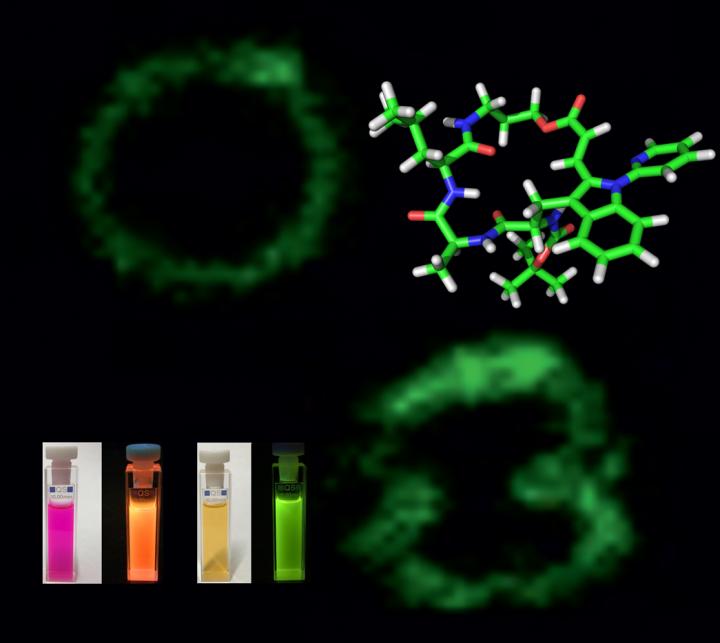
The research group developed the selective labelling of peptides and natural biological products at a late point in the series of steps necessary for synthesis by activating carbon-hydrogen bonds in tryptophan residues. This experimentally simple strategy makes it possible to efficiently access novel fluorescent pep-tides that are highly sensitive to their biological environment. This enabled the team to create a highly sensi-tive “rotor” with the ability to show changes in the composition of membranes of immune cells. Its fluores-cence is dependent on the viscosity of the cell membrane. The researchers observed radiant fluorescence in the presence of cholesterol in the cell membrane. In this way, the rotor can be used to screen certain mole-cules in cells that are important for the adaptive immune system to fight infections and cancer.

“The project demonstrates the power of combining chemical, biological and medical research, which allows the direct observation of cell-specific events,” says project leader Professor Lutz Ackermann from Göttin-gen University. “Furthermore, the successful collaboration ensures our discoveries to have an immediate impact not only in the field of chemistry, but also in the biomedical sciences. Sharing ideas and expertise between the teams enabled a joint approach to real-life problems.”

###

Original publication: Nikolaus Kaplaneris et al. Chemodivergent manganese-catalyzed C-H activation: modu-lar synthesis of fluorogenic probes. Nature Communications (2021). Doi: 10.1038/s41467-021-23462-9. Full text also available here: https://rdcu.be/cl4iz

Contact:

Professor Lutz Ackermann

University of Göttingen

Institute of Organic and Biomolecular Chemistry

Tammannstrasse 2, 37077 Göttingen, Germany

Tel: +49 (0)551 39-33202

Email: [email protected]

http://www.ackermann.chemie.uni-goettingen.de

Media Contact
Melissa Sollich
[email protected]

Original Source

https://www.uni-goettingen.de/en/3240.html?id=6283

Related Journal Article

http://dx.doi.org/10.1038/s41467-021-23462-9

Tags: BiochemistryBiomedical/Environmental/Chemical EngineeringBiotechnologyCell BiologyChemistry/Physics/Materials SciencesMolecular Biology
Share12Tweet8Share2ShareShareShare2

Related Posts

Miniature Sensor Uses Light to Detect Touch — Chemistry

Miniature Sensor Uses Light to Detect Touch

May 8, 2026
Iron Minerals Determine Whether Dissolved Organic Matter Fuels Microbes or Becomes Long-Term Carbon Storage — Chemistry

Iron Minerals Determine Whether Dissolved Organic Matter Fuels Microbes or Becomes Long-Term Carbon Storage

May 8, 2026

Kate Evans Appointed Associate Lab Director for Biological and Environmental Systems Science at ORNL

May 8, 2026

Advancing Multiscale Modeling and Overcoming Operational Challenges in Autothermal CO₂-to-Methanol Reactors

May 8, 2026
Please login to join discussion

POPULAR NEWS

  • Research Indicates Potential Connection Between Prenatal Medication Exposure and Elevated Autism Risk

    840 shares
    Share 336 Tweet 210
  • New Study Reveals Plants Can Detect the Sound of Rain

    727 shares
    Share 290 Tweet 181
  • Scientists Investigate Possible Connection Between COVID-19 and Increased Lung Cancer Risk

    68 shares
    Share 27 Tweet 17
  • Salmonella Haem Blocks Macrophages, Boosts Infection

    61 shares
    Share 24 Tweet 15

About

We bring you the latest biotechnology news from best research centers and universities around the world. Check our website.

Follow us

Recent News

Evaluating Digoxin Use in Patients with Symptomatic Rheumatic Heart Disease

Evaluating the Effectiveness and Safety of Digitalis Glycosides in Treating Heart Failure

Urdu Fall Risk Questionnaire Adapted for Elderly

Subscribe to Blog via Email

Success! An email was just sent to confirm your subscription. Please find the email now and click 'Confirm' to start subscribing.

Join 82 other subscribers
  • Contact Us

Bioengineer.org © Copyright 2023 All Rights Reserved.

Welcome Back!

Login to your account below

Forgotten Password?

Retrieve your password

Please enter your username or email address to reset your password.

Log In
No Result
View All Result
  • Homepages
    • Home Page 1
    • Home Page 2
  • News
  • National
  • Business
  • Health
  • Lifestyle
  • Science

Bioengineer.org © Copyright 2023 All Rights Reserved.