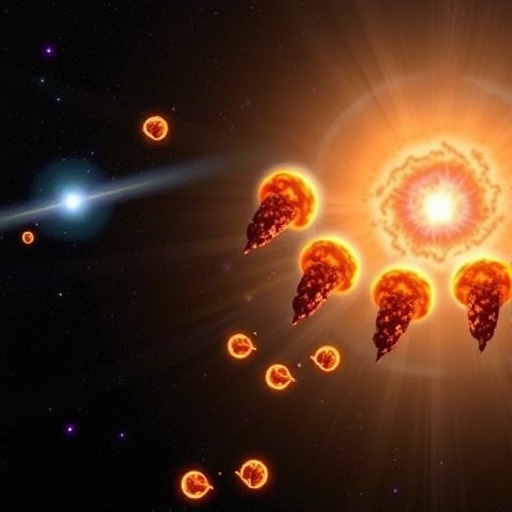
An international team of astronomers has uncovered a previously hidden chapter in the life cycle of stars by observing fragments of stellar material being torn apart and recycled in the outer reaches of the Helix Nebula. The discovery, reported in Nature, reveals 22 complete or partial bow shocks—glowing, arc-shaped waves produced as dense clumps of debris crash through the thin gas between stars. Together, the structures provide an unusually detailed record of how matter expelled by a dying star is transformed from recognizable fragments into diffuse interstellar material that may eventually help form new stars, planets and perhaps even life-supporting environments.
The Helix Nebula lies approximately 650 light-years from Earth in the constellation Aquarius and is among the closest and most thoroughly studied planetary nebulae. Its familiar appearance, often compared to a giant cosmic eye, comes from the glowing shells of gas released by a star near the end of its life. At the center sits a white dwarf, the hot, compact remnant left behind after the star shed its outer layers. Although the bright inner nebula has been photographed extensively, the newly reported observations penetrate much farther outward, revealing an extraordinarily faint halo where the star’s expelled material is still interacting with the surrounding interstellar medium.
The newly detected features resemble the bow-shaped waves that form in front of a boat moving through water. In the Helix Nebula, however, the “boats” are not solid objects but dense, mostly invisible knots of stellar debris moving rapidly through very thin gas. As each fragment travels outward, it compresses and heats the gas in front of it. The resulting shock wave causes atoms in the surrounding material to emit light, creating a faint glowing arc that marks the fragment’s passage. These shocks therefore act as signposts, allowing astronomers to trace otherwise difficult-to-see pieces of the star’s former atmosphere.
What makes the discovery particularly significant is the systematic change in the bow shocks with increasing distance from the white dwarf. Structures closer to the central star are broad, narrow-edged and sharply defined, suggesting that the debris fragments remain relatively dense and coherent soon after they encounter the surrounding gas. Farther away, the arcs become smaller, more diffuse and increasingly broken apart. The progression indicates that the fragments are gradually eroded by their journey through interstellar material. Gas and dust are stripped from their surfaces, turbulent flows shred the clumps, and the resulting material becomes mixed with the diffuse gas that fills the space between stars.
The researchers estimate that an individual fragment survives for only about 10,000 years after it begins interacting strongly with the ambient gas. On astronomical timescales, that is a remarkably brief interval. A star can live for millions or billions of years, yet the final transition from a concentrated piece of stellar debris to fully dispersed interstellar matter occurs comparatively quickly. The Helix observations capture this transition in progress, offering a rare opportunity to study the physical mechanisms that control cosmic recycling. The shocks may also help scientists understand how heat, momentum and chemical elements are transferred from dying stars into their galactic surroundings.
The observations were made with MOTHRA, short for Modular Optical Telephoto Hyperspectral Robotic Array, a new instrument being built at El Sauce Observatory in Chile. MOTHRA is designed to detect extremely faint emission from gases across broad regions of the sky. When complete, the facility will employ 1,140 high-end telephoto lenses and specialized optical filters. Rather than focusing on a narrow field with a conventional large telescope, the array will combine wide coverage with sensitivity to subtle spectral signals. This makes it well suited to mapping enormous, low-surface-brightness structures that can be missed in images dominated by bright nebular cores.
The Helix Nebula was not originally selected as the target of a major discovery. Scientists chose it as a calibration object because its size, brightness and well-documented structure made it a convenient benchmark for testing MOTHRA during construction. The instrument was not yet fully operational when the observations were collected, but even its early configuration detected the faint outer bow shocks. The unexpected result demonstrates the scientific potential of wide-field, low-light imaging systems, especially for studying the outskirts of nebulae where stellar debris blends into the background glow of interstellar space.
“We thought we were taking a calibration image of one of the best-known nebulae in the sky,” said Roberto Abraham, a study co-author, member of the Dragonfly Focused Research Organization and professor of astronomy at the University of Toronto. Instead, the team found a network of structures that had remained largely overlooked. Imad Pasha, another co-author and a member of Dragonfly FRO and visiting scholar at Northwestern University’s Center for Interdisciplinary Exploration and Research in Astrophysics, said the shocks change dramatically with distance from the central star. Their different shapes and levels of fragmentation provide a visual sequence of destruction, showing how the debris is progressively stripped, shredded and mixed into space.
The finding also offers a preview of the distant future of our own solar system. In several billion years, the Sun is expected to expand into a red giant and eventually eject its outer layers, leaving behind a white dwarf surrounded by a planetary nebula. The material released during that transformation will contain gas enriched by the Sun’s nuclear history and will eventually disperse into the Milky Way. Some of it could become part of future molecular clouds, stars and planetary systems. The Helix Nebula shows that this process is not simply a smooth release of gas: it involves clumps, shocks, turbulence and the gradual breakdown of stellar structures. By observing the debris at the moment it is being dismantled, astronomers are seeing how a star’s final act contributes to the next generation of cosmic construction.
Subject of Research: Stellar evolution, planetary nebulae and the recycling of stellar material into the interstellar medium.
Article Title: Numerous bow shocks in the outer Helix Nebula
News Publication Date: 12-Aug-2026
Web References: https://doi.org/10.1038/s41586-026-10724-z; https://www.pietervandokkum.com/; https://www.dragonflytelescope.org/
References: Nature, DOI: 10.1038/s41586-026-10724-z
Image Credits: Credit for previous data: NASA, ESA, C. R. O’Dell (Vanderbilt University), M. Meixner, P. McCullough and G. Bacon (Space Telescope Science Institute). New MOTHRA data shown in black.
Keywords
Helix Nebula, planetary nebulae, stellar evolution, white dwarfs, bow shocks, interstellar medium, stellar debris, cosmic recycling, MOTHRA, astrophysics, observational astronomy
Tags: advanced astronomical observationsbow shocks in planetary nebulaecosmic recycling processesHelix Nebula star life cycleinterstellar material formationnebulae gas dynamicsplanetary nebulae structurestar death and material dispersalstar formation from stellar debrisstellar material fragmentationstellar recyclingwhite dwarf remnants