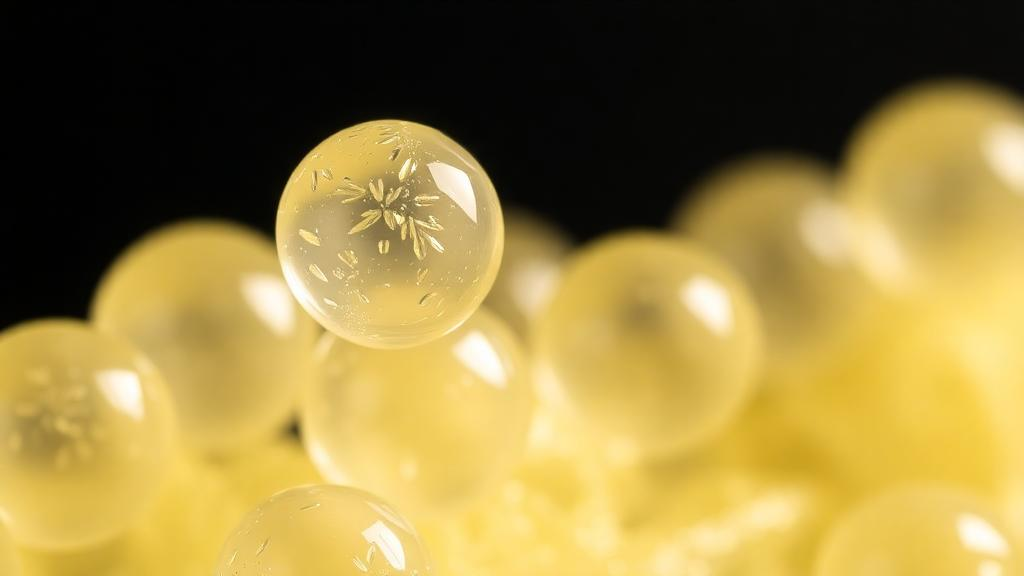
Microplastics have become one of the most ubiquitous contaminants on the planet, turning up everywhere from Antarctic snow to drinking water. Among the many polymer types polluting rivers, lakes and oceans, polystyrene is especially troublesome: it is lightweight, fragments easily into particles that span micrometers to nanometers, and resists the conventional filtration steps used in water treatment. Now, a research team led by Yue Li, Si Yuan Zhang, Ping Xiang, Chin Wei Lai and Chia Jing Chang, affiliated with Universiti Malaya, Southwest Forestry University and partner institutions, reports a new adsorbent material designed specifically to hunt down and hold onto polystyrene particles in water. Writing in the Journal of Materials Science, the group describes recoverable hydrogel beads built from chitosan, a zirconium-based metal-organic framework, and reduced graphene oxide, a trio that together delivers fast, repeatable microplastic capture with a twist: the bead interface responds to visible light.
The material, dubbed CS@UiO-66-NH2@rGO, is assembled in a two-stage process. First, chitosan, a natural polysaccharide derived from crustacean shells, is combined with reduced graphene oxide and shaped into beads, which are then solidified. Second, the team grows the metal-organic framework UiO-66-NH2 directly on the beads through an in situ solvothermal treatment, in which the framework crystallizes from its molecular building blocks while anchored to the bead surface. The result is a millimeter-scale bead with a deliberately rough, hierarchical surface texture rather than a smooth exterior. That texture matters, because the researchers found that scanning electron microscopy, rather than gas-adsorption measurements alone, revealed an enlarged interfacial region where polystyrene particles could actually make contact and stick.
The nitrogen-accessible Brunauer-Emmett-Teller surface area of the finished beads came in at 298.76 square meters per gram, a figure that reflects the porous framework grown throughout the composite. Yet the authors are careful to distinguish between surface area measured by nitrogen adsorption and the effective contact area available to micron-scale polystyrene particles, which are far too large to enter most of the framework’s internal pores. This is a subtle but important point in microplastic adsorption science: what matters most is not the total internal surface but the external, accessible architecture. The rough, corrugated morphology of the beads multiplies the real-world contact area, letting particles wedge into crevices and lodge against the composite surface, a mechanism the researchers term roughness-assisted retention.
Performance figures from the study are striking. Under the selected experimental conditions, the beads removed 97.6 plus or minus 0.6 percent of polystyrene particles from solution and achieved an adsorption capacity of 390.4 milligrams of polystyrene per gram of adsorbent, approaching equilibrium in roughly 45 minutes. That combination of speed and capacity places the material among the more effective adsorbents reported for polystyrene capture, and the bead format itself solves a practical problem that has long plagued nanoscale adsorbents: fine powders are efficient but difficult to separate from treated water, whereas millimeter-scale beads can be retrieved by simple physical means and reused.
To understand how the beads capture their quarry, the team fitted their kinetic data to the two workhorse adsorption models. At the standard test temperature of 303 kelvin, the constrained pseudo-first-order model described the data better than the pseudo-second-order model, yielding root-mean-square errors of 15.66 and 20.71 milligrams per gram respectively. Importantly, the authors note that both models face boundary limitations and that neither consistently outperformed the other across the full temperature range investigated, a candid acknowledgment that kinetic model selection in adsorption studies is often less clear-cut than a single R-squared value might suggest. For equilibrium behavior, nonlinear Langmuir fitting based on four quantifiable data points at 303 kelvin yielded a maximum adsorption capacity of 506.24 milligrams per gram, with a coefficient of determination of 0.9840, indicating a favorable, saturable uptake process.
Durability and real-world robustness were tested as well. After six consecutive adsorption-desorption cycles, the beads still removed 91.8 plus or minus 1.1 percent of polystyrene, demonstrating that the capture interface survives repeated regeneration without collapsing. Perhaps more telling, when the researchers spiked natural-water matrices with polystyrene, the beads maintained removal efficiencies above 82 percent, suggesting that dissolved organic matter, ions and other natural constituents do not catastrophically poison the adsorption sites. For any water-treatment technology, performance in clean laboratory water is easy; holding up in actual environmental water is the harder test that many candidate materials fail.
Beyond simple physical sticking, the composite carries an optoelectronic dimension. Incorporating reduced graphene oxide narrowed the apparent band gap of the material to 2.56 electronvolts, bringing it into the visible-light range. Photoluminescence measurements showed suppressed emission, photocurrent response was enhanced, and electrochemical impedance spectroscopy revealed a reduced Nyquist semicircle diameter. Taken together, these signatures are consistent with a visible-light-responsive interface in which charge carriers separate more efficiently and transfer across the composite junction more readily. In other words, when light strikes the beads, the UiO-66-NH2 and reduced graphene oxide components act as a coupled system for moving electrons, a property more commonly exploited in photocatalysis than in microplastic capture and one that could open avenues for coupling adsorption with light-driven degradation of captured particles in future work.
The researchers propose a multicomponent capture mechanism rather than a single dominant interaction. Polystyrene particles adhere to the external bead surface through hydrophobic interactions and pi-related interactions, the latter arising between the aromatic rings of polystyrene and the graphitic domains of reduced graphene oxide as well as the organic linkers of the framework. Dispersion forces contribute universally, while the corrugated topography physically entraps particles that settle into surface depressions. Electrostatic attraction may also play a role under acidic conditions, specifically at pH values below the isoelectric point of the material, when surface charges reverse and favor attraction to negatively charged polystyrene particles. This layered mechanistic picture helps explain why the beads perform well across varied water chemistries: if one interaction weakens under a given condition, others remain to hold the particles in place.
The work sits within a fast-growing research frontier exploring metal-organic frameworks as microplastic scavengers. Zirconium-based frameworks such as UiO-66 and its amine-functionalized variant are prized for their exceptional chemical and thermal stability, and earlier studies have shown that amine modification and hydrogel integration can enhance adsorption performance. Other groups have pursued ZIF-67 frameworks, magnetic carbon nanotubes, quaternary-ammonium-modified biochars and cellulose nanofiber aerogels for the same task, each with trade-offs between capacity, recyclability and ease of separation. The chitosan scaffold is a strategic choice here: it is abundant, biodegradable and readily forms beads, while its amine-rich chemistry coordinates well with the zirconium nodes of the growing framework, producing the intimate interface that the optoelectronic measurements probe.
The study was funded by Malaysia’s Ministry of Higher Education through the Higher Institution Centre of Excellence program, along with a Universiti Malaya Matching Grant and a Fundamental Research Grant Scheme award, and was published online on 18 October 2026 after acceptance in late September. Whether such beads can be scaled from beaker to treatment plant remains the defining question for the field, and the authors frame their material as a reusable platform for rapid polystyrene capture coupled with a photoresponsive interface rather than a finished remediation solution. Still, the combination of near-complete removal, sub-hour equilibration, six-cycle reuse, tolerance of natural waters and a light-active surface gives this hydrogel bead an unusually complete portfolio of traits. As microplastic contamination continues its march through the global water cycle, materials that can grab plastic particles quickly, hold them securely and come back for more will be in steadily rising demand.
Subject of Research: Recoverable chitosan-MOF-reduced graphene oxide hydrogel beads for capturing polystyrene microplastics from water
Article Title: Recoverable CS@UiO-66-NH2@rGO hydrogel beads for efficient capture of polystyrene microplastics with a visible-light-responsive interface
Article References: Li, Y., Zhang, S. Y., Xiang, P., Lai, C. W., & Chang, C. J. (2026). Recoverable CS@UiO-66-NH2@rGO hydrogel beads for efficient capture of polystyrene microplastics with a visible-light-responsive interface. Journal of Materials Science. https://doi.org/10.1007/s10853-026-13897-0
Image Credits: AI Generated
DOI: 10.1007/s10853-026-13897-0
Keywords: microplastics, polystyrene, hydrogel beads, chitosan, metal-organic framework, UiO-66-NH2, reduced graphene oxide, water treatment, adsorption, visible-light response, photocatalysis, environmental remediation
News Source: Denise Maddox. (October 18, 2026). Chitosan-MOF Hydrogel Beads Capture Polystyrene Microplastics in Under an Hour. Scienmag.