• HOME
  • NEWS
  • EXPLORE
    • CAREER
      • Companies
      • Jobs
    • EVENTS
    • iGEM
      • News
      • Team
    • PHOTOS
    • VIDEO
    • WIKI
  • BLOG
  • COMMUNITY
    • FACEBOOK
    • INSTAGRAM
    • TWITTER
Thursday, October 22, 2026
BIOENGINEER.ORG
No Result
View All Result
  • Login
  • HOME
  • NEWS
  • EXPLORE
    • CAREER
      • Companies
      • Jobs
        • Lecturer
        • PhD Studentship
        • Postdoc
        • Research Assistant
    • EVENTS
    • iGEM
      • News
      • Team
    • PHOTOS
    • VIDEO
    • WIKI
  • BLOG
  • COMMUNITY
    • FACEBOOK
    • INSTAGRAM
    • TWITTER
No Result
View All Result
Bioengineer.org
No Result
View All Result
Home NEWS Science News Biology

CauTrigger models biological state transitions through hierarchical causal decomposition

by
October 22, 2026
in Biology
Reading Time: 2 mins read
0
CauTrigger models biological state transitions through hierarchical causal decomposition

CauTrigger models biological state transitions through hierarchical causal decomposition

Share on FacebookShare on TwitterShare on LinkedinShare on RedditShare on Telegram

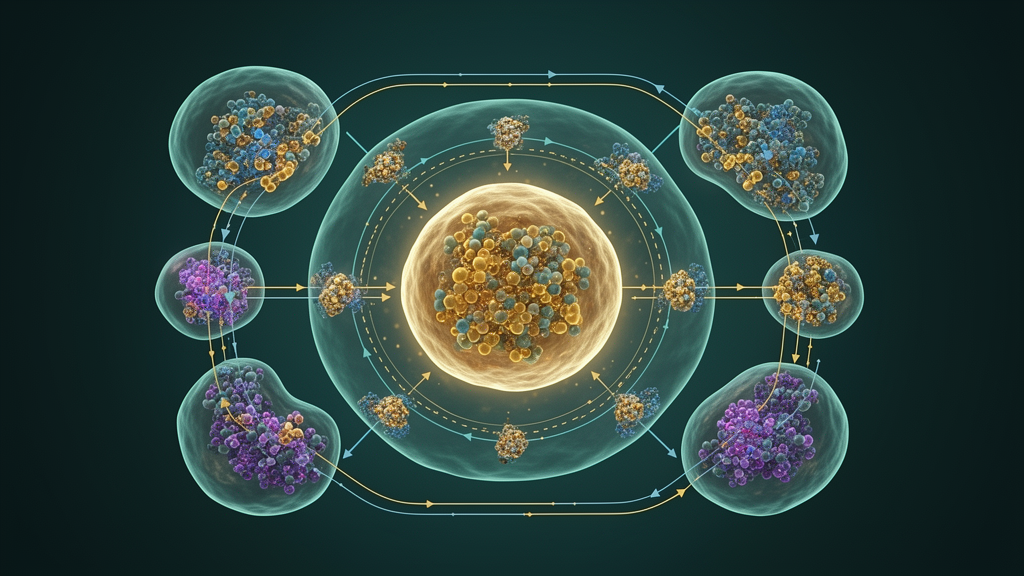
A hierarchical deep latent-variable model called CauTrigger outperformed existing methods in identifying candidate causal triggers and predicting system-level responses to perturbations across synthetic and real-world datasets with multilayer regulatory structures. The computational study, published in Nature Methods, reports that the method can reconstruct hierarchical regulatory relationships from observational data while separating causal factors from potentially spurious associations.

Biomedical measurements often contain relationships among multiple regulatory layers, but an observed association does not necessarily identify the variable responsible for a change in system state. CauTrigger was designed to address this causal-discovery problem by combining hierarchical latent-variable modeling with do-calculus. Its recursive decomposition is intended to distinguish causal and spurious latent factors, allowing the model to represent an underlying regulatory hierarchy rather than treating all measured relationships as equivalent.

The researchers evaluated CauTrigger on two connected tasks: identifying variables that act as causal triggers in multilayer systems and predicting the effects of perturbing those variables. Synthetic datasets with known regulatory structures enabled comparisons with baseline methods, while real single-cell multi-omics and gut microbiome datasets tested the framework in biological applications. Across these evaluations, CauTrigger reported stronger performance than existing approaches for both causal-trigger identification and perturbation-effect prediction.

In an application to single-cell multi-omics data from type 2 diabetes, the framework dissected regulation involving transcription factors, cyclic AMP response elements and target genes, described as TF–CRE–TG regulation. CauTrigger prioritized candidate causal triggers and used in silico perturbations to generate testable hypotheses about biological state transitions. These results are model-based prioritization and prediction from observational data, not experimental confirmation that any particular candidate trigger causes a clinical outcome.

The method was also applied to a cross-omic analysis linking gut microbiota with the fecal host proteome in data associated with autism spectrum disorder. This analysis modeled relationships between microbial and host layers and sought to identify candidate triggers of transitions within the combined system. The two biological applications show how CauTrigger can be used to formulate causal hypotheses from complex measurements, but the supplied study evidence does not establish intervention effectiveness or clinical benefit. The framework instead provides an interpretable, computational route for prioritizing candidate triggers and predicting responses that can be tested in subsequent experiments.

Subject of Research: Causal discovery and perturbation prediction in multilayer biological systems

Article Title: CauTrigger: deciphering biological system state transitions by hierarchical causal decomposition

Article References: Zhang, C., Cai, D., Aihara, K., & Chen, L. (2026). CauTrigger: deciphering biological system state transitions by hierarchical causal decomposition. Nature Methods. https://doi.org/10.1038/s41592-026-03274-9

Image Credits: AI Generated

DOI: 10.1038/s41592-026-03274-9

Keywords: CauTrigger, causal inference, hierarchical modeling, deep learning, biological state transitions, perturbation prediction, single-cell multi-omics, type 2 diabetes, gut microbiome, autism spectrum disorder, deciphering, biological

News Source: Blake Davidson. (October 22, 2026). CauTrigger models biological state transitions through hierarchical causal decomposition. Scienmag.
Tags: autism spectrum disorderbiologicalbiological state transitionsCausal InferenceCauTriggerDecipheringdeep learningGut microbiomehierarchical modelingperturbation predictionSingle-cell multi-omicsType 2 diabetes
Share12Tweet7Share2ShareShareShare1

Related Posts

Multiomic map of methylation in Mycoplasma hyorhinis

Multiomic map of methylation in Mycoplasma hyorhinis

October 22, 2026
Keratin 9 controls mechanical YAP1 signalling in palmoplantar skin

Keratin 9 controls mechanical YAP1 signalling in palmoplantar skin

October 22, 2026

Framework Separates DNA-Sensing Claims by Cell Type and Disease Stage

October 22, 2026

Coral bacteria make steroids that transiently reprogram immunity during heat stress

October 22, 2026

POPULAR NEWS

  • Multiple concussions linked to poorer mental health after college football

    Multiple concussions linked to poorer mental health after college football

    29 shares
    Share 12 Tweet 7
  • CauTrigger models biological state transitions through hierarchical causal decomposition

    29 shares
    Share 12 Tweet 7
  • Danish registry study links cladribine to lower short-term MS relapse rates

    29 shares
    Share 12 Tweet 7
  • Conceptual framework links neural pathways to mammalian physiological regulation

    29 shares
    Share 12 Tweet 7

About

We bring you the latest biotechnology news from best research centers and universities around the world. Check our website.

Follow us

Recent News

Multiple concussions linked to poorer mental health after college football

CauTrigger models biological state transitions through hierarchical causal decomposition

Danish registry study links cladribine to lower short-term MS relapse rates

Subscribe to Blog via Email

Enter your email address to subscribe to this blog and receive notifications of new posts by email.

Join 85 other subscribers
  • Contact Us

Bioengineer.org © Copyright 2023 All Rights Reserved.

Welcome Back!

Login to your account below

Forgotten Password?

Retrieve your password

Please enter your username or email address to reset your password.

Log In
No Result
View All Result
  • Homepages
    • Home Page 1
    • Home Page 2
  • News
  • National
  • Business
  • Health
  • Lifestyle
  • Science

Bioengineer.org © Copyright 2023 All Rights Reserved.