In a discovery that reshapes how scientists think about one of cancer’s most distinctive molecular tricks, researchers at the Institute for Research in Biomedicine in Barcelona, working with the Pediatric Cancer Center Barcelona at Hospital Sant Joan de Déu, have worked out how a cancer-associated protein can switch on stretches of DNA that are normally locked in a silent state. The finding, published in the journal G3: Genes, Genomes, Genetics, was achieved in an unexpected experimental system: the fruit fly, Drosophila melanogaster. By transplanting human cancer proteins into fly cells, the team demonstrated that a mechanism once thought to be exclusive to a rare childhood tumor operates through principles that have been conserved across hundreds of millions of years of evolution.
The tumor in question is Ewing sarcoma, an aggressive cancer that primarily affects children and young adults. For years, molecular biologists have known that Ewing sarcoma carries one of the clearest molecular signatures in all of oncology. The disease is driven by a fusion protein, produced when two separate genes break and rejoin, stitching together a DNA-binding component from the ETS family of transcription factors with an RNA-binding protein from the FET family. This unnatural molecular hybrid does something remarkable: it invades repetitive DNA sequences known as GGAA microsatellites, regions of the genome that in healthy cells sit quietly, transcriptionally inert, and converts them into active regulatory elements that control gene expression. That aberrant activation is considered a central engine of the tumor’s development and one of its best-studied hallmarks.
What has puzzled researchers is that the fusion protein is not the only route to this kind of genomic awakening. Previous studies had observed that ordinary, unfused ETS family proteins can also activate GGAA microsatellites in other cancers, including prostate cancer and B-cell acute lymphoblastic leukemia. In those contexts, no gene fusion exists to explain the phenomenon, yet the silent repeats still spring to life. How a standalone ETS protein could accomplish what seemed to require the fused hybrid remained an open question, and one with real clinical weight, because it suggested that the abnormal activation of these repetitive regions might be far more widespread in cancer than the Ewing sarcoma paradigm implied.
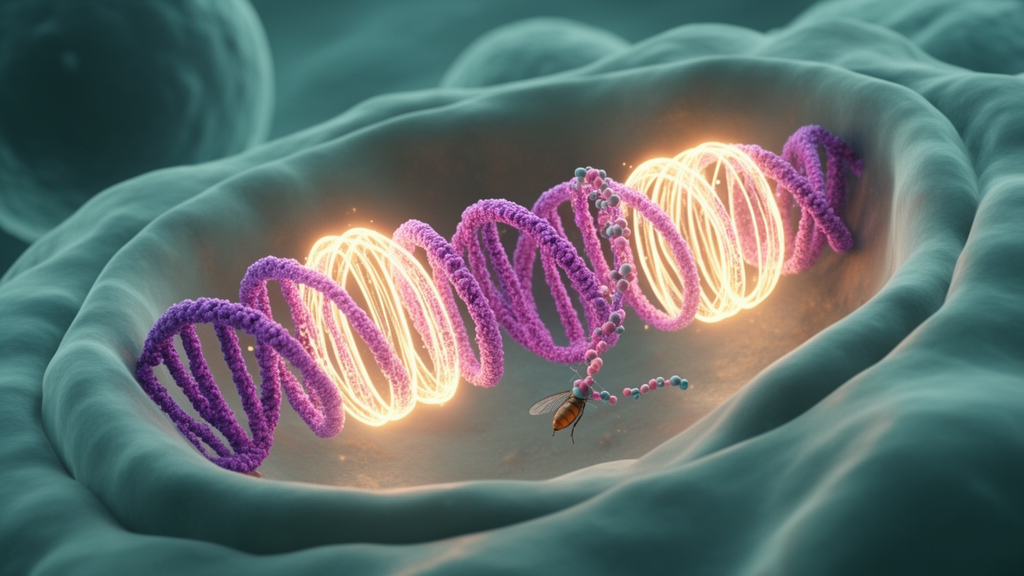
The Barcelona team, led by Dr. Cayetano González, research professor emeritus at IRB Barcelona and ICREA, in collaboration with Dr. Jaume Mora of the Pediatric Cancer Center Barcelona, approached the problem from a direction few would have predicted. They introduced a panel of human cancer-related ETS proteins into fruit flies and watched what happened. One protein in particular stood out. ETV4, an ETS factor previously implicated in prostate cancer, robustly activated GGAA microsatellites in specific fly tissues, lighting up the normally silent repeats with a clarity that surprised even the investigators. The fact that a human cancer protein could execute this genomic maneuver inside insect cells pointed to something fundamental about the mechanism itself.
Dr. González emphasized the evolutionary significance of the result. The fact that this mechanism also works in the fly indicates that it has been conserved across a vast evolutionary distance, he explained, and reinforces the potential relevance of the abnormal activation of these DNA regions in tumors beyond Ewing sarcoma. In practical terms, the machinery that allows an ETS protein to pry open silent repetitive DNA does not depend on any mammalian-specific cellular context. The fly genome contains its own GGAA-like microsatellites, and the fly’s own proteins can be recruited to cooperate with the human interloper. That degree of conservation suggests the underlying biology touches on ancient, basic features of how genomes organize and regulate their repetitive content.
The choice of Drosophila was not merely a matter of convenience; it solved a stubborn experimental bottleneck. In humans, the FET family comprises three very similar proteins, FUS, EWSR1, and TAF15, whose functions overlap so extensively that they can compensate for one another. When researchers try to remove FET activity in human cells, the redundancy blurs the picture, making it hard to determine which partner is doing what. The fly, by contrast, possesses a single equivalent protein, called Cabeza, abbreviated Caz. With only one player on the field, the team could ask a clean question: does ETV4 need a FET-family partner to activate silent DNA? When the researchers reduced Caz levels in the fly, the activation triggered by ETV4 dropped dramatically. When they then introduced the human EWSR1 protein to fill the vacancy, activity was restored. The partnership was no longer hypothetical; it was demonstrable, reversible, and species-portable.
Dr. Cristina Molnar, postdoctoral researcher at IRB Barcelona and first author of the study, highlighted what the cross-species result means for the field. The fact that a protein capable of activating these silent DNA regions in human tumor cells can also do so in fly cells, she explained, reinforces the value of Drosophila as a model to investigate how these regions are activated and what other proteins participate in the process. The fly system now offers geneticists a streamlined platform in which candidate cofactors can be tested one at a time, free from the redundancy that complicates equivalent experiments in human cell lines. Each new protein found to participate in the fly can then be checked for a corresponding role in human cancer cells, creating a productive loop between the two systems.
The results also clarify a crucial distinction between the Ewing sarcoma mechanism and the one operating in other cancers. In Ewing sarcoma, the FET and ETS components are physically welded together in a single fusion protein, and that hybrid can activate GGAA microsatellites without depending on the fly’s Caz protein, as the team confirmed. ETV4, by contrast, is not fused to anything. It must recruit an independent FET-family protein as a collaborator to achieve the same genomic effect. The fusion, in other words, appears to have internalized a partnership that unfused ETS proteins still require from the outside. This distinction provides a mechanistic explanation for why ETS proteins can activate silent repeats in prostate cancer and leukemia even without a fusion event: they simply borrow the FET protein they need from the cell’s own supply.
The team added one more layer of validation by testing a known inhibitor of the process. ETV6, a protein that in human cells halts the activation of these repetitive regions, was found to block ETV4’s activity in the fly as well. The conservation runs in both directions: the activating machinery works across species, and so does the brake that restrains it. Together, these results reinforce the idea that the essential components of the mechanism, the ETS activator, the FET collaborator, and the antagonistic ETV6, form a conserved regulatory module whose misdirection contributes to tumor development in multiple cancer types.
Dr. Mora framed the broader implications for pediatric and adult oncology alike. Understanding how these DNA regions can be activated outside the classic context of Ewing sarcoma, he noted, can help researchers better understand mechanisms that are also altered in other types of cancer. Because GGAA microsatellite activation reshapes gene regulatory networks, the findings could eventually inform strategies aimed at the abnormal proteins or their partnerships rather than the DNA sequences themselves. The work was supported by funding from the European Regional Development Fund, the Ministry of Science and Innovation, the State Research Agency, and the Fundació Sant Joan de Déu per la Recerca. For a field accustomed to studying these genomic events in human tumor cells, the humble fruit fly has now claimed a central place in the investigation, offering simplicity where human biology offers redundancy, and evolutionary depth where clinical urgency demands answers.
Subject of Research: How the cancer-associated ETS protein ETV4 activates silent GGAA microsatellite DNA through collaboration with FET-family proteins, studied in Drosophila.
Article Title: Researchers describe how a protein linked to cancer activates silent regions of DNA
Article References: Researchers describe how a protein linked to cancer activates silent regions of DNA. (n.d.). Original publication
Image Credits: AI Generated
DOI: Not provided
Keywords: Ewing sarcoma, ETV4, GGAA microsatellites, Drosophila melanogaster, ETS transcription factors, FET proteins, EWSR1, Cabeza, gene regulation, prostate cancer, IRB Barcelona, transcription
News Source: Nathaniel Bowman. (October 17, 2026). Cancer Protein Awakens Silent DNA With Help From a Molecular Partner, Fly Study Shows. Scienmag.