A recent study evaluating camera input for autonomous driving has identified significant variations in image quality metrics driven by specific hardware configurations and changing winter weather conditions. Using controlled chart-based imaging and quantitative measurements, researchers conducted a two-part assessment to characterize how different lens setups and atmospheric factors impact the data captured by perception systems, which is critical for the reliability of autonomous vehicles.
In the first experiment, the team compared two distinct camera-lens configurations using an Allied Vision Mako G-319C camera. Configuration 1 employed a 25 mm lens at a 5-meter camera-to-target distance, while Configuration 2 used a 16 mm lens at a 3-meter distance. The researchers observed that Configuration 2 provided superior sharpness metrics under the tested settings. Specifically, it yielded approximately 29.4 percent higher mean weighted MTF50, 35.3 percent higher MTF30, and 36.8 percent higher MTF20 values compared to Configuration 1. Furthermore, Configuration 2 demonstrated roughly 37.5 percent lower mean weighted chromatic aberration. Conversely, Configuration 1 exhibited slightly better color accuracy.
The researchers noted that because focal length, camera-to-target distance, and exposure time all varied between the two setups, these results represent system-level imaging performance differences rather than isolated lens-optics effects.
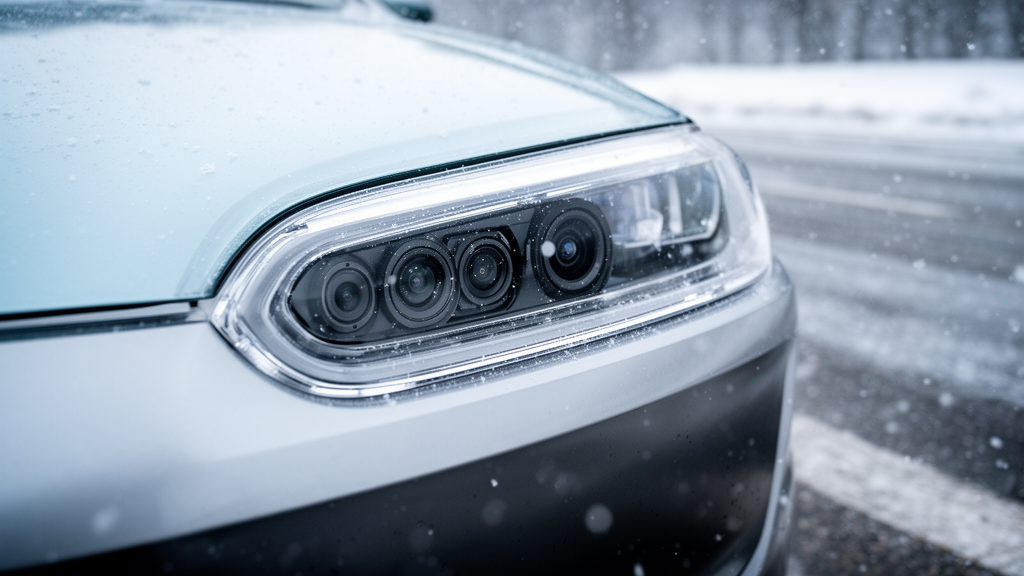
The second part of the study shifted to outdoor evaluations, measuring image quality under varied winter conditions, including light snow, snow, heavy snow, and heavy snow mixed with small hail. By utilizing ASDO/Parsivel 2 measurements to quantify the environmental conditions, the team analyzed four chart images per weather state to assess frame-to-frame consistency.
The findings revealed a non-monotonic response in image quality across the evaluated conditions. Snow produced the highest mean MTF50 and MTF20 values, whereas the combination of heavy snow and small hail resulted in the lowest mean MTF50 and MTF20 values. Chromatic aberration followed a different pattern, with heavy snow producing the highest mean chromatic aberration area and the greatest frame-to-frame variability in the metric.
Ultimately, the study results confirm that camera-input image quality is sensitive to both imaging configurations and environmental factors. The researchers conclude that these variations support the combined use of quantitative weather measurements and repeated image-quality assessment to effectively characterize camera inputs for autonomous driving perception systems.
The study was published in Discover Applied Sciences, an open access journal, and is currently available as an early sharing version. This format provides faster access to peer-reviewed, accepted research while the final version of record is prepared. The work was conducted by Dalal Z. Zreiqat, Vinh Nguyen, and Nathir A. Rawashdeh, who collaborated to produce this assessment.
Subject of Research: Automated driving camera perception system image quality evaluation
Article Title: Camera image-quality assessment for autonomous driving perception under lens variation and winter weather conditions
Article References: Zreiqat, D. Z., Nguyen, V., & Rawashdeh, N. A. (2026). Camera image-quality assessment for autonomous driving perception under lens variation and winter weather conditions. Discover Applied Sciences. https://doi.org/10.1007/s42452-026-09841-1
Image Credits: AI Generated
DOI: 10.1007/s42452-026-09841-1
Keywords: Autonomous driving, Image quality assessment, Camera lenses, Computer vision, Winter weather, MTF50, Chromatic aberration, Sensor performance, Perception systems, Lens variation, Automotive engineering, Weather monitoring, Image consistency, Optical performance, Driving technology
News Source: Denise Maddox. (November 23, 2026). Camera Configuration and Winter Weather Influence Autonomous Driving Perception Image Quality. Scienmag.