A prespecified secondary analysis of a randomized, double-blind, sham-controlled clinical trial has found that multi-session prefrontal transcranial direct current stimulation produces a measurable improvement in working memory among patients with schizophrenia across varying levels of baseline cognitive impairment. Published in Schizophrenia Research: Cognition, the investigation examined whether initial cognitive deficit levels modified the therapeutic efficacy of non-invasive electrical brain stimulation. Active stimulation consistently yielded greater working-memory gains than sham treatment across participants categorized into higher and lower baseline cognitive performance groups. However, formal interaction testing demonstrated that initial cognitive impairment severity did not significantly alter the magnitude of the intervention effect, indicating that prefrontal stimulation produced a comparable working-memory signal across the analyzed spectrum of baseline cognitive severity rather than distinct subtype-specific responses.
Cognitive impairment represents a profound, persistent manifestation of schizophrenia that affects multiple neurocognitive domains and stands as a major determinant of long-term disability, everyday functioning, and overall quality of life. Deficits in processing speed, attention, verbal and visual learning, executive control, and working memory manifest early during the trajectory of the disorder and demonstrate limited responsiveness to traditional antipsychotic pharmacology, which primarily manages psychotic symptoms. Consequently, therapeutic approaches have increasingly concentrated on non-pharmacological modalities designed to engage prefrontal network connectivity and modulate underlying neuroplasticity. Transcranial direct current stimulation, known as tDCS, delivers a mild direct electrical current across targeted cortical regions to modify neuronal excitability and synaptic activity. Because it is non-invasive, well tolerated, portable, and relatively inexpensive, tDCS represents an accessible intervention strategy for addressing cognitive deficits in clinical psychiatric settings.
Despite encouraging findings across preliminary neuromodulation trials, earlier studies evaluating prefrontal tDCS in schizophrenia have yielded variable outcomes, generating debate over intervention efficacy and cognitive specificity. Prefrontal stimulation protocols frequently report modest benefits that vary significantly between studies due to differences in stimulation dosage, electrode placement, session counts, concomitant medications, and baseline sample profiles. Furthermore, individuals diagnosed with schizophrenia exhibit substantial natural variation in cognitive ability, presenting with profiles ranging from relatively preserved cognitive capacity to pervasive, severe neurocognitive impairment. Prior literature has suggested that patients possessing lower baseline performance might demonstrate greater observable gains following cognitive or neuromodulatory interventions, though such patterns can also stem from statistical artifacts such as regression to the mean, testing floor room for change, or ceiling effects in higher-functioning individuals. The researchers designed this secondary study to formally evaluate whether baseline cognitive impairment acts as a true treatment-effect modifier using rigorous statistical interaction analyses.
The current analysis evaluated data from 120 adult participants who completed both pre-intervention and post-intervention evaluations during a randomized, double-blind, sham-controlled clinical trial. The parent trial originally enrolled 173 clinically stable adult participants diagnosed with schizophrenia or schizoaffective disorder according to DSM-5 criteria who were maintained on consistent antipsychotic regimens. Individuals presenting with neurological illnesses, active substance use disorders within the preceding six months, or contraindications to non-invasive brain stimulation were excluded from enrollment. To assess cognitive performance, investigators administered the standardized MATRICS Consensus Cognitive Battery, or MCCB, immediately before the intervention protocol and directly following its completion. The 120 participants with complete paired MCCB assessments formed the complete-case analytic cohort, comprising 62 individuals allocated to active tDCS and 58 assigned to the sham control condition, while 53 randomized individuals lacking paired cognitive assessments were excluded.
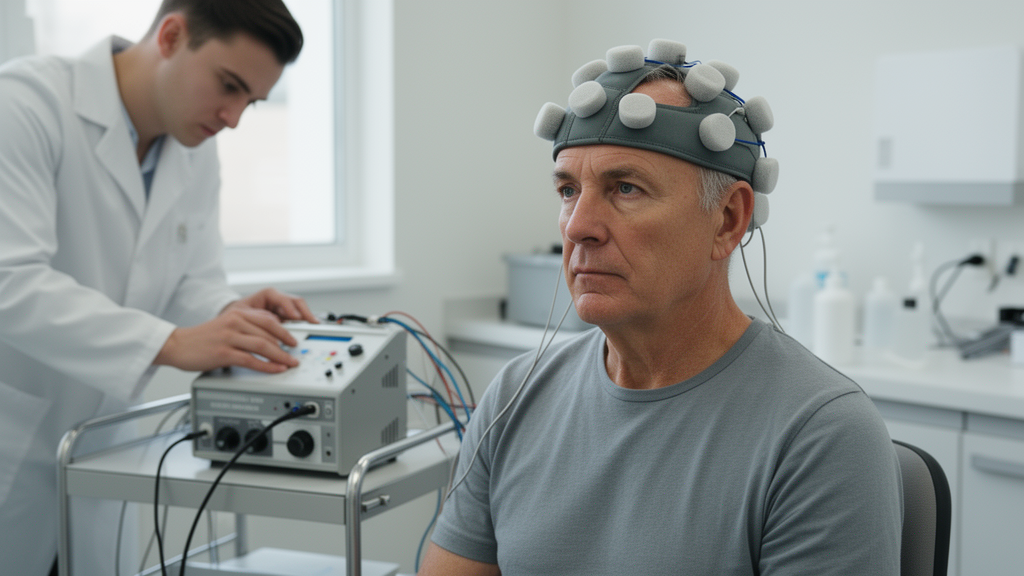
Intervention procedures strictly replicated the stimulation protocol established in the primary randomized trial. Participants in the active intervention arm received 20 minutes of 2-milliampere direct current per session across 10 consecutive weekday sessions over a two-week duration. The electrical montage utilized bifrontal positioning targeting the dorsolateral prefrontal cortex, with the anode positioned over the left dorsolateral prefrontal cortex at site F3 and the cathode over the right dorsolateral prefrontal cortex at site F4 according to the international 10–20 electroencephalographic placement system. Sham stimulation utilized identical electrode positions, device configurations, and ramp-up and ramp-down periods to reproduce the initial cutaneous sensations of active stimulation without delivering sustained electrical currents. Computer-generated allocation sequences handled 1:1 randomization independently from the assessment staff, maintaining complete blinding among patients, clinicians, and cognitive raters throughout the trial.
To classify baseline cognitive heterogeneity without imposing subjective criteria, the investigative team applied k-means cluster analysis to the seven baseline MCCB domain T-scores, which are adjusted for participant age and sex. Evaluating cluster solutions containing two, three, and four groups, mathematical validation metrics identified a two-cluster configuration as optimal. This two-cluster solution separated participants into a greater cognitive impairment group consisting of 52 individuals and a less severe cognitive impairment group comprising 68 individuals. Centroid profiles across both clusters demonstrated broadly parallel performance patterns across the six nonsocial cognitive domains, alongside virtually identical baseline social-cognition scores. This configuration demonstrated that the clustering captured a general gradient of nonsocial cognitive severity along a continuum rather than qualitatively distinct neuropsychological phenotypes or discrete biological subtypes.
Within the primary cognitive-severity groups, active tDCS produced significant working-memory improvements compared to sham stimulation. In the greater cognitive impairment group, participants receiving active stimulation showed a mean working-memory improvement of 4.68 T-points compared to 1.00 T-point among sham recipients, yielding a significant unadjusted between-group difference of 3.68 T-points and a large standardized effect size of Hedges’ g equal to 1.003. Linear mixed-effects models adjusted for participant age, sex, and chlorpromazine-equivalent antipsychotic dosage confirmed this benefit, yielding a time-by-treatment interaction p-value of .0002, which remained robust following joint Benjamini–Hochberg false discovery rate correction across all 14 evaluated domain-by-group hypotheses (adjusted p = .0028) and conservative Holm correction (adjusted p = .0028). Parallel ANCOVA models further supported these findings, demonstrating higher post-intervention working-memory performance in the active group.
Participants categorized within the less severe cognitive impairment group also exhibited positive cognitive outcomes following active stimulation. In this cohort, active tDCS recipients gained a mean of 3.27 T-points in working memory compared to an increase of 0.68 T-points in the sham group, representing an unadjusted between-group difference of 2.59 T-points and a moderate effect size of Hedges’ g equal to 0.692. The adjusted linear mixed-effects model revealed a significant time-by-treatment interaction (nominal p = .0041) that maintained statistical significance under joint Benjamini–Hochberg false discovery rate adjustment (adjusted p = .0287), although it narrowly exceeded the significance threshold under the stricter Holm correction procedure with an adjusted p-value of .0533. Crucially, across the complete family of 14 domain-by-severity comparisons, working memory was the only neurocognitive domain in the MCCB battery to survive joint multiplicity corrections in either subgroup, whereas other domains like visual learning failed to maintain significance after error correction.
Because baseline working-memory scores were included in the initial clustering process, the researchers conducted a sensitivity analysis to eliminate potential circularity and ensure that observed effects were not artifacts of mathematical coupling or regression to the mean. The team repeated the k-means clustering algorithm using the six remaining baseline MCCB domains after standardizing scores and excluding working memory entirely. The resulting two-group solution placed 50 participants into a re-derived greater impairment group and 70 into a re-derived less severe impairment group. Working-memory gains remained statistically significant under active tDCS across both re-derived cohorts in adjusted mixed-effects and ANCOVA models, surviving joint false discovery rate corrections. More importantly, formal statistical testing of the three-way interaction between time, treatment, and cognitive-severity group yielded an estimated difference of 0.93 T-points with a p-value of .4915, providing no evidence that baseline cognitive severity modified the magnitude of working-memory improvement.
The study authors emphasize that these results should be interpreted within the context of specific methodological limitations. Because the study represents a secondary complete-case analysis of 120 of the 173 originally randomized participants, potential selection bias cannot be ruled out if participants who completed assessments systematically differed from non-completers. Furthermore, although adjusted modeling accounted for baseline imbalances in antipsychotic dosage and working-memory performance between arms, the modest sample size restricted statistical power to detect small interaction effects. In addition, cognitive testing occurred immediately following the conclusion of the 10-session protocol, meaning the trial cannot determine whether observed working-memory enhancements persist over extended follow-up intervals or translate directly into improved real-world occupational and functional outcomes. The investigators concluded that while prefrontal tDCS delivers a reproducible working-memory signal across varying degrees of impairment, baseline cognitive severity should not currently be utilized as a clinical selection criterion for treatment.
Subject of Research: Prefrontal transcranial direct current stimulation effects on working memory across baseline cognitive severity groups in schizophrenia
Article Title: Working-memory effects of prefrontal tDCS across baseline cognitive-severity groups in schizophrenia: A secondary analysis of a randomized double-blind sham-controlled trial
Article References: Muñoz-Gualan, A. P., Padilla, S., Romero-Ferreiro, V., Cardona-Bejarano, S., García, M. M.-B., Moleón-Ruiz, Á., Rodriguez-Jimenez, R., & García-Fernández, L. (2026). Working-memory effects of prefrontal tDCS across baseline cognitive-severity groups in schizophrenia: A secondary analysis of a randomized double-blind sham-controlled trial. Schizophrenia Research: Cognition, 46, Article 100456. https://doi.org/10.1016/j.scog.2026.100456
Image Credits: AI Generated
DOI: 10.1016/j.scog.2026.100456
Keywords: transcranial direct current stimulation, schizophrenia, working memory, prefrontal cortex, neuromodulation, cognitive impairment, MATRICS Consensus Cognitive Battery, clinical trials, dorsolateral prefrontal cortex, randomized controlled trial, neuropsychology, cognitive remediation, k-means clustering, effect modification, psychiatry, neuroscience
News Source: Ophelia Keating. (November 23, 2026). Prefrontal tDCS Boosts Working Memory Across Baseline Cognitive Severity in Schizophrenia. Scienmag.