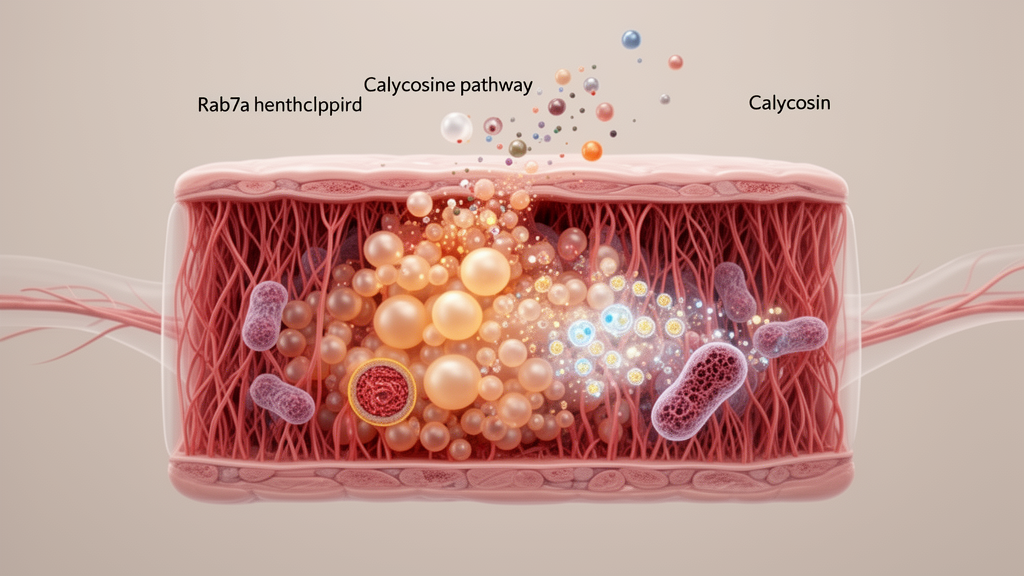
Calycosin, a natural isoflavone obtained from the roots of Astragalus membranaceus, reduced myocardial injury and improved cardiac function in a mouse model of diabetic cardiomyopathy, according to experiments reported in Frontiers in Pharmacology. In the study, calycosin lowered triglyceride accumulation and fibrosis in the heart and increased evidence of lipid-droplet degradation in cardiomyocytes. Mechanistically, the compound increased the abundance of the small GTPase Rab7a and suppressed its ubiquitination, while genetic silencing of Rab7a removed calycosin’s protective effects in cultured neonatal mouse cardiomyocytes exposed to high-glucose and high-lipid conditions. The results identify Rab7a-dependent lipophagy as a possible mechanism behind the compound’s effects, but they do not establish a clinical treatment for diabetic heart disease.
The investigators induced diabetic cardiomyopathy in 8-week-old male C57BL/6J mice by combining a four-week high-fat diet with five daily injections of low-dose streptozotocin, a combination intended to produce insulin resistance and type 2 diabetes-like metabolic dysfunction. Mice were maintained on the high-fat diet through 12 weeks, and diabetic cardiomyopathy was identified from abnormalities in cardiac structure and function measured by echocardiography. The experimental groups included untreated controls, control mice given calycosin, untreated diabetic mice and diabetic mice treated with calycosin. Beginning one week after the final streptozotocin injection, the treatment groups received calycosin orally at 10 mg/kg per day for four weeks, while control animals received saline. The final analysis included eight mice per group for echocardiography and four per group for biochemical and histological measurements.
Calycosin improved several measures of cardiac injury in the diabetic mice. Animals receiving the compound had a more favorable early-to-late mitral inflow velocity ratio than untreated diabetic animals, indicating improved diastolic function, and their left ventricular internal diameters at diastole and systole were smaller than those in the untreated group. Left ventricular ejection fraction and fractional shortening, both indicators of systolic function, improved relative to untreated diabetic mice. Serum lactate dehydrogenase, a marker of cell injury, was also lower after treatment. Histological analysis found less disorganization of myocardial architecture, smaller cardiomyocyte cross-sectional areas and reduced collagen deposition; total myocardial collagen was approximately 44.3% lower in calycosin-treated diabetic mice than in the untreated diabetic group. These observations describe improved disease measures in an experimental model rather than evidence of clinical efficacy in people with diabetes.
The cardiac effects coincided with a reduction in myocardial lipid accumulation. Diabetic mice had higher cardiac triglyceride concentrations and larger Oil-Red O-positive areas than controls, and calycosin significantly reduced both measures. Transmission electron microscopy then showed fewer lipid droplets in cardiomyocytes from treated animals. Some droplets appeared enclosed within autophagosomal structures and undergoing degradation, providing morphological evidence that the compound was associated with lipophagy, the selective autophagic removal of lipid droplets. Consistent with that interpretation, untreated diabetic mice had a lower ratio of LC3-II to LC3-I and higher p62 accumulation, signs of impaired autophagic flux, whereas calycosin restored the flux markers toward control values. The authors combined these measurements with triglyceride quantification and histological staining rather than relying on a single marker to assess whether lipid clearance accompanied the improved cardiac phenotype.
Parallel experiments tested the same process in neonatal mouse cardiomyocytes isolated from one- to three-day-old pups. Cells were challenged with 25 mmol/L glucose and 150 micromol/L palmitic acid to reproduce the high-glucose, high-lipid environment associated with diabetic cardiomyopathy. A viability screen found that 0.25 to 5 micromol/L calycosin did not significantly affect cardiomyocyte viability relative to normal-glucose conditions, whereas 10 micromol/L markedly reduced viability. At 5 micromol/L, calycosin significantly reversed the loss of viability caused by the high-glucose, high-lipid treatment and was selected for subsequent experiments. It also reduced lactate dehydrogenase release and the fluorescence intensity of BODIPY-stained intracellular lipid droplets. Immunofluorescence imaging showed greater colocalization between LC3 and lipid droplets after calycosin treatment, while western blotting indicated increased autophagic flux.
Rab7a emerged as a candidate mediator through an intersection analysis of 4,873 genes associated with lipid deposition and diabetic cardiomyopathy. The analysis identified 185 overlapping genes, with pathway enrichment linking them to lipid and atherosclerosis pathways and lipid catabolism. Rab7a was the only candidate among three overlapping genes described by the authors as functionally associated with autophagy. Rab7a is a membrane-trafficking GTPase involved in autophagosome maturation and fusion with lysosomes, a step required for degradation of autophagic cargo. Molecular docking placed calycosin near Lys127 on a modeled Rab7a structure and predicted a possible high-affinity interaction, but this computational result was not equivalent to experimentally demonstrating direct binding. Rab7a protein levels were reduced in diabetic mouse hearts and in high-glucose, high-lipid-treated cardiomyocytes, while calycosin restored them in both settings.
Co-immunoprecipitation provided further evidence that calycosin affects the turnover of Rab7a. Rab7a ubiquitination increased in cardiomyocytes subjected to high glucose and high lipid, whereas treatment with calycosin significantly suppressed that increase. In combination with the increase in Rab7a protein abundance, the findings support a model in which calycosin stabilizes Rab7a by limiting ubiquitin-dependent degradation. The precise molecular route remains unresolved: the study did not establish whether calycosin prolongs Rab7a’s half-life, whether the relevant modification is specifically K48-linked ubiquitination, or which upstream regulator, E3 ligase or deubiquitinating enzyme is involved. The docking prediction also remains a hypothesis about how calycosin might influence Rab7a rather than proof of a direct molecular contact.
The strongest mechanistic test came from knocking down Rab7a in the cultured cardiomyocytes. The researchers tested three Rab7a-specific small interfering RNAs and selected one that reduced Rab7a expression by 75%. Under high-glucose, high-lipid conditions, this knockdown increased lactate dehydrogenase release and intracellular lipid accumulation, reduced the colocalization of LC3 with lipid droplets, decreased the LC3-II-to-LC3-I ratio and increased p62 accumulation. Rab7a silencing also abolished the ability of calycosin to preserve cell viability, clear lipid droplets and sustain lipophagic activity. This loss-of-function result supports the conclusion that Rab7a is required for calycosin-mediated lipophagy and the accompanying reduction of lipotoxic injury. It does not, however, exclude parallel pathways, and the investigators noted that rescue experiments with an RNA-resistant form of Rab7a or with Rab7a overexpression were still needed to confirm causality more fully.
The study’s main limitation is the gap between its cellular model and adult heart biology. Neonatal cardiomyocytes differ metabolically from adult cardiomyocytes, and the detailed assays of Rab7a ubiquitination, lipophagic flux and Rab7a knockdown were conducted in these immature cells rather than in adult primary cardiomyocytes or a cardiomyocyte-specific animal model. In the mice, investigators assessed cardiac function, lipid deposition and Rab7a abundance, but they did not perform the full suite of mechanistic interventions. It also remains unknown whether calycosin influences fatty-acid uptake or oxidation in addition to promoting lipid-droplet degradation. Taken together, the experiments provide a coherent preclinical mechanism: calycosin was associated with reduced Rab7a ubiquitination, greater Rab7a abundance, enhanced autophagic targeting and degradation of lipid droplets, lower myocardial lipid storage and less injury in diabetic mice. Whether that mechanism can be reproduced in adult cardiac cells, translated into a safe treatment for humans or accompanied by meaningful clinical benefit requires further research.
Subject of Research: Precalcosin effects on Rab7a-dependent lipophagy in diabetic cardiomyopathy mice and neonatal mouse cardiomyocytes
Article Title: Calycosin alleviates myocardial injury in diabetic mice by enhancing lipophagy in cardiomyocytes via Rab7a regulation
Article References: Zhang, Q., Li, M., Zhao, X., Wang, Y., Jiang, Y., Feng, Y., Wang, M., Zhang, H., Ge, P., Zhou, J., & Liu, J. (2026). Calycosin alleviates myocardial injury in diabetic mice by enhancing lipophagy in cardiomyocytes via Rab7a regulation. Frontiers in Pharmacology, 17, Article 1880993. https://doi.org/10.3389/fphar.2026.1880993
Image Credits: AI Generated
DOI: 10.3389/fphar.2026.1880993
Keywords: calycosin, diabetic cardiomyopathy, Rab7a, lipophagy, cardiomyocytes, lipid droplets, myocardial injury, autophagy, ubiquitination, mouse model, alleviates, myocardial
News Source: Ophelia Keating. (October 26, 2026). Calycosin reduces myocardial injury in diabetic mice through Rab7a-dependent lipophagy. Scienmag.