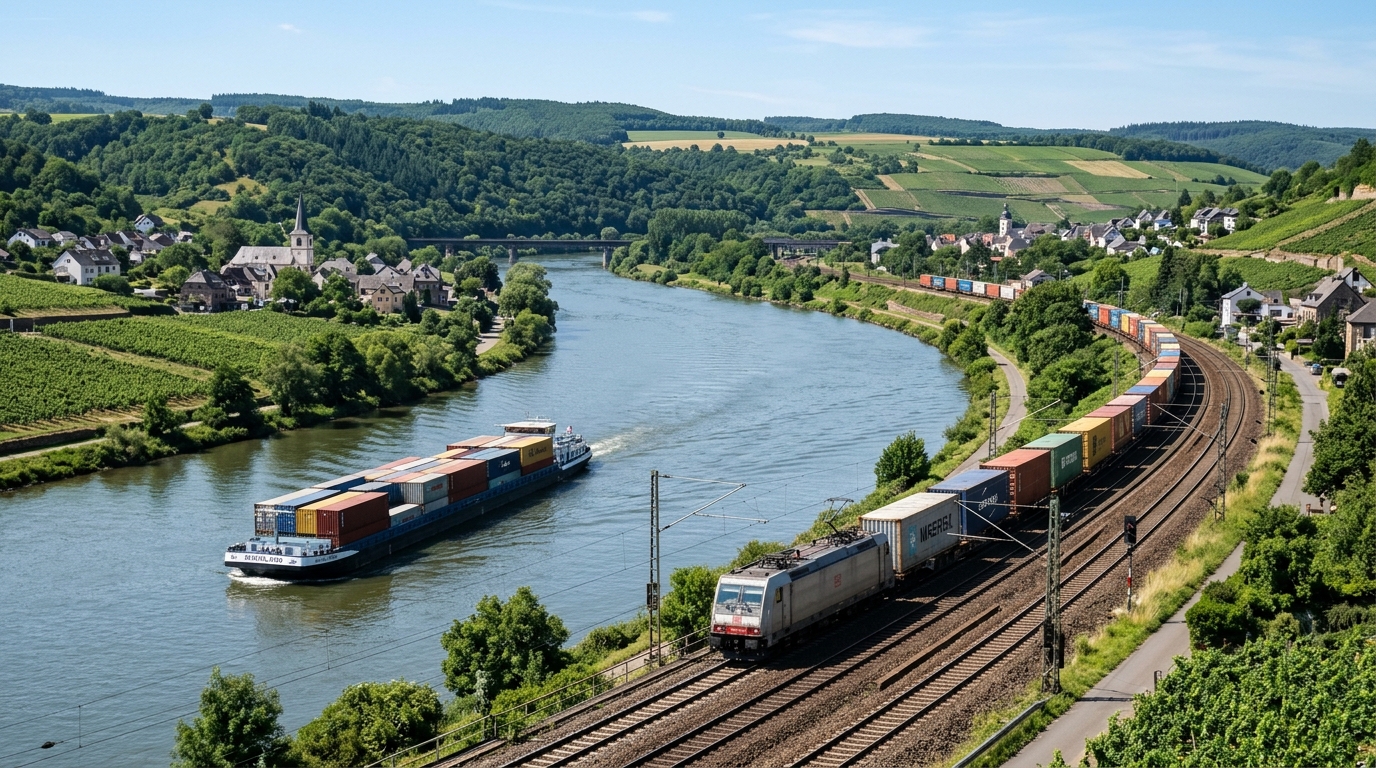
Freight transport models that look impressive at the national level can fail quietly at the level where it matters most for network assignment: the individual origin-destination cell. A new open-access study published in European Transport Research Review by Bart Jourquin addresses this gap with a calibrated framework that links behavioural modal-choice estimation directly to freight matrix assignment, tested on three European datasets of very different spatial scale. The central finding is sobering and practical at once: a well-specified behavioural model reproduces aggregate modal shares reasonably well, but it cannot, on its own, reconstruct the sparse geography of rail and inland-waterway flows that assignment models require.
The problem stems from the structure of the multinomial logit model itself. Whenever a non-road alternative such as rail or inland waterway transport is technically available between two regions, the logit assigns it a positive probability. If the total tonnage flowing between those regions is large, even a tiny probability generates noticeable predicted tonnes in cells where the observed non-road flow is exactly zero. Rail and inland-waterway matrices are notoriously sparse: a relatively small number of corridors and commodity groups carry most of the traffic, while many technically feasible cells carry none. The result is a model that can match the total rail share while scattering rail tonnes across dozens of empirically unused relations, making the resulting matrices unusable for realistic network assignment.
The framework proposed in the paper combines two layers with deliberately distinct roles. The first is a behavioural multinomial logit model in which the attributes of rail and inland waterways are expressed as logarithmic ratios relative to road, so each non-road option is compared directly with the corresponding road movement for the same origin-destination pair. The specification includes commodity-group constants, mode-specific piecewise-linear distance splines with knots fixed ex ante at 150 and 300 kilometres, and a rail market-structure correction that switches on when inland waterways are available for a cell. Road, the dominant and almost universally available mode, serves as the reference alternative with its utility normalised to zero.
The second layer is a bounded base-year calibration that adds utility corrections to the non-road alternatives. These constants are not behavioural parameters estimated through the likelihood function; they are residual corrections derived iteratively from the same base-year matrices, updated in proportion to the log-ratio between observed and predicted tonnage, damped, clipped at each step, and bounded to a maximum absolute value. The operational calibration operates at the mode-OD-group level, meaning two bounded constants, one for inland waterways and one for rail, are stored for every origin-destination-commodity observation. Across the three datasets this amounts to nearly 1.44 million stored constants for about 720,000 observations.
The data come from the ETISPlus European FP7 research programme, providing estimated origin-destination matrices for the year 2010 at NUTS-2 and NUTS-3 regional levels. Modal costs, distances and moving times are not observed market prices but are constructed by computing pure-mode paths in the Nodus freight network modelling software, using cost functions in 2010 prices that include labour, vehicle capital, fuel, maintenance and insurance components. Because cost, time and distance all derive from the same network representation, they are mechanically correlated, which is why the author warns that estimated coefficients should be read as conditional effects within the constructed dataset rather than as statements about real-world price elasticities.
The behavioural estimation itself is unusual in an instructive way. Rather than modelling individual shipment choices, the model is estimated from aggregate modal shares, with annual tonnes entering as frequency weights in a weighted cross-entropy objective. The author is explicit that this produces a volume-weighted pseudo-likelihood, not a conventional choice likelihood: the extremely small standard errors and large t-statistics that result are numerical diagnostics of the weighted aggregate criterion, not evidence of shipment-level statistical significance. Interpretation therefore rests on coefficient signs, active bounds and stability across datasets. On that basis, the most robust result is the negative inland-waterway cost coefficient, present in all three datasets: a ten percent increase in relative inland-waterway cost reduces the odds of choosing that mode by roughly thirty percent in the European dataset, thirty-five percent in the Benelux+ dataset and eighteen percent in the German dataset.
Other behavioural effects are more fragile. Moving-time coefficients are negative in the European NUTS-2 dataset but hit their zero bound in both NUTS-3 datasets, which the author interprets not as evidence that transport time is irrelevant, but as an indication that at finer spatial resolution moving time adds little independent information once cost, distance splines and availability are controlled for. Distance effects are strongly dataset-specific, with inland waterways disadvantaged at short distances in the European data but showing mostly positive coefficients in the Benelux+ and German applications. A rail-cost term was tested as a sensitivity case: it was negative and identified away from its bound only in the European dataset, where it modestly reduced pre-calibration error, but it reached its zero bound in both NUTS-3 datasets and produced no improvement after calibration, so it was excluded from the reference specification.
The evaluation strategy is designed to keep calibration and validation strictly separate, following established transport-modelling guidance. After the detailed calibration, OD-cell error measured by the Weighted Absolute Percentage Error falls sharply across all datasets and modes, and remaining biases become negligible. But the paper insists these very low values are in-sample base-year reconstruction statistics, not predictive performance: the corrections are defined at essentially the same level as the observations themselves, so a close fit is the expected outcome of the design. The distribution of calibration constants supports this reading. Unweighted, eighty to eighty-nine percent of rail constants sit at the negative bound, reflecting the vast number of technically available but unused cells; weighted by observed tonnage, however, almost no traffic is associated with capped constants, and the tonnage-weighted medians for cells that actually carry non-road flow are strongly positive, between roughly 2.4 and 3.2, showing that the layer reinforces established corridors rather than suppressing real flows.
Transferability is examined through repeated random OD-pair holdout experiments, in which twenty percent of directional OD pairs are withheld, all commodity observations for a pair kept together, and a coarser mode-group-distance calibration applied that can generalise to unseen pairs. Across three repetitions with different random seeds, twenty-seven dataset-mode comparisons in total, post-calibration error was lower than pre-calibration error in every case, but the gains were modest: for Europe, inland-waterway error fell from 1.451 to 1.382 and rail from 1.056 to 1.032, with a clearer rail improvement in the Benelux+ dataset. The author frames this as limited evidence that the coarser calibration captures some transferable structure by mode, commodity group and distance band, while stressing that the random holdout remains an interpolation test within the same regions, not proof of transfer to entirely unseen corridors.
The practical implications are carefully bounded. For base-year assignment, the detailed calibration is the relevant setting, and the estimated model has been implemented as a plugin in Nodus, with a software-consistency test showing broadly comparable aggregate shares and cell-level results between the Python estimation environment and the assignment environment, though German inland-waterway cell-level errors revealed implementation discrepancies worth further investigation. For policy scenarios, the framework should be used as a pivot around the calibrated base year, with base-year constants held fixed. Because the reference model contains no rail-cost response and rail moving time is unidentified in the two NUTS-3 models, applications centred on rail pricing or rail performance would require additional data, external elasticity evidence or dedicated re-estimation. A further limitation is that the assessment relies on the modal matrices themselves rather than independent observations of assigned network flows, leaving full external validation against corridor counts as the natural next step. The core conclusion stands: freight modal-choice modelling for assignment needs both an interpretable behavioural structure and an explicit, bounded calibration mechanism capable of reproducing the sparse geography of real freight flows.
Subject of Research: A calibrated two-layer freight modal-choice framework linking multinomial logit estimation with OD-matrix assignment for European multimodal transport networks.
Article Title: From modal-choice estimation to freight OD-matrix assignment: a calibrated framework for European multimodal transport models
Article References: Jourquin, B. (2026). From modal-choice estimation to freight OD-matrix assignment: a calibrated framework for European multimodal transport models. European Transport Research Review, 18(1), Article 102. https://doi.org/10.1186/s12544-026-00863-9
Image Credits: AI Generated
DOI: 10.1186/s12544-026-00863-9
Keywords: freight transport, modal choice, multinomial logit, OD matrices, network assignment, calibration, rail, inland waterways, Europe, Nodus, WAPE, holdout validation
News Source: Denise Maddox. (November 5, 2026). Calibrated Freight Model Reproduces Sparse Rail and Waterway OD Matrices Across Europe. Scienmag.