• HOME
  • NEWS
  • EXPLORE
    • CAREER
      • Companies
      • Jobs
    • EVENTS
    • iGEM
      • News
      • Team
    • PHOTOS
    • VIDEO
    • WIKI
  • BLOG
  • COMMUNITY
    • FACEBOOK
    • INSTAGRAM
    • TWITTER
Thursday, June 25, 2026
BIOENGINEER.ORG
No Result
View All Result
  • Login
  • HOME
  • NEWS
  • EXPLORE
    • CAREER
      • Companies
      • Jobs
        • Lecturer
        • PhD Studentship
        • Postdoc
        • Research Assistant
    • EVENTS
    • iGEM
      • News
      • Team
    • PHOTOS
    • VIDEO
    • WIKI
  • BLOG
  • COMMUNITY
    • FACEBOOK
    • INSTAGRAM
    • TWITTER
  • HOME
  • NEWS
  • EXPLORE
    • CAREER
      • Companies
      • Jobs
        • Lecturer
        • PhD Studentship
        • Postdoc
        • Research Assistant
    • EVENTS
    • iGEM
      • News
      • Team
    • PHOTOS
    • VIDEO
    • WIKI
  • BLOG
  • COMMUNITY
    • FACEBOOK
    • INSTAGRAM
    • TWITTER
No Result
View All Result
Bioengineer.org
No Result
View All Result
Home NEWS Science News Chemistry

Brand new physics of superconducting metals refuted by Lancaster physicists

Bioengineer by Bioengineer
May 12, 2021
in Chemistry
Reading Time: 2 mins read
0
IMAGE
Share on FacebookShare on TwitterShare on LinkedinShare on RedditShare on Telegram

IMAGE

Credit: Lancaster University

Lancaster scientists have demonstrated that other physicists’ recent “discovery” of the field effect in superconductors is nothing but hot electrons after all.

A team of scientists in the Lancaster Physics Department have found new and compelling evidence that the observation of the field effect in superconducting metals by another group can be explained by a simple mechanism involving the injection of the electrons, without the need for novel physics.

Dr Sergey Kafanov, who initiated this experiment, said: “Our results unambiguously refute the claim of the electrostatic field effect claimed by the other group. This gets us back on the ground and helps maintain the health of the discipline.”

The experimental team also includes Ilia Golokolenov, Andrew Guthrie, Yuri Pashkin and Viktor Tsepelin.

Their work is published in the latest issue of Nature Communications.

When certain metals are cooled to a few degrees above absolute zero, their electrical resistance vanishes – a striking physical phenomenon known as superconductivity. Many metals, including vanadium, which was used in the experiment, are known to exhibit superconductivity at sufficiently low temperatures.

For decades it was thought that the exceptionally low electrical resistance of superconductors should make them practically impervious to static electric fields, owing to the way the charge carriers can easily arrange themselves to compensate for any external field.

It therefore came as a shock to the physics community when a number of recent publications claimed that sufficiently strong electrostatic fields could affect superconductors in nanoscale structures – and attempted to explain this new effect with corresponding new physics. A related effect is well known in semiconductors and underpins the entire semiconductor industry.

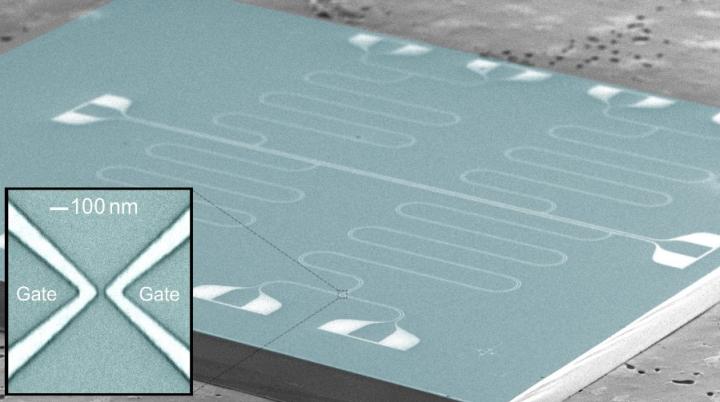
The Lancaster team embedded a similar nanoscale device into a microwave cavity, allowing them to study the alleged electrostatic phenomenon at much shorter timescales than previously investigated. At short timescales, the team could see a clear increase in the noise and energy loss in the cavity – the properties strongly associated with the device temperature. They propose that at intense electric fields, high-energy electrons can “jump” into the superconductor, raising the temperature and therefore increasing the dissipation.

This simple phenomenon can concisely explain the origin of the “electrostatic field effect” in nanoscale structures, without any new physics.

###

Media Contact
Gillian Whitworth
[email protected]

Related Journal Article

http://dx.doi.org/10.1038/s41467-021-22998-0

Tags: Chemistry/Physics/Materials SciencesElectromagneticsMaterialsNanotechnology/MicromachinesSuperconductors/SemiconductorsTechnology/Engineering/Computer Science
Share13Tweet8Share2ShareShareShare2

Related Posts

New Study Uncovers Key Factors Driving Water Chemistry in Nanoscale Environments

June 25, 2026

Plasma Technology Extends Catalyst Lifespan in Hydrogen Production

June 24, 2026

Electric Field and Oxygen Spillover Collaborate to Control Electrode Migration in SOECs

June 24, 2026

Innovative Speckle-Based Metrology System Advances Precision Measurement of Next-Generation X-Ray Mirrors

June 24, 2026
Please login to join discussion

POPULAR NEWS

  • Saying Goodbye to PGY-6: Pediatric Fellowship Realities

    103 shares
    Share 41 Tweet 26
  • Multi-Hospital Study Reveals Long Covid Burden Is Twice as High as Current Estimates

    92 shares
    Share 36 Tweet 23
  • Detection of EDCs in Breast Milk and Infant Urine Up to Six Months Highlights Early Exposure Risks

    77 shares
    Share 31 Tweet 19
  • New Drug Candidate Developed at McMaster Shows Potential for Treating Brain Cancer

    58 shares
    Share 23 Tweet 15

About

We bring you the latest biotechnology news from best research centers and universities around the world. Check our website.

Follow us

Recent News

New UK Study Reveals Plant-Based Alternatives Have Twice the Additives Compared to Animal Products

FDA Approves New Treatment for HR+, HER2+ Advanced Breast Cancer Following Promising Results from the PATINA Trial by Alliance Foundation

New Study Uncovers Key Factors Driving Water Chemistry in Nanoscale Environments

Subscribe to Blog via Email

Enter your email address to subscribe to this blog and receive notifications of new posts by email.

Join 82 other subscribers
  • Contact Us

Bioengineer.org © Copyright 2023 All Rights Reserved.

Welcome Back!

Login to your account below

Forgotten Password?

Retrieve your password

Please enter your username or email address to reset your password.

Log In
No Result
View All Result
  • Homepages
    • Home Page 1
    • Home Page 2
  • News
  • National
  • Business
  • Health
  • Lifestyle
  • Science

Bioengineer.org © Copyright 2023 All Rights Reserved.