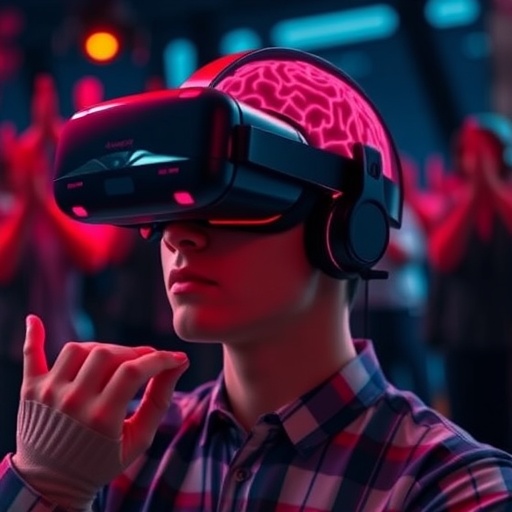
What if virtual reality could transcend the conventional boundaries of sight and sound and fully engage the tactile senses, allowing users to genuinely feel virtual environments at their fingertips? A trailblazing research team from Pohang University of Science and Technology (POSTECH) has embarked on an innovative journey to explore this possibility. By ingeniously integrating an MRI-compatible haptic device with functional brain imaging technology, the scientists have, for the first time, quantitatively measured how the inclusion of tactile sensations in virtual reality (VR) profoundly shapes human brain activity, effectively shifting the perception of virtual experiences towards a tangible reality.
The pioneering study was spearheaded by Professor Keehoon Kim from the Department of Mechanical Engineering at POSTECH, alongside graduate researcher Joonsub Byun. Their collaborative effort included prominent figures such as Professors Yong-An Chung and Hyeonseok Jeong from the Catholic University of Korea and Dr. Jooyeon Kim of the Korea Basic Science Institute. This multidisciplinary team’s findings appeared in the prestigious journal PLOS ONE, marking a significant advance in immersive technology research.
Virtual reality has long been heralded for its capacity to revolutionize sectors like healthcare, education, gaming, and professional training. Yet, a persistent scientific challenge has been the objective quantification of immersion depth within virtual environments. Historically, the level of user engagement and realism has been gauged predominantly through subjective self-reporting methods, such as questionnaires probing how “real” or engrossing the experience felt. These approaches, however, lack the empirical rigor necessary for deeper understanding or technological refinement.
To break free from this limitation, the researchers sought to directly capture neural correlates of immersion by observing brain responses in real-time. Functional magnetic resonance imaging (fMRI), with its high spatial resolution and non-invasive monitoring capabilities, presented the ideal tool to gather this data. However, a formidable technical obstacle arose: conventional haptic devices, reliant on metallic actuators and electronic components, are incompatible with MRI environments due to the latter’s intense magnetic fields that pose both operational risks and imaging artifacts.
Addressing this, the POSTECH team engineered an innovative pneumatic multi-finger haptic display, uniquely powered entirely by air pressure. This device eschews all metal-based parts, relying solely on non-magnetic materials, thereby permitting safe and interference-free operation within the MRI scanner. Remarkably, it delivers independent, simultaneous tactile stimulation to four fingers, replicating nuanced touch experiences crucial for heightened immersion during VR interactions.
Using this cutting-edge apparatus, the researchers conducted meticulous experiments on a state-of-the-art 3 Tesla (3T) fMRI machine, which offers exceptional neural imaging precision, doubling the magnetic field strength of standard clinical MRI scanners. Participants donned the pneumatic haptic glove while being subjected to VR environments both with and without tactile feedback. This methodical comparison illuminated striking differences in brain activity, elucidating how sensory integration unfolds during these immersive experiences.
Results revealed that tactile stimulation does not merely activate somatosensory cortex regions associated with touch. Rather, it induces widespread augmentation of neural dynamics, engaging brain areas responsible for motor planning, attentional control, and higher-order cognitive processing. Most notably, when tactile feedback was delivered in flawless temporal synchrony with visual and auditory cues, the brain’s response intensified dramatically. This temporal alignment appears fundamental to the brain’s acceptance of virtual stimuli as authentic percepts, underscoring multisensory integration as a cornerstone of immersion.
The implications of these findings reverberate far beyond entertainment technologies. From a clinical perspective, the ability to objectively measure VR immersion through brain data heralds transformative possibilities in surgical simulation training, where tactile feedback fidelity is paramount. Furthermore, it opens doors to quantitatively assessing VR therapies used in pain relief, treatment of phobias, and neurological rehabilitation, offering clinicians a powerful window into patient engagement and therapeutic efficacy.
Additionally, this breakthrough may catalyze advancements in remote robotic surgery, where haptic feedback can enhance precision and surgeon confidence. Immersive educational platforms stand to gain as well by grounding virtual learning experiences in truly multisensory realities, thereby improving knowledge retention and skill acquisition. Lastly, the platform could establish standardized neural benchmarks for VR content evaluation, facilitating the development of more compelling, scientifically validated experiences.
Professor Keehoon Kim emphasized, “Tactile sensation at the fingertips is indispensable for genuine immersion in virtual reality, complementing visual and auditory inputs. This study represents a critical leap forward by introducing a new framework capable of quantitatively analyzing VR experiences through objective brain activity measurements rather than subjective accounts.” This underscores the study’s fusion of engineering prowess and neuroscience to reimagine the future of virtual interaction.
The research initiative received generous support from multiple sources, including the Korean Ministry of Health and Welfare’s Health Technology R&D Project for Dental and Medical Technologies, the Ministry of Science and ICT’s Mid-Career Researcher Program and Outstanding Young Researcher Program, as well as backing from POSCO Holdings. This intersectoral collaboration highlights the rapidly evolving landscape of VR research at the intersection of technology, medicine, and cognitive science.
In summary, this groundbreaking work by the POSTECH team not only provides a sophisticated tool for decoding the brain’s multisensory response to virtual reality but also sets a new standard for immersion assessment. By bridging the sensory gap with innovative pneumatic haptics compatible with fMRI and illuminating the neural signatures of synchronized sensory integration, their research elevates our understanding of what it truly means to “feel” digital worlds. As VR continues to shape myriad facets of human experience, such empirical insights will be pivotal in steering its evolution from simulated illusion to near-real perception.
Subject of Research: Multisensory integration and immersion in virtual reality, neural correlates of tactile feedback using fMRI-compatible haptic devices.
Article Title: Exploring immersion through a fMRI-compatible multi-finger handheld haptic display
News Publication Date: 27-Mar-2026
Web References:
10.1371/journal.pone.0343297
Image Credits: POSTECH
Keywords
Virtual reality, fMRI, haptic feedback, multisensory integration, brain activity, pneumatic haptic display, immersive technology, neuroscience, tactile sensation, functional magnetic resonance imaging, neural correlates, sensory perception
Tags: brain activity monitoring in virtual realitybrain response to tactile stimuli in VRcross-disciplinary VR neuroscience researchenhancing VR realism with touchfingertip immersion haptic feedbackfunctional brain imaging in VRimmersive virtual reality technologyMRI-compatible haptic devicesmultisensory VR experiencesPOSTECH VR researchquantitative measurement of VR immersiontactile sensation integration in VR