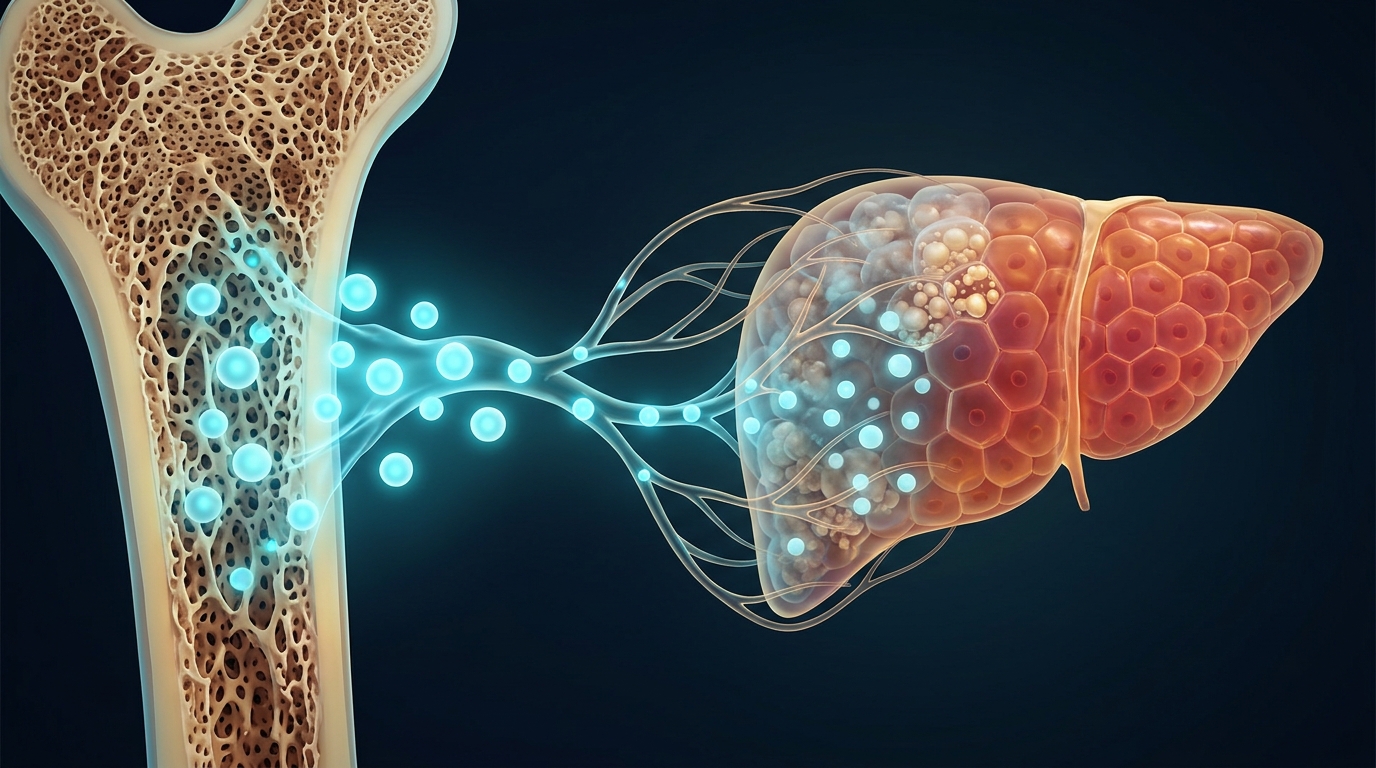
A growth factor released by bone marrow cells can ease fatty liver disease in diabetic mice, according to a new study in the Journal of Cellular and Molecular Medicine. The protein, called myeloid-derived growth factor or MYDGF, was reduced in the blood and bone marrow of mice with diabetic non-alcoholic fatty liver disease. When researchers restored MYDGF in these animals, liver fat, inflammation and liver enzyme levels all improved. The effect worked through a chain of molecular signals that switches on two cholesterol transporters, ABCA1 and ABCG1, in liver macrophages. The authors describe this as the first demonstration that MYDGF protects against this form of fatty liver disease and that the bone marrow can improve liver steatosis through this factor.
Non-alcoholic fatty liver disease is the most common liver disorder worldwide and often progresses to fibrosis and cancer. Obesity and type 2 diabetes are major drivers of the condition, and diabetes complicated by fatty liver is the most frequent chronic complication of diabetes. The disease is defined by fat accumulation exceeding five percent of liver composition, in which lipid uptake and synthesis outweigh fatty acid oxidation. Because diabetic fatty liver disease is linked to inflammation, insulin resistance and lipid abnormalities, it raises mortality and healthcare costs, yet effective treatments remain unavailable. This gap motivated the research team, based at Hunan Medical College, to examine how a factor produced by bone marrow might influence liver fat metabolism.
MYDGF is released by bone marrow-derived monocytes and macrophages. The researchers had previously shown that it improved insulin resistance and glucose-lipid metabolism in diabetic mice. In the new work, they first confirmed that serum MYDGF levels were clearly reduced in mice with diabetic fatty liver disease compared with controls, and that MYDGF protein and Mydgf messenger RNA were also reduced in the bone marrow. At the same time, circulating levels of the inflammatory molecules TNF-α, IL-1β and IL-6 were significantly raised, as were inflammatory factors in the liver. Serum MYDGF showed a negative correlation with several inflammatory markers, suggesting a link between the factor and inflammation in the disease.
To test whether MYDGF matters for disease progression, the team generated mice lacking Mydgf specifically in myeloid cells. They verified that the knockout removed MYDGF mainly from macrophages and monocytes while leaving lymphocytes and stromal cells largely unchanged, and that MYDGF levels in the heart, liver, spleen, lung and kidney were unaffected. When these myeloid-specific knockout mice were made diabetic with a high-fat diet and low-dose streptozotocin, their hepatic steatosis was more pronounced than in diabetic wild-type mice, with more lipid droplets, greater liver lipid deposition and higher hepatic triglyceride content. Isolated hepatocytes from the knockout animals showed markedly higher messenger RNA levels of lipid synthesis genes including Srebp1c, Fasn, Scd1 and Acc1, while lipid oxidation genes such as Cpt1a and Acox1 showed no significant change. Liver dysfunction was also evident, with elevated alanine aminotransferase and aspartate aminotransferase, and macrophage accumulation and inflammatory factor levels in hepatocytes, Kupffer cells and serum were all increased.
The researchers then asked whether restoring bone marrow-derived MYDGF could reverse these effects. In one set of experiments they transplanted bone marrow cells between irradiated wild-type and knockout recipients. Transplanting wild-type bone marrow into diabetic knockout recipients mitigated hepatic steatosis and lipogenesis, lowered macrophage accumulation and reduced inflammatory factor levels in Kupffer cells, hepatocytes and serum, while also improving metabolic profiles. Conversely, transplanting knockout bone marrow into diabetic wild-type recipients worsened fatty liver disease and metabolic disorders. In a complementary approach, they injected an adeno-associated virus carrying the MYDGF gene directly into the marrow cavities of diabetic knockout mice at three-week intervals over twelve weeks. Serum MYDGF became detectable within seven days and persisted for up to twenty-one days after a single treatment. This bone marrow-specific overexpression reduced hepatic steatosis, lowered triglyceride levels, lessened lipogenesis and diminished inflammation, particularly in the diabetic knockout mice.
Turning to cells, the team examined whether MYDGF acts directly on Kupffer cells, the resident liver macrophages. They treated the cells with twenty-five millimolar glucose to mimic the diabetic environment and added one hundred nanograms per millilitre of recombinant MYDGF for twenty-four hours. Under these conditions, recombinant MYDGF dampened the inflammatory response triggered by high glucose and inhibited macrophage migration. It also reduced macrophage foaming, decreased cholesterol content within the macrophages and improved efferocytosis, the process by which macrophages clear dying cells. Co-culture experiments supported this: mixing Kupffer cells with bone marrow cells from wild-type mice reduced inflammatory gene expression, foaming and cholesterol content while boosting efferocytosis, whereas bone marrow cells from knockout mice had no effect. These findings indicate that MYDGF from bone marrow protects against diabetic fatty liver disease by modulating macrophage function.
The molecular pathway behind these effects emerged from analysis of liver macrophages. Levels of TREM2, phosphorylated AMPK, PPARγ, LXRα, ABCA1 and ABCG1 were all decreased in liver macrophages of diabetic knockout mice compared with diabetic wild-type mice, and all were increased in mice treated with the MYDGF virus compared with a control virus. Recombinant MYDGF treatment similarly stimulated the AMPK/PPARγ/LXRα pathway in high-glucose-treated Kupffer cells. ABCA1 exports free cholesterol to lipid-poor apolipoprotein A-I to form high-density lipoprotein, which then accepts cholesterol carried by ABCG1, so raising these transporters promotes cholesterol efflux from macrophages. PPARγ and LXRα are nuclear receptors, and LXRα binds response elements in the Abca1 and Abcg1 promoters to drive their transcription, while activated PPARγ upregulates LXRα and suppresses NF-κB signalling.
To confirm the pathway’s importance in living animals, the researchers created mice lacking Pparg in myeloid cells by crossing Pparg-floxed mice with Lyz2-cre mice, then bred these onto the Mydgf knockout background to produce double knockouts. Compared with controls, Mydgf knockout mice, myeloid Pparg knockout mice and double knockouts all showed significantly reduced TREM2, phosphorylated AMPK, LXRα, ABCA1 and ABCG1 in liver macrophages, with the largest reductions in the double knockouts. All three groups had increased hepatic lipid deposition, macrophage accumulation and inflammation, again most severely in the double knockouts. MYDGF gene delivery improved these measures in each group, but the improvement was smaller in the double knockouts, indicating that PPARγ is required for the full protective effect. In cultured Kupffer cells, silencing Pparg or Ampk with small interfering RNA partly reversed the MYDGF-driven increases in pathway proteins and the improvements in adhesion, inflammation, foaming, cholesterol content and efferocytosis, though the reversal was incomplete, hinting that other routes may also contribute.
The authors conclude that MYDGF promotes ABCA1- and ABCG1-mediated cholesterol efflux, suppresses foam cell formation in macrophages and alleviates diabetic fatty liver disease by activating the AMPK/PPARγ/LXRα signalling pathway, and they suggest it may serve as a novel molecular target for treatment. They also note that the bone marrow could be a potential target for metabolic diseases including diabetes, fatty liver disease and osteoporosis. Several caveats apply. The findings come from mouse models and isolated cells, so whether MYDGF behaves the same way in humans remains unknown. The study measured associations between serum MYDGF and inflammatory markers rather than proving causation for that correlation, and the authors themselves state that the relative contributions of non-macrophage-related cascades, including possible direct effects on hepatocytes and liver sinusoidal endothelial cells, still need dedicated follow-up work. Because PPARγ agonists can cause adverse effects such as cardiac failure, macrophage-specific regulation of the pathway may be a safer route, but translating any of this into therapy will require much more research.
Subject of Research: The role of myeloid-derived growth factor from bone marrow in diabetic non-alcoholic fatty liver disease in mice
Article Title: Myeloid‐Derived Growth Factor Alleviates Diabetic Non‐Alcoholic Fatty Liver Disease by Up‐Regulating ABCA1 and ABCG1 Expression via the AMPK/PPARγ/LXRα Pathway
Article References: Chen, Z., Meng, B., Wang, B., & Ding, Y. (2026). Myeloid‐Derived Growth Factor Alleviates Diabetic Non‐Alcoholic Fatty Liver Disease by Up‐Regulating ABCA1 and ABCG1 Expression via the AMPK / PPARγ / LXRα Pathway. Journal of Cellular and Molecular Medicine, 30(21), Article e71428. https://doi.org/10.1111/jcmm.71428
Image Credits: AI Generated
DOI: 10.1111/jcmm.71428
Keywords: MYDGF, non-alcoholic fatty liver disease, type 2 diabetes, bone marrow, macrophages, cholesterol efflux, ABCA1, ABCG1, AMPK, PPARγ, LXRα, liver inflammation
News Source: Daisy Hatcher. (November 4, 2026). Bone Marrow Hormone MYDGF Eases Fatty Liver Disease in Diabetic Mice. Scienmag.