• HOME
  • NEWS
  • EXPLORE
    • CAREER
      • Companies
      • Jobs
    • EVENTS
    • iGEM
      • News
      • Team
    • PHOTOS
    • VIDEO
    • WIKI
  • BLOG
  • COMMUNITY
    • FACEBOOK
    • INSTAGRAM
    • TWITTER
Thursday, June 25, 2026
BIOENGINEER.ORG
No Result
View All Result
  • Login
  • HOME
  • NEWS
  • EXPLORE
    • CAREER
      • Companies
      • Jobs
        • Lecturer
        • PhD Studentship
        • Postdoc
        • Research Assistant
    • EVENTS
    • iGEM
      • News
      • Team
    • PHOTOS
    • VIDEO
    • WIKI
  • BLOG
  • COMMUNITY
    • FACEBOOK
    • INSTAGRAM
    • TWITTER
  • HOME
  • NEWS
  • EXPLORE
    • CAREER
      • Companies
      • Jobs
        • Lecturer
        • PhD Studentship
        • Postdoc
        • Research Assistant
    • EVENTS
    • iGEM
      • News
      • Team
    • PHOTOS
    • VIDEO
    • WIKI
  • BLOG
  • COMMUNITY
    • FACEBOOK
    • INSTAGRAM
    • TWITTER
No Result
View All Result
Bioengineer.org
No Result
View All Result
Home NEWS Science News Chemistry

Blood vessel formation in damaged tissues with mussel adhesive protein

Bioengineer by Bioengineer
April 12, 2021
in Chemistry
Reading Time: 3 mins read
0
IMAGE
Share on FacebookShare on TwitterShare on LinkedinShare on RedditShare on Telegram

IMAGE

Credit: POSTECH

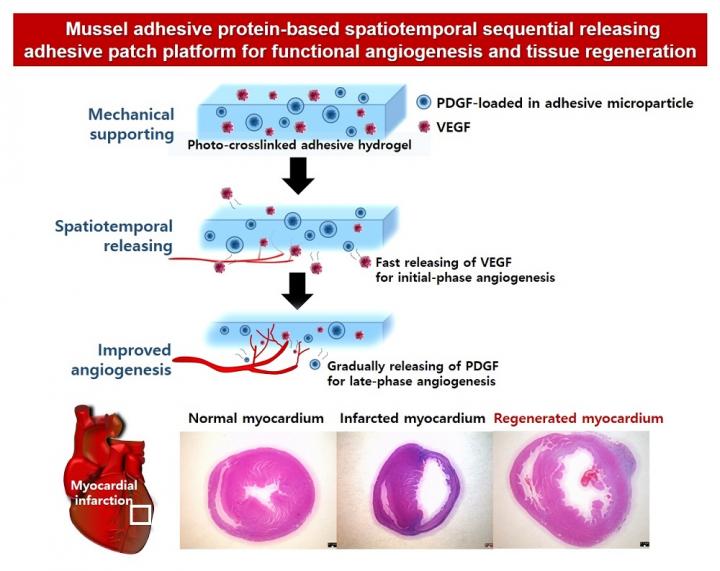
Blood vessels deliver nutrients and oxygen to each organ in our body. They are difficult to completely restore to their original conditions once damaged by myocardial infarction or severe ischemic diseases. This is because various angiogenic growth factors must be applied sequentially in order to restore the vascular structure. Recently, a research team at POSTECH has bioengineered a novel adhesive patch platform that can efficiently deliver blood vessel-forming growth factors spatiotemporally using mussel adhesive protein (MAP), a bio-adhesive material that is made from mussels harmless to humans.

A POSTECH research team led by Professor Hyung Joon Cha and Dr. Tae Yoon Park of the Department of Chemical Engineering has developed a drug-delivering adhesive patch using two formulations – coacervate-based microparticles and light activation-based crosslinked hydrogels – that can be mass-produced. The team verified their effectiveness in tissue regeneration including neovascularization using a rat model for myocardial infarction and excisional wound model incapable of self-healing.

The research team produced microparticles by instantaneously encapsulating and crosslinking platelet-derived growth factor (PDGF) required for the late-phase angiogenesis during the process of forming coacervate microdroplets formed by the electrostatic interaction of MAP and hyaluronic acid.

In addition, PDGF-loaded microparticles and the vascular endothelial growth factor (VEGF) required for initial-phase angiogenic factor are simultaneously encapsulated in a MAP-based crosslinked hydrogel, spatially separated and mounted the two factors easily and quickly.

This effective novel angiogenesis-inducing platform showed that PDGF was secreted and delivered 1.9 times later in time despite its smaller size than VEGF. In addition, the team confirmed that the platform allows crosslinking to occur instantaneously so that it can easily adhere even to uneven curved surfaces.

“We have developed a new platform that can efficiently deliver angiogenic factors spatiotemporally by using the formulation property of MAP, an original biomaterial,” remarked Professor Hyung Joon Cha who has long devoted himself to studying the MAP. “It is of great significance that we have confirmed the functional recovery beyond effective neovascularization by applying it to actual animal model of myocardial infarction and severely damaged skin model.”

“It will be successfully applicable to chronic and ischemic diseases in a similar environment.” He added eagerly, “This platform can play a key role in the neovascularization treatment market as it uses biocompatible biomaterials that are harmless to the human body.”

###

This MAP-based hydrogel and coacervate liquid microdroplets fabrication technology have undergone a technology transfer to Nature Gluetech Co., Ltd. and is currently being commercialized.

The finding of this study was published in Biomaterials, the most authoritative journal in the field of biomaterials. The study was conducted with the support from the health and medical technology development project supported by the Ministry of Health and Welfare and the Korea Institute for Health Industry Promotion, and as part of the Nano-New Materials Core Technology Development Program of the Ministry of Science and ICT and the National Research Foundation of Korea.

Media Contact
Jinyoung Huh
[email protected]

Original Source

https://postech.ac.kr/eng/blood-vessel-formation-in-damaged-tissues-with-mussel-adhesive-protein/#post-22471

Related Journal Article

http://dx.doi.org/10.1016/j.biomaterials.2021.120774

Tags: BiochemistryBiologyBiomechanics/BiophysicsBiotechnologyChemistry/Physics/Materials SciencesClinical TrialsMarine/Freshwater BiologyMedicine/HealthTechnology/Engineering/Computer Science
Share12Tweet8Share2ShareShareShare2

Related Posts

AI and Physics Collaborate to Design Advanced Hydrogen Storage Materials

June 25, 2026

International Team Including Dresden Scientists Develops Novel Designer Proteins for Advanced Study of Living Tissue

June 25, 2026

New Study Uncovers Key Factors Driving Water Chemistry in Nanoscale Environments

June 25, 2026

Plasma Technology Extends Catalyst Lifespan in Hydrogen Production

June 24, 2026
Please login to join discussion

POPULAR NEWS

  • Saying Goodbye to PGY-6: Pediatric Fellowship Realities

    103 shares
    Share 41 Tweet 26
  • Multi-Hospital Study Reveals Long Covid Burden Is Twice as High as Current Estimates

    92 shares
    Share 36 Tweet 23
  • Detection of EDCs in Breast Milk and Infant Urine Up to Six Months Highlights Early Exposure Risks

    77 shares
    Share 31 Tweet 19
  • New Drug Candidate Developed at McMaster Shows Potential for Treating Brain Cancer

    58 shares
    Share 23 Tweet 15

About

We bring you the latest biotechnology news from best research centers and universities around the world. Check our website.

Follow us

Recent News

Tracking Lanthanide-Labeled Microplastics in Plants

POSTECH Researchers Slash Cost of Reconstituted Cell-Free Systems by 95%

AI and Physics Collaborate to Design Advanced Hydrogen Storage Materials

Subscribe to Blog via Email

Enter your email address to subscribe to this blog and receive notifications of new posts by email.

Join 82 other subscribers
  • Contact Us

Bioengineer.org © Copyright 2023 All Rights Reserved.

Welcome Back!

Login to your account below

Forgotten Password?

Retrieve your password

Please enter your username or email address to reset your password.

Log In
No Result
View All Result
  • Homepages
    • Home Page 1
    • Home Page 2
  • News
  • National
  • Business
  • Health
  • Lifestyle
  • Science

Bioengineer.org © Copyright 2023 All Rights Reserved.