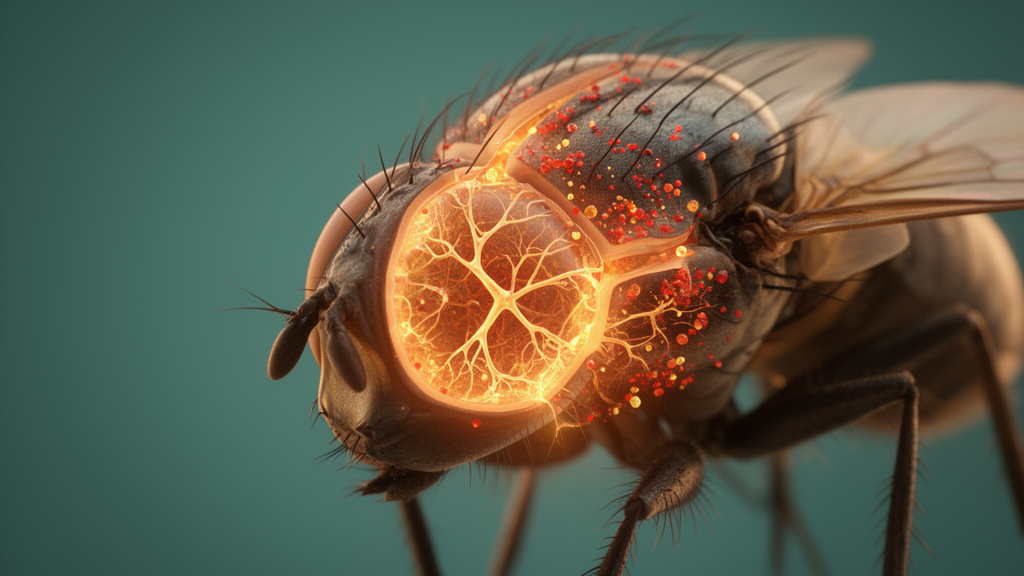
A weakened blood–brain barrier can turn mild amyloid toxicity into severe neurodegeneration, according to a new study in fruit flies. Researchers generated a Drosophila melanogaster model of Alzheimer’s-like disease by expressing human amyloid-beta (hAβ1–42) in all glial cells, which produced a shortened lifespan, locomotor deficits and amyloid plaque deposition. When the team then selectively disrupted the flies’ blood–brain barrier, the neurodegeneration grew markedly worse, even though the amount of amyloid accumulating in the brain did not change substantially. The findings, published as a peer-reviewed research article in Biological Research, point to a synergistic interaction between barrier failure and amyloid toxicity, and they highlight the protective role that an intact barrier normally plays against neurodegeneration.
The blood–brain barrier is essential for maintaining central nervous system homeostasis by regulating the exchange of molecules between the brain and the circulating blood, and dysfunction of this barrier has been implicated in the progression of several neurodegenerative disorders, including Alzheimer’s disease. To test how barrier integrity influences disease in a controlled setting, the researchers targeted the G protein-coupled receptor moody in subperineurial glia, a key cellular component of the Drosophila blood–brain barrier. Knocking down moody in these cells produced a significant increase in paracellular permeability, meaning that molecules could pass more freely between the blood side and the brain side of the barrier. Crucially, this barrier disruption did not markedly alter the accumulation of hAβ1–42, allowing the team to separate the effects of barrier failure from the effects of amyloid load itself.
With permeability increased but amyloid levels roughly unchanged, the consequences for brain tissue were stark. Barrier disruption exacerbated neurodegeneration, as evidenced by increased vacuole formation and apoptosis in the optic lobes, along with reduced neuropil size in both the medulla and the mushroom body β lobes. Behavioural assays reinforced the picture: moody knockdown accelerated locomotor decline and increased seizure susceptibility in the amyloid-expressing animals. Notably, these behavioural effects were absent in flies that lacked hAβ1–42 expression, indicating that barrier failure alone was not sufficient to drive the deficits. Instead, the damage emerged only when barrier dysfunction was combined with amyloid toxicity, supporting the authors’ conclusion that the two insults act synergistically rather than independently.
The study establishes Drosophila as a powerful model for dissecting neurovascular contributions to Alzheimer’s disease and underscores the importance of blood–brain barrier maintenance in mitigating disease progression. Because the work was carried out in a fly model with glial expression of human amyloid-beta, the results describe mechanisms relevant to an Alzheimer’s-like pathology in insects rather than clinical outcomes in human patients, and the authors present the findings as a foundation for further dissection of how barrier integrity protects the nervous system. The article, published on 3 October 2026 as an open-access research article, was shared early to provide faster access to the peer-reviewed, accepted research; this version is subject to further edits and will be replaced by the final Version of Record.
Subject of Research: Blood–brain barrier dysfunction and Alzheimer's-like neurodegeneration in a Drosophila model
Article Title: GPCR/moody reduction at the blood–brain barrier accelerates Alzheimer’s-like neurodegeneration in Drosophila
Article References: Morales-Inzunza, V., Paredes-González, S., Valderrama, M., Rubilar-Fajardo, A., Allup-González, J., Quiñones, F., & Contreras, E. G. (2026). GPCR/moody reduction at the blood–brain barrier accelerates Alzheimer’s-like neurodegeneration in Drosophila. Biological Research. https://doi.org/10.1186/s40659-026-00726-6
Image Credits: AI Generated
DOI: 10.1186/s40659-026-00726-6
Keywords: blood-brain barrier, Drosophila, Alzheimer's disease, amyloid-beta, moody receptor, subperineurial glia, neurodegeneration, paracellular permeability, glial cells, locomotor decline, apoptosis, optic lobes
News Source: Cassandra Pierce. (October 28, 2026). Blood–Brain Barrier Breakdown Speeds Alzheimer’s-Like Damage in Fruit Flies. Scienmag.