• HOME
  • NEWS
  • EXPLORE
    • CAREER
      • Companies
      • Jobs
    • EVENTS
    • iGEM
      • News
      • Team
    • PHOTOS
    • VIDEO
    • WIKI
  • BLOG
  • COMMUNITY
    • FACEBOOK
    • INSTAGRAM
    • TWITTER
Friday, June 26, 2026
BIOENGINEER.ORG
No Result
View All Result
  • Login
  • HOME
  • NEWS
  • EXPLORE
    • CAREER
      • Companies
      • Jobs
        • Lecturer
        • PhD Studentship
        • Postdoc
        • Research Assistant
    • EVENTS
    • iGEM
      • News
      • Team
    • PHOTOS
    • VIDEO
    • WIKI
  • BLOG
  • COMMUNITY
    • FACEBOOK
    • INSTAGRAM
    • TWITTER
  • HOME
  • NEWS
  • EXPLORE
    • CAREER
      • Companies
      • Jobs
        • Lecturer
        • PhD Studentship
        • Postdoc
        • Research Assistant
    • EVENTS
    • iGEM
      • News
      • Team
    • PHOTOS
    • VIDEO
    • WIKI
  • BLOG
  • COMMUNITY
    • FACEBOOK
    • INSTAGRAM
    • TWITTER
No Result
View All Result
Bioengineer.org
No Result
View All Result
Home NEWS Science News Biology

Bleach-induced transformation for humidity-durable air filters

Bioengineer by Bioengineer
June 26, 2019
in Biology
Reading Time: 2 mins read
0
IMAGE
Share on FacebookShare on TwitterShare on LinkedinShare on RedditShare on Telegram

IMAGE

Credit: DGIST

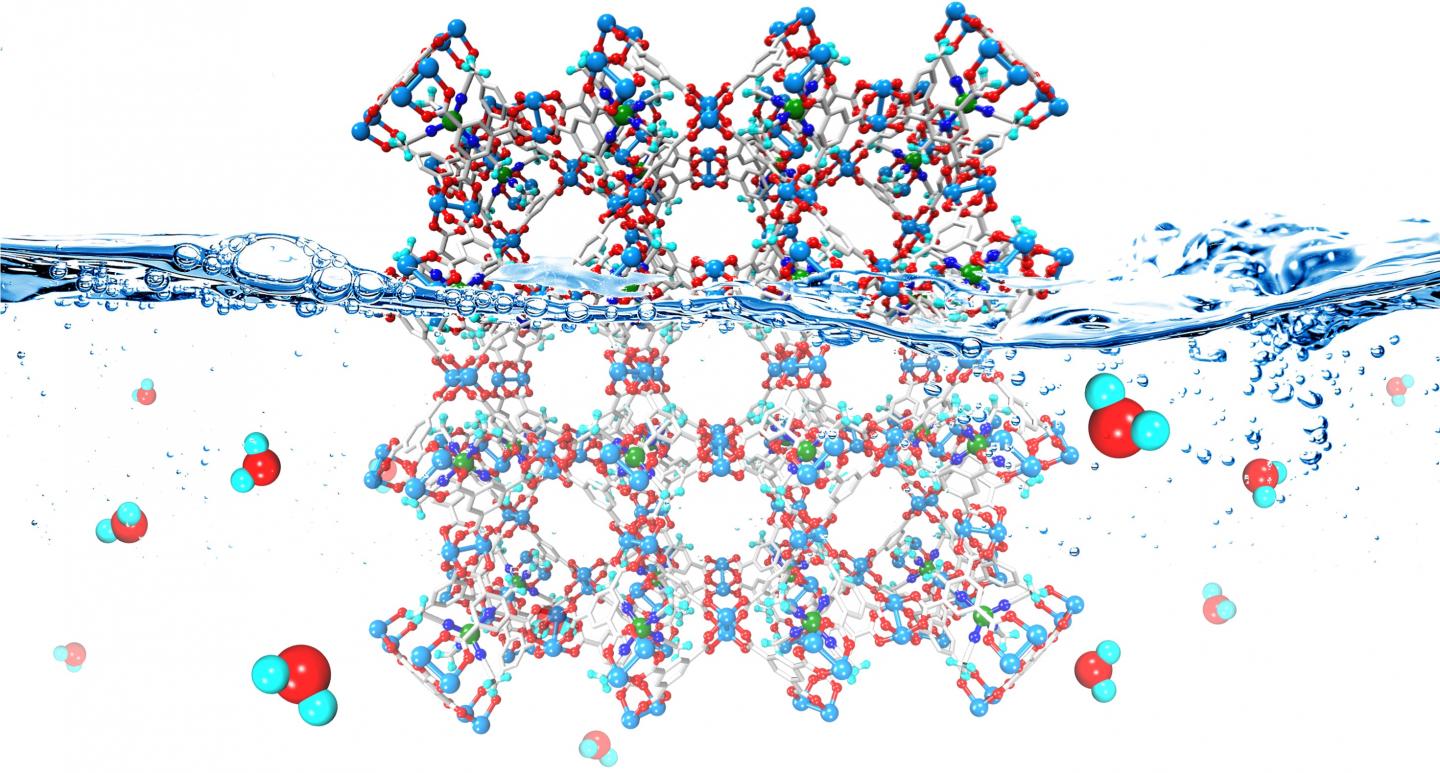
Adding hydroquinone, a skin-bleaching ingredient, to a well-known ‘metal organic framework’ changes its copper ions in a way that makes this porous material exceptionally stable in water.

“We developed a new method to enhance the water stability of metal organic frameworks, with potential for applications that can effectively filter and purify air from ultrafine dust without decomposing due to humidity,” says DGIST materials scientist Nak Cheon Jeong. The Korean researchers reported their findings in the Journal of the American Chemical Society.

Metal organic frameworks (MOFs) are made from metal ions bonded by organic links. They assemble in a way that leads to the formation of internal cage-like structures, giving the material its porous nature. MOFs have an impressive surface area compared to other porous materials. It is this, and the ability of scientists to tune their structures, that has led to their use in a wide range of applications, including gas uptake, molecule separation, drug delivery, and catalysis. Most MOFs decompose in the presence of humidity and water, so scientists have been looking for ways to make them more durable.

Jeong and his colleagues found that treating a well-known copper-based MOF, called HKUST-1, with hydroquinone at 80°C made the material so stable that it didn’t degrade after weeks of submersion in water or even after two years of exposure to humid air.

Copper ions and their organic links in HKUST-1 assemble to form large and small cages with paddlewheel-shaped metal ion nodes. Normally, water molecules attach to elements within this MOF, displacing the bonds between the copper ions and organic links, and causing the material to degrade or transform into a non-porous solid. Hydroquinone treatment, on the other hand, leads to a very stable HKUST-1 in water.

Jeong and his team found that a single electron from hydroquinone is transferred to cupric ions (Cu2+) within HKUST-1, changing them to cuprous ions (Cu+). This change is self-limiting: no more than 30% of the cupric ions change in this way. Half of the Cu+ ions remain in their positions on HKUST-1’s paddlewheel cages. But the other half form complexes that dissociate from the structure and become trapped within the material’s smaller cages, like a ship-in-a-bottle.

Further studies are needed to understand exactly how these changes lead to such a substantial improvement in HKUST-1’s stability in water.

Jeong and his team believe the same concept could be applied to other copper-based paddlewheel MOFs. They plan to conduct follow-up research on potential practical applications for their approach.

###

Media Contact
Nak Cheon Jeong
[email protected]

Original Source

https://www.dgist.ac.kr/en/html/sub06/060202.html?mode=V&no=669a755c74c225abaed79009ab50a9dc

Related Journal Article

http://dx.doi.org/10.1021/jacs.9b02114

Tags: Atomic PhysicsAtomic/Molecular/Particle PhysicsBiochemistryBiomedical/Environmental/Chemical EngineeringBiotechnologyChemistry/Physics/Materials SciencesIndustrial Engineering/ChemistryMolecular Physics
Share12Tweet8Share2ShareShareShare2

Related Posts

Natural Hallucinogens: Evolution’s Ecological Tools, Not Mere Chemical Byproducts

June 25, 2026

This Famous Butterfly Revealed: Three Distinct Species Hidden in One

June 25, 2026

Scientists Attack Soybean Cyst Nematode by Starving Its Food Source

June 25, 2026

Decoding the Secret Code of a Crucial Immune Sensor

June 24, 2026
Please login to join discussion

POPULAR NEWS

  • Saying Goodbye to PGY-6: Pediatric Fellowship Realities

    103 shares
    Share 41 Tweet 26
  • Multi-Hospital Study Reveals Long Covid Burden Is Twice as High as Current Estimates

    92 shares
    Share 36 Tweet 23
  • Detection of EDCs in Breast Milk and Infant Urine Up to Six Months Highlights Early Exposure Risks

    77 shares
    Share 31 Tweet 19
  • New Drug Candidate Developed at McMaster Shows Potential for Treating Brain Cancer

    58 shares
    Share 23 Tweet 15

About

We bring you the latest biotechnology news from best research centers and universities around the world. Check our website.

Follow us

Recent News

Tracking Lanthanide-Labeled Microplastics in Plants

POSTECH Researchers Slash Cost of Reconstituted Cell-Free Systems by 95%

AI and Physics Collaborate to Design Advanced Hydrogen Storage Materials

Subscribe to Blog via Email

Success! An email was just sent to confirm your subscription. Please find the email now and click 'Confirm' to start subscribing.

Join 82 other subscribers
  • Contact Us

Bioengineer.org © Copyright 2023 All Rights Reserved.

Welcome Back!

Login to your account below

Forgotten Password?

Retrieve your password

Please enter your username or email address to reset your password.

Log In
No Result
View All Result
  • Homepages
    • Home Page 1
    • Home Page 2
  • News
  • National
  • Business
  • Health
  • Lifestyle
  • Science

Bioengineer.org © Copyright 2023 All Rights Reserved.